
 © Epopée Royale
Gravel running: the urban runner’s latest escape route?
Published on Wed, August 5, 2026
Saturated sidewalks, cookie-cutter races… Urban runners are slipping off the asphalt and onto dirt paths 20 minutes from the ring road. A quiet shift that says a lot about how we live in cities and chase performance.
For years, we’ve been sold urban running as a lifestyle. Get up early, tame the city, rack up miles between red lights and bike lanes overrun with scooters. And it worked: French running has never had more people out there. But something’s shifted. The average annual spend per runner has now hit €1,120, up 12% vs. 2024, according to the RunMotion Barometer 2025, and a good chunk of that money is no longer going on road shoes. It’s going on outsoles that bite into dirt. It’s going on gravel running.
The trend didn’t start yesterday. But in 2025, it clearly crossed a line. Fifty percent of runners now do both road and trail, with the jump from one to the other getting smoother and smoother. In between, a grey zone has settled in: not really trail, not really road. A pocket of freedom now being called GRVL, and it looks a lot like a collective answer to asphalt fatigue.
Not trail, not road, just something else
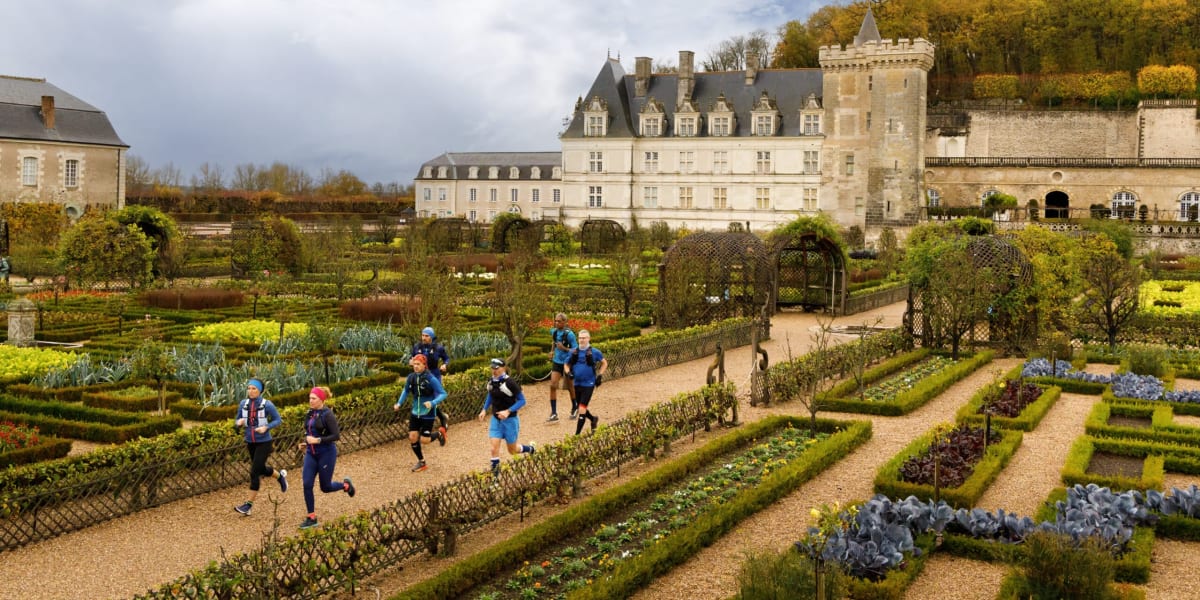
To get what we’re talking about, you first have to kill off a few misconceptions. Gravel running is a truce between two worlds that used to feel opposite: the flow of road running and the variety of natural terrain. We’re not talking technical trails, endless vert, or rocky little kickers that turn every stride into a negotiation. Gravel running sticks to relatively stable surfaces and moderate gradients: forest tracks, farm roads, greenways, the kind of routes where you can keep your stride efficient without your knees spending the evening filing complaints.
David Jou, physiotherapist and co-founder of Motiv NY, summed up the mindset perfectly for Salomon : “As a city dweller who trains mostly on the roads and an ultrarunner who prefers the technical terrain of upstate New York, gravel running gives me the versatility I’ve been looking for. It’s an interesting, efficient discipline that lets you mix things up and bring nature into an urban training routine, not to mention the benefits for my joints.” That’s the gravel runner profile in a nutshell. Not necessarily someone chasing the UTMB. Just someone who wants to get off the sidewalk.
Nature within commuter-rail distance
One of gravel running’s strongest arguments is how easy it is to access. Where trail can demand a car, a free weekend, and a pair of poles, gravel running lets you run in nature without the crowds and without the stress of city traffic, as a way to reconnect with your surroundings at a human pace. Tools like Komoot, OpenRunner, or AllTrails make it easy to spot, in minutes, where the dirt starts and the asphalt ends and it’s often closer than you think.
Running on dirt, following a river, cutting through a forest… it’s a genuine mental reset, far from the noise and pressure of the city. Gravel running lets you burn energy while topping up the batteries. That’s not trivial. At a time when studies on runners’ mental well-being keep piling up, the “nature” effect on cortisol isn’t exactly up for debate anymore. No traffic lights to watch, no wrong-way cyclist to anticipate, no exhaust to inhale. Your brain gets a break too.
That pull toward nature shows up in the data too: according to the CREDOC National Barometer of Sports Participation 2025, walking and running is the most practiced activity, with 32% of people saying they run at least once a week. And a good share of those outings are now aimed at getting away from the blacktop.
What’s cool is you can run in these shoes and grab a drink afterward without looking like an idiot
Salomon saw the shift coming, and earlier than everyone else
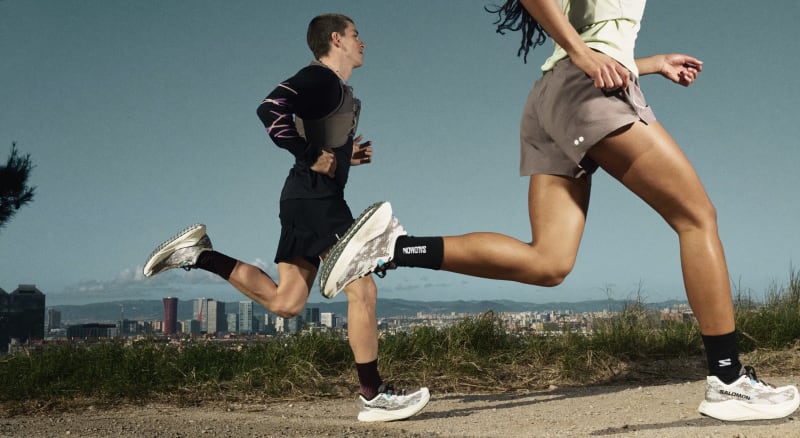
Brands didn’t wait for the trend to go mainstream before jumping in. Salomon, in particular, went all-in. As early as the Fall/Winter 2024-2025 season, the Annecy-based brand unveiled the GRVL concept: a gravel running shoe line that blends the cushioning and bounce of road runners with extra grip inspired by gravel bike tires. The outsole idea? Exactly what a cyclist wants on a rocky track: bite into the ground without giving up speed on pavement.
At the start of 2025, Salomon released the Aero Glide 3 GRVL, quickly crowned the benchmark gravel running shoe of 2025, with a dialed balance of cushioning, pop, and durability. The Aero Glide 3 GRVL weighs just 275 grams, with a high stack midsole (40 mm heel, 32 mm forefoot) built on Energy Foam Evo. Its little brother, the Aero Blaze 3 GRVL, nudges things further on responsiveness. And the momentum doesn’t stop there: the Spring/Summer 2026 collection pushes the concept even further, leaning more fashion-forward and expanding into apparel and a running vest.
As one of the brand’s designers put it in Field Mag: “Gravel is a unique opportunity to bring the outdoor spirit back into cities. Runners want to discover nature right on their doorstep.” And he adds, with disarming honesty: “What’s cool is you can run in these shoes and grab a drink afterward without looking like an idiot ”.
Art Basel, the Champs, and dirt paths
But Salomon didn’t just drop shoes. The brand made a real cultural move in October 2025. From October 24 to 26, Salomon made its Art Basel Paris debut with “Sensorial Terrains,” a one-off immersive piece created with studio PAVILLON NOIR and visual artist Theo Tagholm, shown in the heart of the Grand Palais. Its Champs-Élysées flagship turned into a pop-up gallery with two free-access installations, while community runs set off from the store.
The message was clear: “ GRAVEL RUNNING is as much culture as practice: fluid, intentional, curious, and shaped by experience rather than competition. ” In other words, the brand isn’t just selling a shoe anymore. It’s selling a way to live in the city by stepping out of it, or at least stepping out of it differently. Salomon deliberately positioned gravel as part of broader culture, not just the performance-running world.
We’ve also seen Salomon put on a Gravel Art Run in Lyon: no-pressure running, more like a city ramble with an art immersion. Just the urge to run differently. Or team up with MEC Vancouver to launch community runs around its new pairs. The strategy is consistent: make gravel running a movement before turning it into a market.
 © Salomon
So what’s it like with the shoes on?
Out on the ground, the gravel running experience wins over pretty much everyone who tries it. Mixed surfaces, natural cushioning, happier joints, minimal gear, fewer constraints, an easy start straight from your front door: it’s a formula that appeals as much to experienced runners looking for variety as to newcomers who haven’t quite figured out how to step off the pavement.
A Believe in the Run tester called the Aero Glide 3 GRVL his favorite shoe of 2025, full stop, not just in its category, and said he’d happily use it as a road daily trainer too. That kind of verdict says it all: a well-designed gravel shoe isn’t a compromise. It’s better than pure pavement because it gives you more, and on dirt it holds its own without losing that smooth ride.
Urban running, looking for meaning
It would be too easy to write gravel running off as a gear trend pushed by well-marketed brands. Underneath, something deeper is happening: a real redefinition of what it means to run in the city. The community forming around it shares the same mindset: curiosity, the urge to explore, the pleasure of the run for its own sake rather than for performance.
That may be the real break. Not abandoning asphalt, we’re not there yet, but rejecting the pure performance logic that long ruled urban running. The stopwatch, the Strava segment, the flat boulevard time trial. Gravel running is saying something else: that the route matters as much as the pace. That stopping to look at a field still counts as running. That a session doesn’t need to be “optimized” to be worth anything. In an era where we run while watching our watch, heading down a dirt path feels almost like an act of resistance. And clearly, more and more people are up for resisting.