
Amiens crowns Samarienne runner French 100 km champion
 © Danou Rose
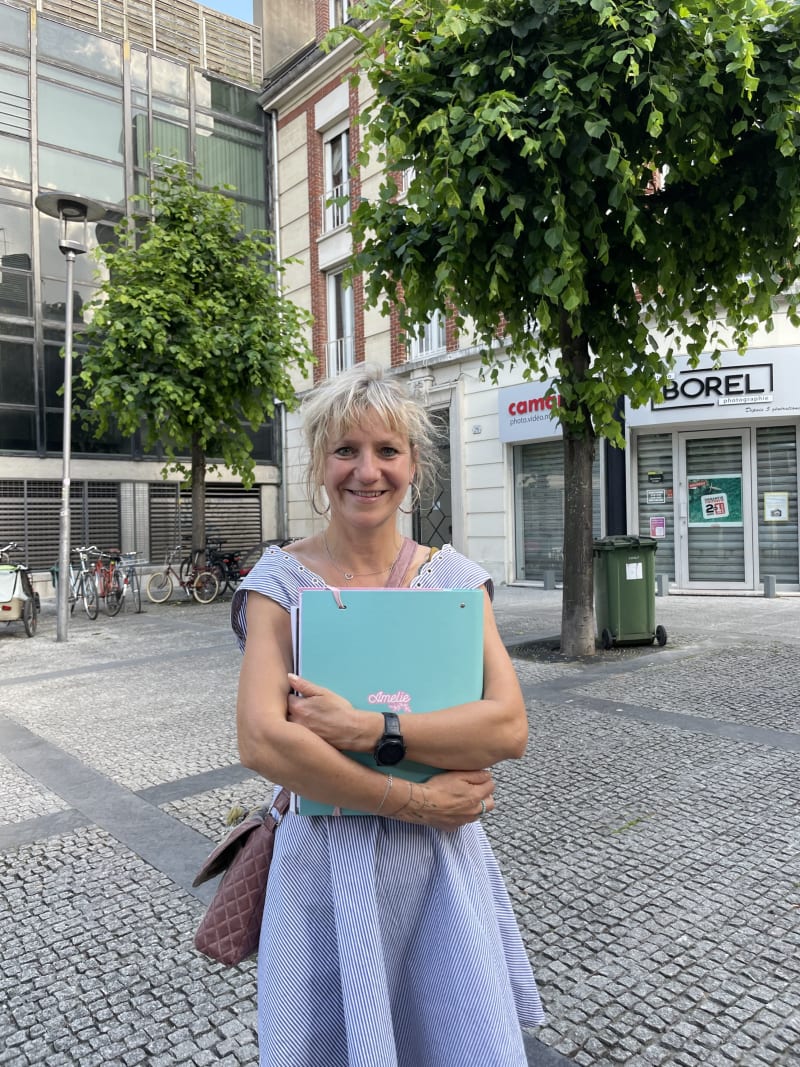
Dressed in a little black dress and heeled sandals, Virginie Durand has traded her running kit for a café meeting just a stone’s throw from Amiens Cathedral. Carrying a hefty binder under one arm, the French 100 km champion in the Master 4 category sits down opposite me, ready to share her story as a runner. Rarely in the spotlight, this Samarienne in her fifties has more in reserve than meets the eye. She may have just one national title to her name, but she has no intention of stopping there and is already promising more big performances.
“If I don’t run for two days, I don’t feel right,” Virginie says. Her story with running began more than 30 years ago, but really took shape around 15 years ago, a sporting marriage soon to celebrate its crystal anniversary.
On May 18, 2023, in Steenwerck, Virginie narrowly missed out on the French 100 km title. After 9 hours 15 minutes of running, and with a brilliant personal best to show for it, she discovered that she could not be crowned because she was not registered with a club. A huge frustration, but one that pushed her to bounce back, despite a practice she still describes as very solitary: “ I do my long runs on my own. You just have to run, it’s as simple as that.”
Self-taught, then, Virginie finally had her moment of glory more than a year later, on October 12, 2024, in the Somme. The flat course took her from Amiens to Camon, then on to Épagnette. This time, registered with Courir à Abbeville, she finally won the national title in the Master 4 category, finishing in 10:01 despite hostile weather conditions. “ There, you’re fighting yourself. It’s always yourself, but this time... it was raining and cold. My legs started hurting straight away... well, at 70 km, if you know what I mean.” In the overall standings, she finished 64th out of 360 starters, an impressive result for a runner as humble as she is determined.
Where a passion was born
As a child, she discovered an early passion for running. She was not necessarily fast; what mattered was the pleasure and the escape. Mud, on the other hand, was not for her. “ I liked running, but not cross country. ” she says.
After a man approached and then followed her during one of her runs, Virginie finally decided to join a club at 40, even though she continued to train mostly on her own. Realizing that she could keep up with the group without difficulty, and now had more time for herself, Virginie threw herself into it fully. This time, with real determination. She began entering official races more regularly.
A 10 km in 43 minutes, followed by the Grand Paris Half Marathon in 1:45, complete with “goosebumps” at the finish: the times started to tumble. “ The longer I ran, the more I felt I was good at it ” explains the distance runner, attached to the solitary side of running that had defined her early days.
When a group prepared for a marathon in Brittany, she joined them for the training but did not feel ready to take the plunge. On race day, she felt she was missing out on the payoff for several months of hard work. “ I thought: right, come on, I’m going for it! ” says the road runner, who took part in her first marathon in Nantes the following year. At around 44, the prestigious Paris Marathon caught her attention. “ I thought that for the same price, I could do an 80 km race... so I chose the EcoTrail. That’s how everything went off the rails! ” (laughs) She followed that with a 110 km race, training “a lot”. The longer the distances became, the more demanding the preparation was.
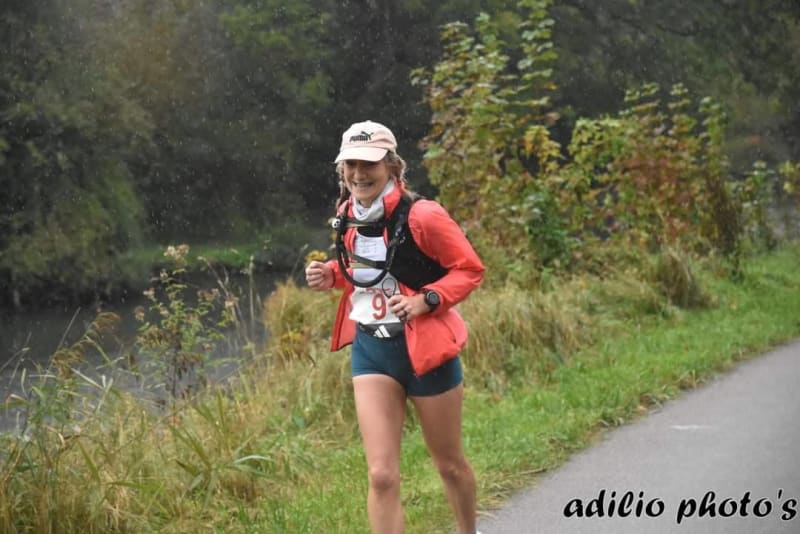
Then came a period when the veteran gradually left the tarmac behind and turned towards trail running. An unexpected change, considering that this lover of running in the great outdoors had felt no attraction to cross country in her early days. “ It’s not the same thing. You don’t run at the same speed. And if you feel like walking, you can... although obviously, depending on your level, you don’t walk, or you walk as little as possible ” she explains.
 © Adilio photo’s
A life built around running
During this transitional summer season, Virginie takes part in one or two races a month. Less drawn to trail running in recent years, with its difficult conditions, risk of falling and muddy ground that reminds her of the cross-country races she never liked, she has turned to road running, which is steadier and more predictable and where she feels completely at home.
When she does not have a major race coming up, Virginie runs almost every day. During the first week of June, she clocked up 150 km in seven days and 200 km in ten days, without exceeding 20–25 km per run. “ It rained the whole of last week” she says. Rain or wind, she always runs, even late at night. Her trick: a small snack beforehand to keep her going. For her routes, she favours safe loops around Abbeville, along the Somme and as far as Épagnette or Pont-Rémy. Now that daylight lasts longer, it feels more reassuring.
With Indochine, Taylor Swift or sometimes a TV series playing in the background, she keeps herself entertained during her long runs. She also keeps one weekly track session with the group on Wednesdays: “ At first, it triggered my speed. My body got used to the difficulty. When you run long, your body hurts a little and your mind has to work.” Virginie is a true road-running addict, often supported in the closing stages of her races by her granddaughter Garance, who runs the final metres with her, and by her “boyfriend”.
“ When I run, I feel good. There’s nature, you look around and enjoy it. When it gets hard, I go into my own bubble and think about my family, my friends... I make up stories in my head, and I keep going. I hang on.
An inexplicable love
“ When I run, I feel good. There’s nature, and you enjoy it. ” That is what draws so many new runners in: fresh air, scenery and, of course, “adrenaline”. “ You have that little challenge in your head saying: ‘I’m going to make it’ ” Virginie explains. No longer content with targeting the women’s win, she now has her sights set on the overall standings: that is what long-distance racing makes possible. She is proud to be able to “wear the men down”.
To get through the difficult moments, she shares her tips: “ When it gets hard, I go into my own bubble and think about my family, my friends... And I keep going. I hang on.” She cannot fully explain all the sensations. “ At first, when I felt pain, I would think about another part of my body to forget it, and it would go away. It’s crazy. ” Running is physical and mental work.
She has been passionate about it for 13 or 14 years. When an infection affected her big toes, she even cut open her shoe so she could keep running. “ Sometimes you wonder whether you’re all right” she laughs, before concluding: “ After a 100 km race, I feel good. On Monday, I’m out jogging again, much to the dismay of those who think I’m crazy.”
Her strength: going long
Virginie never runs without her favourite piece of kit: the old pack she always takes with her, packed with a survival blanket, biscuits made especially for the occasion, dried fruit and homemade sugary drinks made with honey or agave syrup, since she is lactose intolerant...
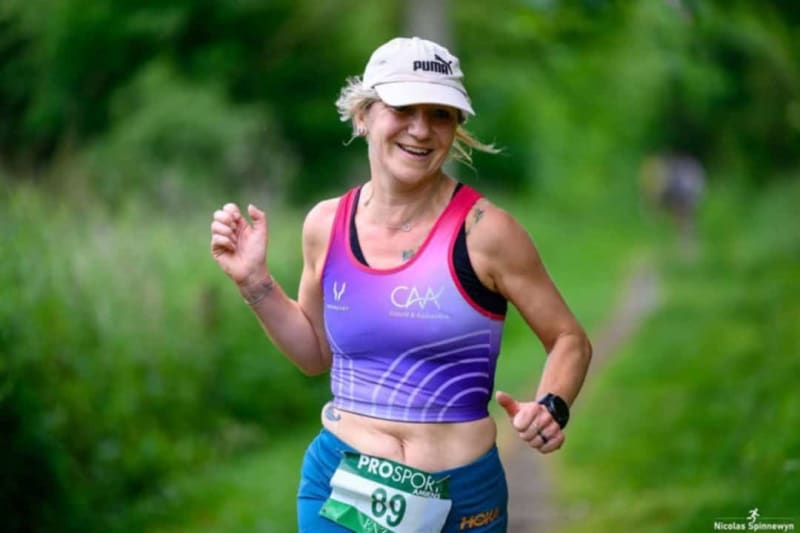
The longer the distance, the more comfortable Virginie feels in her running shoes. For her, running a marathon is no more taxing than a 10 km, and paradoxically, the pain can sometimes be worse over shorter distances, when the heart rate shoots up quickly. During prolonged efforts such as six- or 24-hour races, her body adapts naturally.
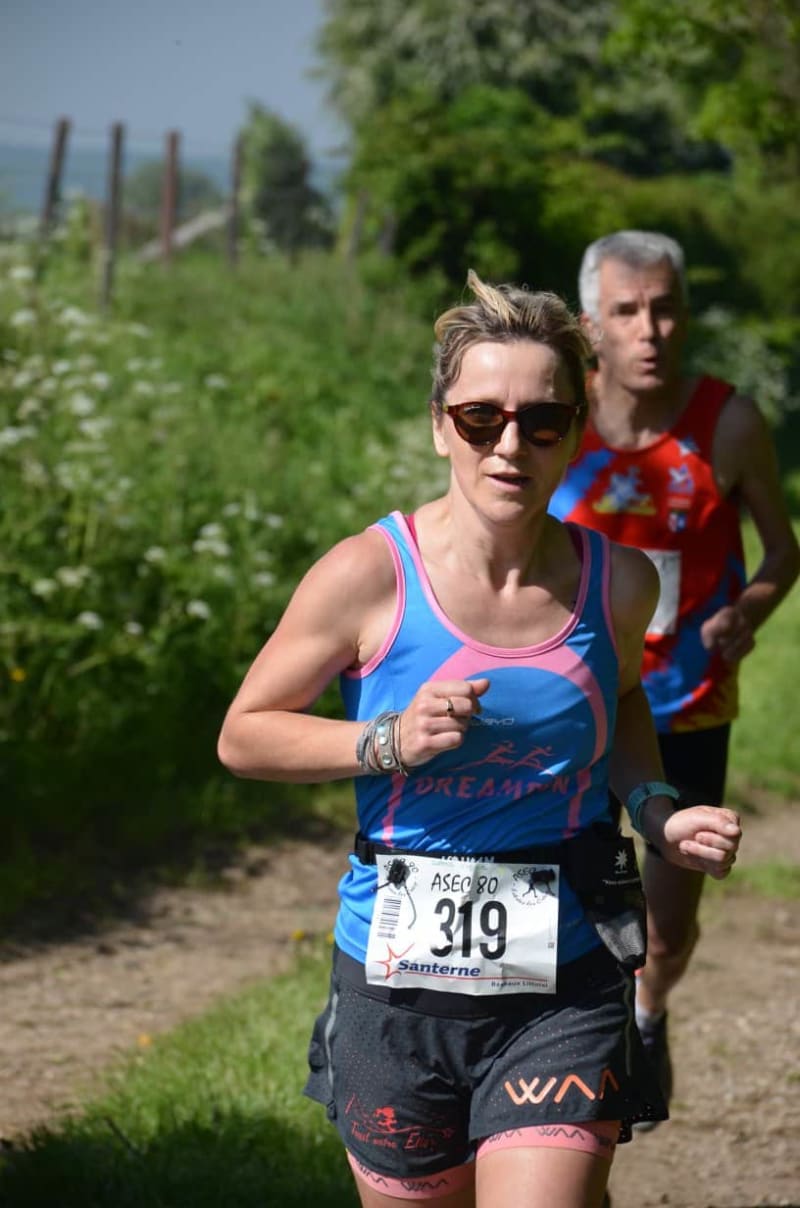
In a six-hour race, she takes short one-minute breaks every 10 km to drink and eat, then sets off again. Over 24 hours, her pace varies between 4:45 and 5:30 per kilometre depending on the stage of the race. She holds around 12 km/h for the first 50 to 70 kilometres before slowing down. “ Sometimes I finish a 24-hour race at six minutes per kilometre. I let my body decide ” she says. Her body instinctively knows where the limit lies: “ In a 5 km, you’re done by the end. In a 10 km, you’re dead at the finish. It’s the same in a 100 km. In a six-hour race, I could have carried on. I was ready for much more.”
©
 © Daniel Mouillard
 © Sabine Loeb
 © Nicolas Spinnewyn
 © Sabine Loeb
Preserving the memories
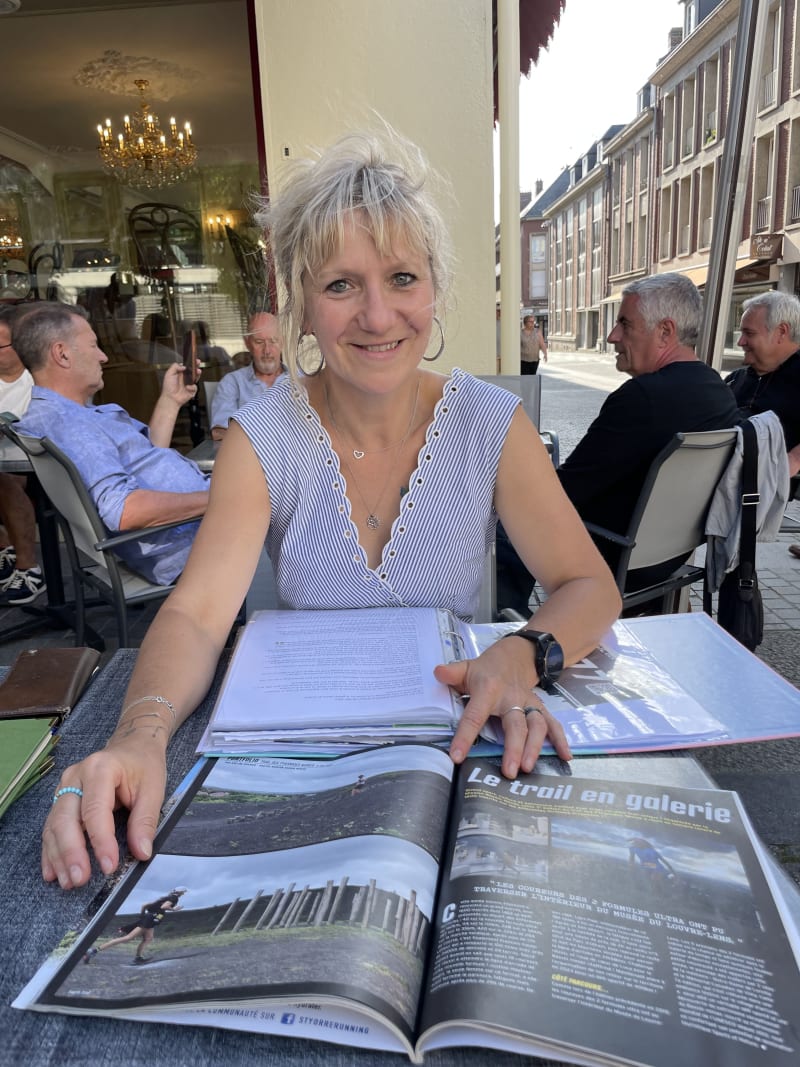
She keeps all her race bibs in a binder. After every race, Virginie takes the time to write down how it felt. Like a blogger, she shares her race reports on Facebook with friends she has met at different events. “ I always write a short piece with photos, then print it out. They’re memories.” Memories carefully preserved, like the photo she shows me on the cover of the Roadbook for the Trail des Pyramides Noires.
Among her best memories, the road runner mentions this trail in Oignies, in the Nord department. Still amazed, she recalls covering its 110 km in 13:50: “ You set off in the middle of the night, then climb in the dark. You don’t really know what’s going on, you’re alone and yet it’s incredibly alive. When the night ends, it’s magnificent: you see the slag heaps, the countryside, the birds, you hear everything. ” Unaware that she was among the leaders, she finished fourth overall and first woman. “Running across old mining sites is lunar.”
She also mentions her most recent marathon, Paris, where she set a personal best on “a magnificent course, with crowds cheering all the way”. Three hours and 20 minutes of happiness for this runner from Abbeville, who was “in the wrong corral, thinking I was going to run 3:30”, forcing her to weave through the field.
The road ahead
On June 28, Virginie will line up for a 24-hour race, hoping to “ break 200 ”. She wants to make up for a frustrating first experience in Eppeville in 2018, marred by a counting issue. “ Until 7 a.m., I was in first place, but at the finish I had 178 km, less than the 186 km shown on my watch.” There is still a hint of bitterness in her voice, but today she is confident.
When we met on June 12, she had just completed her final big training block and was preparing to cut back her mileage ahead of the race. “ Three weeks out, I always do one big block. During the final week, I’ll try to take it easy. It’s going to drive me mad. ”
This next 24-hour race is not officially accredited, so there is no title at stake. “ To begin with, I don’t care whether it’s accredited. I’m not very competitive. I mainly look at how close it is, so I can get home easily afterwards. ” But her club encourages her to enter accredited 24-hour races, because she rarely comes away without a medal around her neck.
Several titles are now in the Samarienne’s sights. On September 14, 2025, she will compete in the French Half Marathon Championships in Auray-Vannes, hoping to claim another title in her category. “ It’s not great, but I checked first to see whether it was worth travelling for... and I have a chance” she says with a smile.
In Abbeville on May 31, she also secured qualification for the French 10 km Championships, which works out perfectly: the race will be held in Troyes, not too far from home. A real advantage for the Master 4 champion, as her job makes a quick trip to the south for a single race difficult, without even mentioning the cost involved.
To begin with, I don’t care whether it’s accredited or not. I’m not very competitive. I mainly look at how close it is, so I can get home easily afterwards.
Did Virginie Durand not deserve a proper spotlight on her life as an exceptional runner? A passion this deep for running deserves to be celebrated. In less than a week, she will push her body to the limit in an attempt to break the symbolic 200 km barrier in the 24-hour race. We wish her the very best. To be continued...