
Clément Gass, blind runner and world-record holder: “You can run a marathon every day after breakfast”
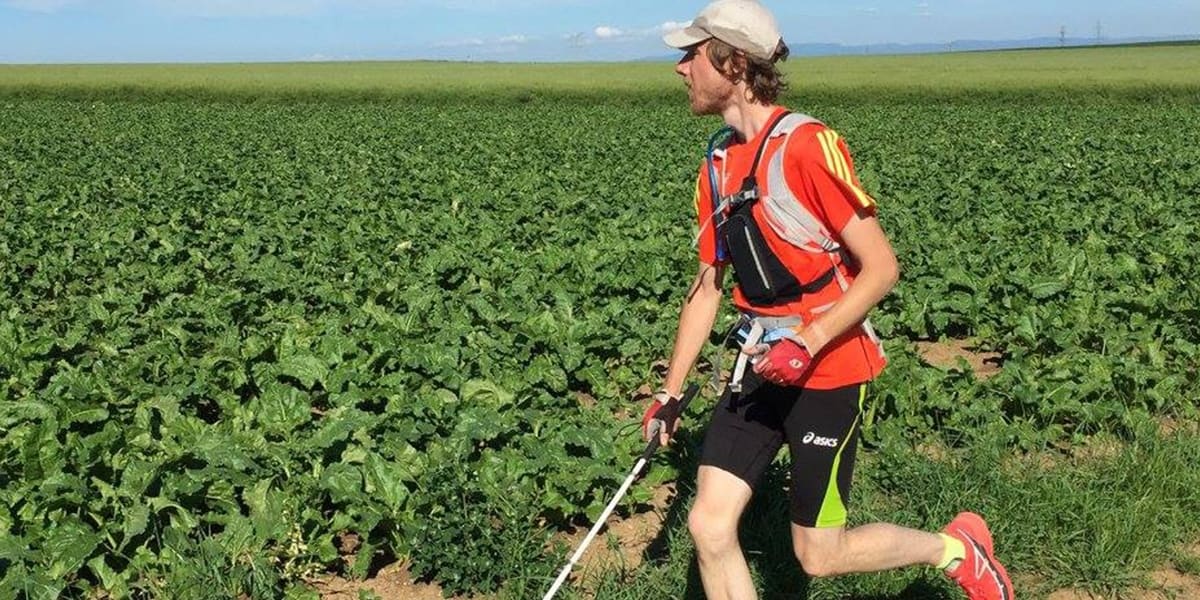 © gr20-infos.com
Blind since birth, a statistical engineer, trail runner, marathoner and world-record holder for running independently, Clément Gass invented his own voice-guided GPS so he could run without a guide. From the GR20 to the 20 km de Paris, the Alsatian charts his own course through what he calls a “living geography”, guided by one simple philosophy: push your limits without ever losing the joy of it.
An unconventional and formidable competitor will take on the 20 km de Paris on 12 October. A visually impaired runner with no shortage of daring, Clément Gass spoke to Marathons.com for almost 80 minutes in a conversation that moved between sporting testimony, life story and philosophical reflection. Because Clément Gass has never waited for the trails to be marked out for him. A trained engineer and passionate inventor, the Alsatian has turned his visual impairment into a testing ground. With his voice-guided GPS, he runs alone and fully independently, from marathons to long mountain traverses. The world-record holder for running a marathon independently, the native of Lutzelhouse in Bas-Rhin has also taken on some of the most demanding terrain, from the GR20 to the steep slopes of the Vosges, always determined to go where he is least expected. Along the way, the boy from Schaffhouse-sur-Zorn, also in Bas-Rhin, has not only pushed back his own limits and introduced other blind runners to trail running, he has also developed mobility aids with the Vue du Cœur association and shared a philosophy in which disability never takes away freedom of choice. In this interview, the 38-year-old all-terrain athlete talks about his close calls off the trail, his greatest joys as a runner, his convictions as a hands-on engineer and his enduring taste for keeping a low profile, far from the spotlight. Meet a runner who challenges preconceptions and turns every stride into an act of freedom.
You started running at 12, in your native Alsace. What stands out from those first steps? And from your first race?
I started running to get around. As a blind person, getting around by other means is difficult. Running is simply walking faster: it lets you go farther using the same means of transport. My first memory is running behind my brother in the supermarket. While our parents did the shopping, we were bored, so we ran around the aisles, always following the same route. As I kept speeding up, I ran straight into a pole. My childish reaction was: “But it wasn’t there last time!” It could have traumatised me, but instead it taught me to build precise mental maps of all the environments I move through. Official races came much later, after I was 20, perhaps even 25. I had already taken part in small local races, such as the 5 km Châteaux d’Ottrott. At the time, I couldn’t always afford the entry fee, so my student friends and I would sometimes run alongside the crowd without a race number, timing ourselves.
As a child, you already went hiking alone, with only your cane. How did those experiences build your proprioception and confidence?
It happened very gradually. You can’t ask a blind person to run alone overnight. You start by walking, then brisk walking, then slow running, on flat, safe surfaces: tracks, grass, football pitches. Then quiet roads and wide country paths. Little by little, you add grass, roots, woodland, elevation, rocks... It takes years of practice.
You compare running with the jump from cycling to driving, in terms of freedom. Can you explain?
Running is the only way of getting around that I can do without depending on anyone else. No permission, no driver and no timetable needed. I can go out at any time. Over 10 kilometres, the time saved by running at 10 km/h rather than walking at 4 km/h is huge. The difference is comparable to that between a bicycle and a car.
“In nature, no one is there to remind me that I’m blind.”
Running alone, without a guide, gives you a particular kind of freedom. What changes for you?
I started without a guide, on familiar terrain. Guides only got involved for competitions or fast training sessions. Outside those situations, I have always run much more on my own. Without a guide, I only depend on my own schedule, not someone else’s. It is also a way of forgetting my disability. In nature, no one is there to remind me that I’m blind. Neither are the animals. They are just as wary of me as they are of a sighted person.
Why didn’t the traditional method, with a guide and a tether, work for you?
I have nothing against it, but it limits your freedom. Running alone means being in charge. When you are tethered, the guide chooses the route. I need to steer my own run, building a kind of living geography in my mind.
 © Clément Gass in action, proving that a blind runner can find his own way in complete independence. © Sébastien Bozon
Were you afraid during your first completely solo outings?
Fear is always there, but it is not panic. It is total alertness. At any moment, I could trip, leave the path or fall into a hole. My cane anticipates obstacles, but it does not cover 100% of the ground. I regularly stray off the trail. Quite simply, the difference between the middle and the edge is not always distinct enough to feel. A cane gives you a poor sense of the terrain, and at a certain pace, a tenth of a second is enough to put one foot beside the trail, then the other, and end up completely off track. When that happens, the only solution is to react immediately. If my left foot drops into empty space, the right one will follow straight away. So I have to throw myself sideways and grab hold of the stable ground with my hand. Fortunately, in the Vosges, leaving the trail does not mean going over a 50-metre cliff. There are steep, unstable slopes, but they are made of earth, so you can usually catch yourself.
In 2015, you co-developed a voice-guided GPS app adapted to your needs. How did the idea come about? And how does it work in practice on a race such as the 20 km de Paris?
The original idea came from a researcher. He had developed an app for hiking. I told him that all the ones I had tried up to then were useless. In the end, I realised that his system was better than the others, even though it was still imperfect. Since I am an engineer by training, we worked together: he handled the coding, while I contributed the ideas and the algorithm logic. Little by little, we created a voice-guided GPS that combines GPS, a compass, a gyroscope and the phone’s sensors, which makes it much more accurate. You can also customise the route by marking a change in gradient, a fallen tree or any other hazard spotted during a recce. That way, the next time I can run with confidence: the voice warns me about the hazard before I reach it. Every seven seconds, the speech synthesis tells me the direction and distance to the next key point. For example: “at one o’clock, in 53 metres, turn to two o’clock”. By measuring the distance between two announcements, I know how fast I am running. It is precise and, above all, adaptable, even when I am working hard.
Did you have any technical problems, such as the compass failure on your first 27 km trail race?
Yes, there were glitches at the beginning. On that trail, the directions became inaccurate after 12 km. Fortunately, I knew the course and there were other runners around. I took a few wrong turns, but I always managed to get back on track, either with help from volunteers or simply by hearing the race announcers in the distance. GPS is a tool, but you must always know how to manage without it.
“That time, 4:04 for the marathon, had symbolic value: showing that you can run alone, without a guide, and set an official benchmark.”
You hold the world record for an independent marathon by a blind runner, 4:04, set at Cernay-La-Ville in Yvelines. What did that moment mean to you?
For me, it was not a goal in itself, just a consequence. The record matters less to me than the pleasure of running in the forest or mountains. But that time had symbolic value: showing that you can run alone, without a guide, and set an official benchmark. I hope it will encourage other visually impaired people to give it a try.
Are you already imagining the next innovations that could make running even more accessible for blind people?
There is always room to improve. If self-driving cars can be guided with extreme precision at high speed, why not a runner in the future? The question of cost remains: smartphones and apps need to stay affordable. I would be happy to contribute to new projects, but not on my own. Developing an app requires a real team. And running is not the only area: take reading, for example. Text recognition is still very approximate. It works well with clean, recent print, but as soon as there are tables, charts or handwriting, it becomes unusable. There is a huge amount still to improve.
You have also crossed Alsace and even completed the GR20, 180 km in Corsica. Was it harder than a marathon?
The GR20 is much harder than a marathon. It lasts ten days, with fatigue, pain and sometimes even a fracture thrown in for good measure. It is primarily a mental challenge. You can run a marathon every day after breakfast.
 © Clément Gass has no hesitation about venturing onto the Vosges trails he loves so much. © Documents remis
In 2016, you set a world record over 54 km with 2,020 m of elevation gain in 9:38, again running independently. What stayed with you from that challenge?
It was probably harder than a marathon. In the mountains, the risk is constant, the effort lasts longer, and physically you are tested from start to finish. But it is also another kind of pleasure, combining exertion with constant concentration.
Do you still set performance goals?
Not really, not in numbers. My goal is to do the best I can. I do not run for a specific time, but to improve and push my limits. I do not believe in this constant escalation towards ever-longer distances: running 200 or 300 km while depriving yourself of sleep means putting your health at risk. I would rather be able to run 70 km regularly for the rest of my life than destroy myself in pursuit of one achievement.
“I am constantly building a mental map of the places I pass through.”
You often use the phrase “living geography” to describe the way you run. What do you mean by that?
I am constantly building a mental map of the places I pass through. Every sound, every change in terrain and every smell becomes a reference point. Once I have travelled a path, I can memorise it and return later on my own. It is as if I were drawing the terrain in my head, layer by layer.
You have introduced other blind people to trail running. What do you get from sharing your experience?
First, there is the simple pleasure of sharing a passion. The more of us there are, the more we laugh! But what moves me most is seeing someone discover that they can do what they thought was impossible. In the mountains, I sometimes come across hikers who are a little lost, and I am the one who shows them the way. It always surprises them, because people assume that a blind person should have fewer reference points. In reality, when I know an area well, I sometimes move around more confidently than sighted people discovering the terrain. It completely turns the perspective on its head: in that moment, there is no disability. Just people sharing the same space, with their strengths and limitations.
You have said that you want “independent marathoning to be recognised as a discipline” and your times to be comparable with those of sighted runners. How do you see this practice being incorporated into official rankings?
Today, I am ranked alongside sighted runners. When I finish 1,000th out of 2,000, I am neither first nor last, and that makes sense: I am being assessed in the same race as everyone else. But why not create a parallel category to highlight this practice and attract more people? I would like para-sport and able-bodied competitions to take place together, as one big celebration. In sports such as judo, categories are created by weight or age. We could just as easily do it by type of disability. That would be genuine integration, not parallel worlds.
“We don’t take a ‘disability train’ to a ‘disability workplace’, so why talk about ‘disability sport’?”
How do you view the place of disability in sport in France today?
In everyday life, we all live together. We don’t take a “disability train” to a “disability workplace”, so why talk about “disability sport”? The terminology shows that the separation is still there. At elite level, competitions are kept apart, but in clubs, integration is often much more natural. There was a surge of enthusiasm for the Paralympic Games, then it quickly faded. Disability sport is still too often treated as a sideshow. I dream of a system in which integration is the norm, just as it should be between men’s and women’s sport. Today, we still organise two separate World Cups, as if the two worlds could never meet.
In 2024, you carried the Paralympic flame. What did you feel in that moment?
It was a special moment. It was a way of being included in the Olympic movement, even though my discipline does not fit into the usual categories. That day, there were all kinds of people, from a wheelchair-using school student to an elite athlete. When he handed me the flame, I truly felt the connection that unites all our differences.
Through the Vue du Cœur association and Yvoir, you develop mobility aids and support other blind people. What does that bring you on a human level?
Community work is above all about the satisfaction of moving things forward together. At the moment, we are working on a sturdier, more suitable version of the cane, useful both for athletes and in everyday life. Every outing becomes a testing ground: I try new tips, observe how they wear and push them to their limits. It occupies a lot of space in my mind, but it is also what makes the project concrete and useful.
I have been involved with the association for around ten years. It was originally created to help a young visually impaired person, then opened up to others. Today, it remains small-scale, which is what I appreciate: manageable projects without heavy administration, but with a real everyday benefit. Above all, it provides a space to share our experiences and move forward together.
If you could pass on one message to young athletes with disabilities, what would it be?
I do not necessarily feel qualified to tell them what to do. But if I had one piece of advice, it would be to listen to no one... including me! We all have the same ability to decide how we live our lives, whether we have a disability or not. The key is not to let norms or prejudice put you in a box. And you have to learn to see the glass as half full, or even one-tenth full. Because that one-tenth is already huge: there are more things to explore than one lifetime could ever contain. It is that small part, however small it may be, that makes you want to keep moving forward.