
Dunkerque to Marseille on Foot: Olivier Maria’s Wild Sandal-Clad Challenge
 © Jérôme Habasque
Olivier Maria, a 33-year-old amateur runner, made his mark in April 2026 with one hell of an adventure. He reached Marseille from Dunkerque in 10 days, 11 hours and 50 minutes, covering 1,134 km on foot.
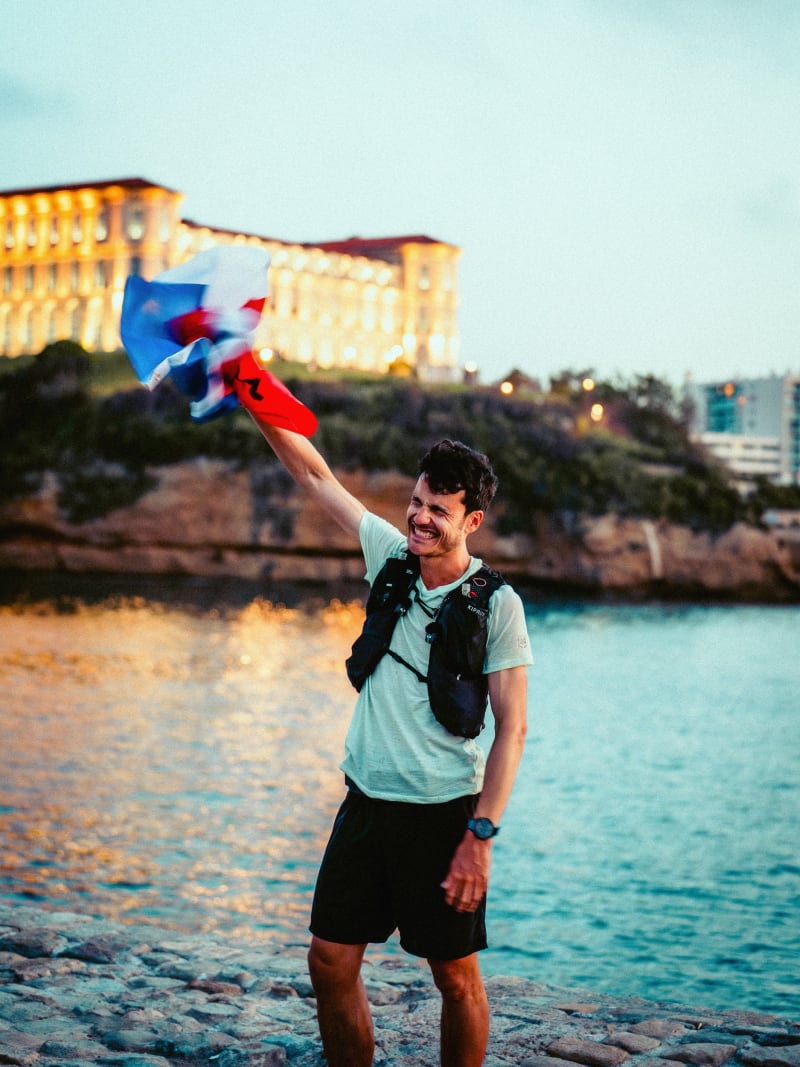
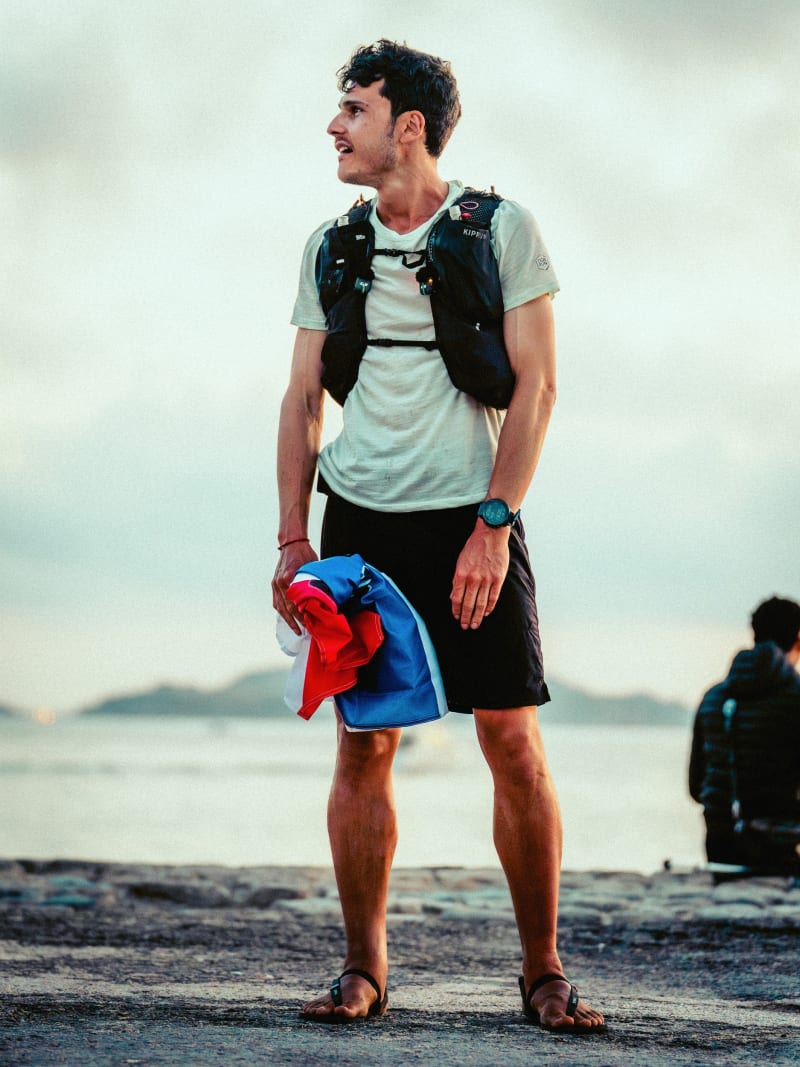
Olivier Maria. The name may not mean much to you, especially if you’re not one of the 62,000 people who follow him on Instagram. And yet, he’s a titan. In 10 days, 11 hours and 50 minutes, he ran across France. You can hardly have missed the photo of him standing by the sea, with the Palais du Pharo in the background, holding up a French flag marked “Dunkerque-Marseille”. The smile, the emotion on his face, the song chosen to accompany the post celebrating the completion of a two-year project: it’s all there.
But before pulling off this feat, the Lille native fell before getting back on his feet. Here’s the story of a sporting and human adventure born from a simple question: “Is it possible to run across France?” He answered in the affirmative, without ever underplaying the effort it would take.
Running with Olivier, from 2015 to today
Olivier started out as a road runner. “I ran fairly standard distances,” he says. “From the 10K to the marathon.” Then, one day, he discovered ultra-cycling. He took on extreme formats such as Race Across France, an event covering nearly 2,500 kilometres across the country.
Barely had he completed that challenge when another idea began taking shape in his adventurer’s mind. “Since I come from running, race in minimalist sandals and care deeply about keeping things simple, the next step was to run across France, because it requires even less equipment and mechanical support ,” he explains.
When he announced the project on social media in November 2024, he was something of a pioneer. Since then, plenty of similar initiatives have emerged, though they are not always driven by the same intentions. Like Pierre Destailleur, Olivier is supported by the Universport association and above all wants to place his extreme practice within an environmentally responsible approach. “What I wanted to convey beneath the surface of this project was the idea of doing sport from home, without flying to the other side of the world,” he says. It’s a vision he managed to embody during this unique crossing of France.
“ I had a blank canvas. I wanted to go to a particular city, leave whenever I felt like it.
A low-impact project, entirely self-supported
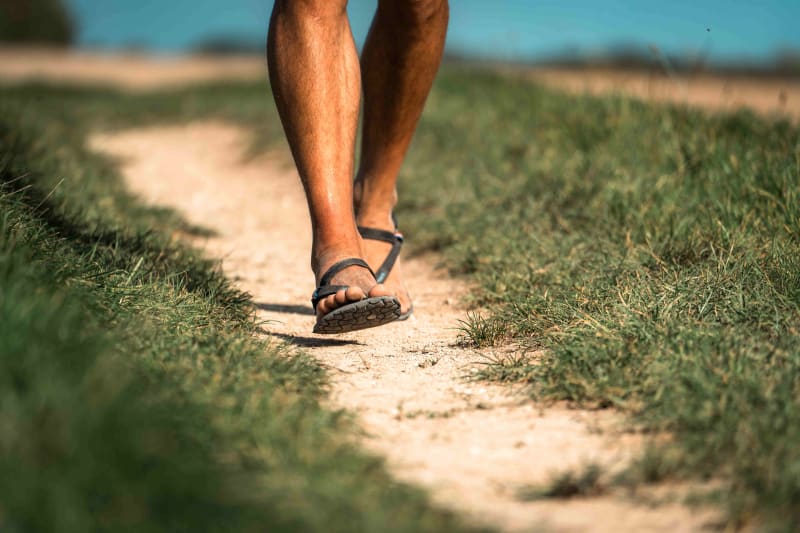
You don’t need the latest gear to cover 1,136 km in nearly eleven days. That’s the impression this ultra-runner gives. With a single pair of sandals, he made it all the way. Nothing particularly surprising, in his view: “Humans have been running without big shoes for 5,000 years. They didn’t wait for these shoes before running long distances,” he says.
Through his project, Olivier also challenges the importance given to equipment. “Running is still something natural. It’s better to focus on yourself and your training,” he continues. Beyond the performance itself, wearing minimalist models also carries an environmental logic. “It’s much more sustainable,” he says. “The pair I’ve taken furthest went beyond 3,000 kilometres.” When they finally reach the end of their life, he throws away only the soles and keeps the straps. The manufacturer sends him just the replacement soles, which he attaches himself. “There’s something pretty cool about the DIY side of it and, in terms of waste, it’s much more environmentally friendly,” he insists.
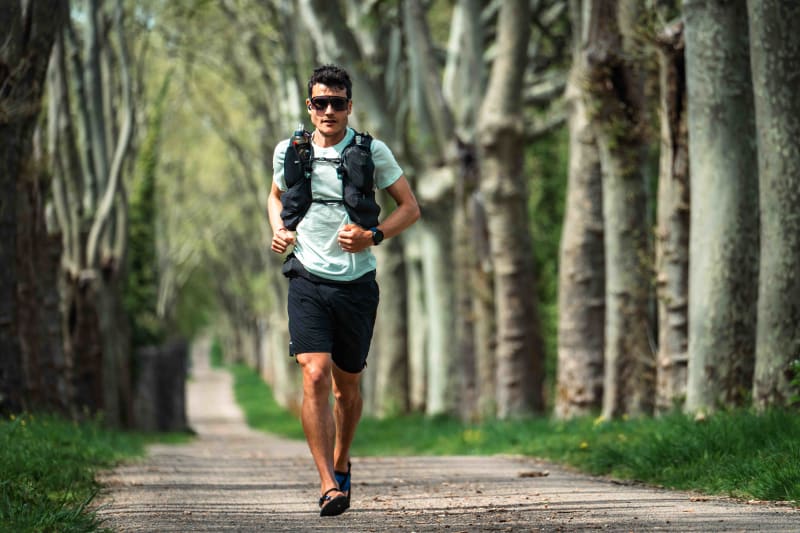
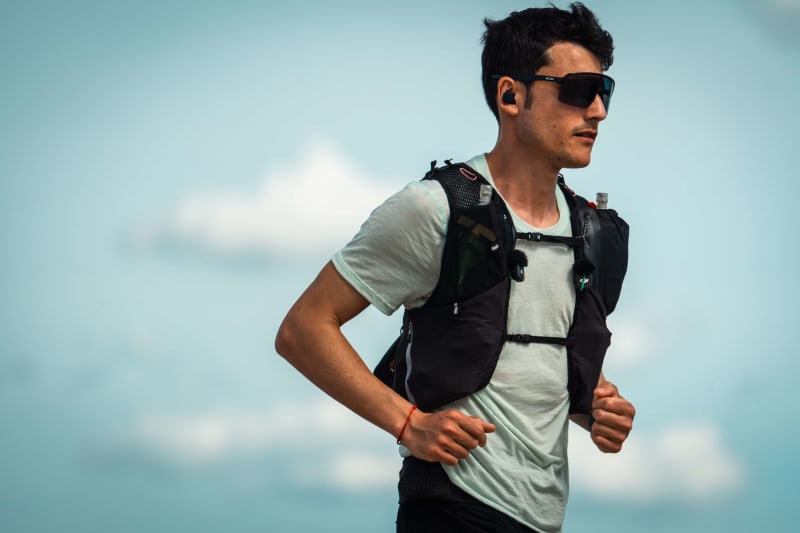
Beyond his sandals, Olivier also showed that a challenge like this could be completed entirely self-supported. He set off from Dunkerque with a pack weighing just two kilos on his back, carrying his route in his head and on his phone. To stay hydrated, he planned his route around water sources, particularly in cemeteries, which he had located in advance on his GPS track. Food followed the same logic: he resupplied along the way, at whatever shops he came across. “I ate whatever I could: fruit purée, sandwiches, fizzy drinks for the sugar… but I still lost quite a lot of weight,” he says. Clothing-wise, it was the bare minimum again: a merino T-shirt, “washed every two or three days”, and a few spare clothes for the evening. “I really took only the essentials,” he sums up.
 © Bryan Baret
 © Jérôme Habasque
 © Bryan Baret
 © Jérôme Habasque
 © Jérôme Habasque
The training runs… and the failure before the breakthrough
By the time he lined up for the start of his crossing, Olivier knew he couldn’t afford to carry too much. His various test runs had taught him that taking too much food was counterproductive. But those efforts did more than help him fine-tune his pack: they taught him how to handle continuous effort over very long distances.
He wasn’t planning to settle for one marathon a day, or five to six hours of effort. His target was closer to 100 kilometres a day, with the aim of reaching Marseille in as few days as possible. From the start of his preparation in January 2025, he quickly realised that the biggest challenge wasn’t so much the distance… as the next day. Setting off again. “When I started training, I ran Lille to Dunkerque, around 90 km, in the winter of 2025. The next morning when I woke up, I couldn’t move. My legs were completely shot. I told myself I still had to set off again the next day. Gradually, I managed to string efforts together: first 5 to 10 km the next day, then two long runs back to back.”
The training paid off, and his body eventually adapted. He even managed three-day blocks covering 300 kilometres, “in real-world conditions, to see whether it was too hard by the end and whether it was actually doable”. One of those tests was a Lille to Amsterdam run, which also gave him the chance to pick up his “made in the Netherlands” sandals.
These dress rehearsals were no guarantee of success, however. In October 2025, a first attempt ended in failure. “I got injured. I had a bacterial infection in my foot, and it swelled up,” he recalls. Forced to stop, he didn’t give up. He went back to training, more determined than ever. The second time, he got it right. During his successful crossing, he reached Troyes and returned to the Aube sports centre, the same room, the same person. It was a deeply symbolic moment. “Until I reached that place, it was mentally tough. I kept telling myself, ‘I’m going to get past a major hurdle.’ Once I’d made it, another adventure was opening up. Crossing that point also allowed me to lay my old injury to rest, and I was going further than I had ever gone before. ”
When Olivier Maria tells the story of his adventure, everything sounds almost smooth, to the point of seeming inevitable. Yet his story hinged on very little: his ability to get back up after a first abandonment that was hard to swallow. That frustration, born of failure, was probably what gave him the momentum to see it through. Because it has to be said: the final three days were marked by intense pain, with no real enjoyment, just suffering. “It’s pretty indescribable to have done something that crazy ,” he concludes, smiling.