
Inès-Marie Ducancelle, from surviving a coma to a 2:39:40 marathon
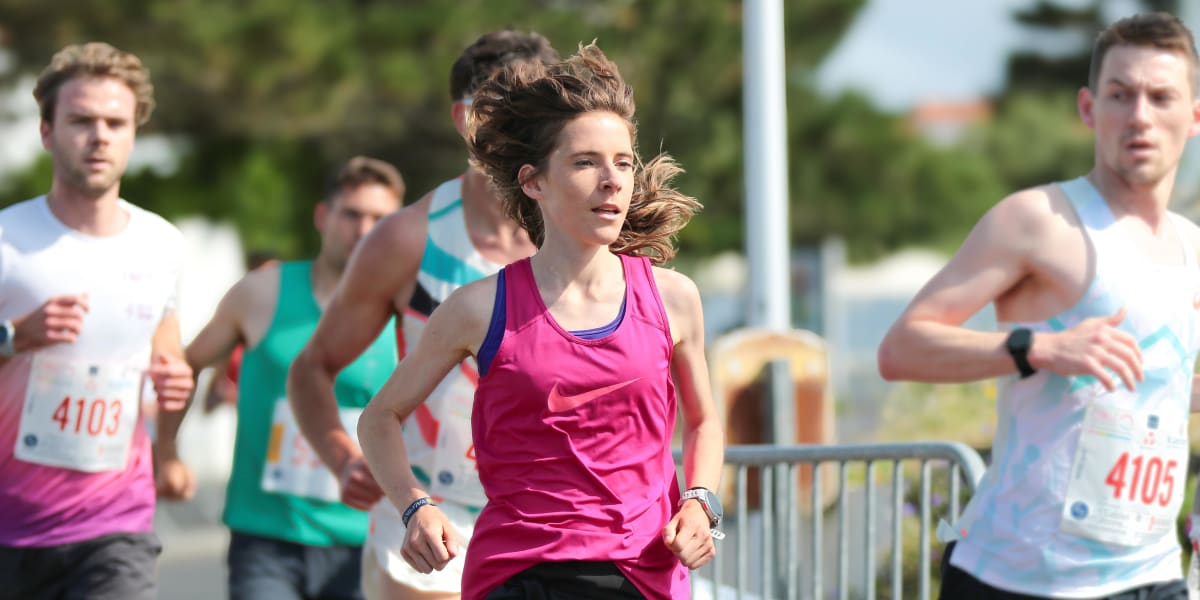 © STADION-ACTU
At 23, Inès-Marie Ducancelle has spent the past few months turning heads in the running world. This hyperactive athlete, a newcomer to the scene, has made an immediate impact, first with a run of around a dozen wins at local races near Angers, then with a superb 2:39:40 over 42.195 km at the Saumur Marathon. The runner from Avrillé draws her strength from a life story that is as moving as it is extraordinary, and from a mindset and wisdom far beyond her years.
“I’ve been hyperactive since birth. I had to try every sport,” begins Inès-Marie Ducancelle briskly. Hyperactive, just like the way she speaks. Fast-paced, confident, always intent on making herself clear. The student of biology and health sciences seems to have lived a thousand lives. Dance, tennis, football, swimming, and finally basketball, the sport she fell in love with at the age of 10. “I played basketball at a very good level for 10 years. I went through selection trials, the usual route to get into good teams,” explains the athlete who currently works as a Nike employee, having put her studies on hold. “I was already doing a bit of running on the side, but I hated it. I mainly did it to help out my school team.” Yet the future athlete was already racking up wins in school cross-country races, then at departmental and regional level. “Even as a child, I had a natural ability for running, but I didn’t care. I was completely focused on basketball.”
Her future seemed almost mapped out. The basketball player was talented, with sport as her driving force and plenty of energy to move forward. But Inès-Marie Ducancelle’s life changed course in November 2022. After “quite a few personal problems”, her health suddenly collapsed and “deteriorated at a terrifying speed.” The young woman suffered multiple organ failure. “I went into a hypoglycaemic coma. My blood sugar level was zero, which caused all my organs to fail,” the athlete explains with precision.
“I went into cardiac arrest. My father found me unconscious on the sofa, with my eyes rolled back. The fire service managed to revive me, but by the time I reached hospital my body had started to deteriorate. I then suffered several more cardiac arrests during that same week in November,” she continues, speaking at a pace that reflects the urgency and distress of what she is describing. “Even though the staff always managed to revive me, my organs began shutting down one after another. My lungs had atrophied and could no longer inflate. I had to be intubated and became completely dependent on machines.”
That was followed by a month in intensive care, where patients usually stay “a week at most.” “Whenever they tried to heal one organ, another would start malfunctioning. Then my liver was affected because of all the medication I was taking. Once my condition stabilised, I was transferred to the nephrology department because my kidneys could no longer detoxify my body. I was beginning to poison myself, so I needed emergency dialysis. It’s an artificial process that removes waste and excess fluid from the body.”
A month passed, but the dialysis sessions lasting “four hours in the morning and four in the evening” were not working. “I kept getting worse. The doctors were discouraged and told my parents that we were finished, that there was nothing more they could do for me because nothing was working. We carried on and held on to hope. With patience, a miracle happened.” From one day to the next, dialysis finally worked, bringing with it one victory: regaining “the outside world, leaving the hospital, going home.”
“When you go from death to life, you can’t help but admire the beauty of simple things”
Yet the condition of the woman living in Angers was “alarming”, following a dramatic loss of weight during her time in intensive care. “I desperately wanted to get out. I was in critical condition, but I felt the need to live somewhere that would be good for me. Staying in a ten-square-metre hospital room was suffocating. I told my mother I would die if I stayed there any longer,” recalls the runner. Inès-Marie Ducancelle had to rebuild herself at her own pace during her recovery, supported by home medical care. It was “” for the former basketball player, who found herself in a wheelchair and had expected to get back to her old life quickly. “I had no use of my legs, and the wheelchair wasn’t suited to the house at all. We had to get creative and find little solutions to the challenges of everyday life. I was fed by machines, and nurses came to give me injections every day. You become very resourceful when you no longer have the means to adapt; you learn to live differently,” she acknowledges.
From the fragility of a dragonfly to her release from the medicalised world, Inès-Marie Ducancelle rediscovered the will to live, with a lioness’s ferocity. It was a rebirth for the future athlete, who had been confined to a healthcare facility from November 2022 to February 2023. “When you go from death to life, you can’t help but admire the beauty of simple things. But I was trapped in a lifeless body, and that was the hardest pain of all. I clung to the memory of the old Inès-Marie who was always on the move and excelled at everything. So when I found myself paralysed, I had to hold on to personal challenges and small everyday pleasures that seem insignificant or pointless to most people.” Walking around the living-room table while sitting in her wheelchair, then climbing one step of the staircase, then several, until she could reach her upstairs bedroom. These were the goals that kept the athlete moving forward. “I cried when I reached my bedroom again. It was a much bigger victory than any medal. I had to start all over again, and I fed off those little things to keep going.”
The survivor recounts this period in a clear, confident voice. For her, looking ahead was unimaginable, because “everything that comes from projecting yourself into the future is just fear, and that fear of the future is harmful to the present.” Her life-changing ordeal taught her to live “all the way, without regrets”, because “tomorrow, everything could start all over again.”
A decisive encounter in her recovery
After walking, one small step at a time, came running. Inès-Marie Ducancelle found the strength to fight her way back to life thanks to adopting a Golden Retriever named Ucky. She brought the dog home as soon as she left hospital, a shield against loneliness and isolation. The runner already had several cats. As a child, the fighter had dreamed of becoming a vet. Taking a dog under her wing had always been something she wanted to do. Animals are her second passion, and she felt a “vital need” for a companion.
“When I regained the use of my hands in intensive care, I picked up a pencil and drew a Golden Retriever. It was time to get one, so I discussed it with my parents. He accompanied me through my recovery and saved my life. Since then, the two of us have been inseparable,” smiles the survivor, who says she devoted all her energy to understanding her new friend’s needs. Two months later, pushed on by her four-legged companion, she swapped her wheelchair for walking. “When you have a dog, you can’t tell yourself you don’t feel like going out. For him, it’s a basic need. I had the discipline to take him out morning, noon and night.” Ucky stayed by her side as relearning how to walk normally proved a long process. “I was still staggering. I was very fragile at first and couldn’t keep going for long,” recalls the athlete, who spent a year undergoing rehabilitation alongside her friend.
A few months later, the woman who describes herself as a hothead took a break from her biology studies to hike across the Alps with Ucky. It was a vital need, because illness had damaged the former basketball player’s self-confidence, and she needed goals to give this new life meaning. “Crossing lakes and mountains opened my mind and helped rebuild it. That was when metres became kilometres and I started running, because after walking comes running,” says Inès-Marie Ducancelle. She noticed a real improvement in her condition in March 2024.
Skiing, then running, from May to September 2024. The Entente Angevine Athlétisme athlete grew in confidence, her body getting stronger alongside her mind. Her older brother by three years, Louis, suggested they go running together. “He’s the one who gave me a taste for running,” she insists. A few years earlier, she had watched him come home from school cross-country races with “muddy spikes.” During an outing in the Alps after her recovery, Inès-Marie Ducancelle left him “completely wiped out,” to her great surprise. “He asked me why I wasn’t racing and said I’d be really good. I have a bit of imposter syndrome, so it seemed unimaginable. I’d been in a wheelchair a year earlier.”
After “a lot of thought”, the younger sibling agreed and pinned on a race bib at the start of the 2024 school year to see what she could do. “I won the race, and I haven’t stopped since,” adds the impressive runner proudly, now with around a dozen wins since September. That does not include her extraordinary 2:39:40 at the Marathon de la Loire in Saumur in May 2025, her first marathon, a time that immediately stood out. Her strengths? Endurance, resilience and long distances.
“30 km in the legs, 10 km in the head and 2 km in the heart”
Running a marathon was a genuine symbol for Inès-Marie Ducancelle. But there were also injuries and the split with her coach, along with “a deep period of self-questioning and various problems.” So much so that the future marathon runner was ready to give up two weeks before race day. A conversation during a race with a runner planning to take part in Saumur reignited her motivation. The many people she met at road races eventually convinced her too, including a mother whose daughter had leukaemia. Her warrior spirit put her back on track. “I did my marathon build-up in ten days. It was pretty extreme: a 5K, a 10K and a half marathon to build fitness before the 42.195 km. I ran with my heart, for myself and for all the people who push me to keep going. When I pin on a bib, I transcend myself. During the race I kept repeating: it’s 30 km in the legs, 10 km in the head and 2 km in the heart.”
An unconventional approach built around feel
Inès-Marie Ducancelle has no coach. It is not a deliberate choice; the Angers runner suspects it may be because of her “fiery” personality, and because she wants to find someone “focused on the human being” who suits her. “I tried Exel’s remote training plans, but they’re not for me. I mostly go by feel, while always paying attention to my body and sensations. Having some structure would help me improve.” The new marathon runner has joined Entente Angevine Athlétisme, where she takes part in track sessions.
The rest of the week, the animal lover trains alone around her job at Nike and the demands of daily life. On Sundays, the Avrillé native joins the Sunday Runners group for her long runs. “I keep a certain level of discipline and intelligence in my training. It’s 80% alone and 20% in a group. You have to find a balance. I like both. I also enjoy being alone in my bubble, meditating. Through races and events I’ve met many extraordinary people, and I quickly understood how powerful a group can be.”
The athlete finds her reason for living in running. Her weekly mileage varies according to her injuries and goals. Right now, her sights are set on L’Ultra Marin Raid Golfe du Morbihan, at the end of June 2025. “You shouldn’t focus on the number of kilometres but on their quality. At the moment I’m not running huge mileage, between 100 and 140 km.” Inès-Marie Ducancelle has found in athletics an activity built around a “symbiosis between body and mind.”
“In sport, you’re the driving force behind your own progress and development. I love that, along with pushing yourself beyond your limits. Running is a metaphor for life: you spend more time climbing the mountain than reaching the summit. That pursuit of achievement is so much richer in contemplation and emancipation than a simple victory.” Inès-Marie Ducancelle is fascinated by every discipline, with a preference for trail and off-road races.
Her dream? Taking part in the UTMB in Chamonix, because it makes more sense to her than running on a track, even though she knows the track could help her improve. Charity races and projects also appeal to the hiker, who has notably covered the GR34, the GR5, the GR360 and the GR37. Why not hear from organisers of this kind of event and “run for others.”
A new outlook on life after her ordeal
Her view of life has changed completely since the multiple organ failure. Inès-Marie Ducancelle believes she can put things into perspective more easily and see beyond her trauma. Her bonds with her family have grown stronger, while her race wins embody her resilience and the victory of this “collective battle.” “I’m not stronger than anyone else, just more sensitive to life. I’m aware of that. Every day is unique; it can’t be repeated, only lived. I make the most of every moment, here and now. I’ve kept my touch of madness and my inner child, but I’m wiser and I know my limits.”
The runner from Angers wants to live as if every day were her last. “Happiness isn’t a goal to reach; it’s a state that allows you to stay alive,” says the distance runner, who is no longer afraid to open doors that once seemed unimaginable. She may see herself working in health and social sport, which is why she has put her studies on hold. “My aim is to find balance in everyday life, not only in sport but also with my family, friends and work. When we have no expectations, we have no disappointments, and that’s where we find happiness.” Inès-Marie Ducancelle prefers not to look too far ahead, because it means “thinking about a future that doesn’t exist yet.”
Although the survivor sometimes feels out of step with the rest of the world and with other athletes because she has brought her darker side into the light, she believes that difference is her strength. The runner attributes her wins to the hardships she has endured. “I don’t feel stronger than other people. Quite the opposite, I’m more fragile. But today I’m trying to turn that into fuel for racing. I’m not sad to be unusual in the running world. What I love about this sport is that everyone pins on a bib for different reasons, yet we all meet at the finish line with the same sense of wonder and satisfaction at having made it. That diversity of people enriches running.”
Keeping the enjoyment in her training is essential to improving, she believes. Currently ranked among the top 100 French marathon performers of all time, 93rd at the time of writing, she admits that she lacks a proper support team capable of helping her reach her full potential. No matter. Inès-Marie Ducancelle would rather keep working on her own and stay focused on the present before seeing where it takes her.
“Many people think reaching the top will make them happy, but success isn’t the end goal and failure isn’t the end of the world. It’s in our darker moments that we find the light to rise. You have to keep believing, even when there’s no hope left, because with time, patience, perseverance, enjoyment and passion, you can only improve. Hope is life’s only remedy.” Clear-eyed, the distance runner feels defeats are not celebrated enough, “even though they’re the moments that allow us to find ourselves”, and that the greatest victory is the “ability to bounce back after difficult times.”
Inès-Marie Ducancelle has undeniably managed to turn years of trauma into strength. The runner hopes to do so, at the very least, for people living through similar situations. “What I lacked when I was ill was people who had been through the same thing as me. Having someone to look up to is essential for recovery. If I can help through my experience, that would be more than a victory; it would be worth its weight in gold.”
Happiness isn’t a goal to reach; it’s a state that allows you to stay alive
Today, Inès-Marie Ducancelle is not chasing times alone. She is running with life, for life. Every stride is a victory over fate, a vivid tribute to resilience and rediscovered light. From intensive care to the finish line, her journey is a lesson in courage, patience and faith in the future. At just 23, the runner from Avrillé reminds us that hope is not an abstract concept but a tangible force, capable of lifting a body from the ground and setting a heart in motion again. In her case, that force comes with a fiery mindset and an energy that radiates. Inès-Marie Ducancelle is far more than a promising athlete: she is a survivor, a fighter and a source of inspiration.