

Ethiopia, running’s other giant
In the second half of the 20th century, Ethiopia established itself alongside neighboring Kenya as one of the world’s great distance-running nations. Today, Tamirat Tola and Tigist Assefa continue to carry a proud national tradition that began with Abebe Bikila’s exploits in 1960.
Ethiopia has long been a land of champions. Kenya is often regarded as the leading marathon nation, but Ethiopia has nothing to envy in its neighbor. Its runners’ current performances are proof enough. Tamirat Tola, born in 1991 in Sebeta, won the latest Olympic marathon in Paris, setting an Olympic record of 2:06:26. His compatriot Tigist Assefa is one of the leading names in women’s distance running. In her first Olympic marathon in Paris, the Addis Ababa native took silver after a superb battle for victory with Sifan Hassan, the Dutch superstar who was born… in Ethiopia. From New York to Berlin via London, Ethiopian athletes are always in the mix. How far back does that tradition go?
The history of running in Ethiopia
The history of running in Ethiopia truly begins with Abebe Bikila, who became a legend after the 1960 Olympic Games in Rome. He returned from Europe with gold, becoming the country’s first Olympic medalist. He repeated the feat at the Tokyo Olympics four years later. Bikila was the idol of an entire people who had always fought for their freedom. Ethiopia’s history over the centuries has indeed been marked by continuous struggles against neighboring nations and internal uprisings. Once threatened by Italy, Ethiopia fought constantly for its independence and development, particularly under Emperor Haile Selassie, who would also attend the funeral of national hero Abebe Bikila in 1973. Like neighboring Kenya, Ethiopia has highlands. Addis Ababa sits at 2,355 meters above sea level, an altitude that stimulates red blood cell production. A genuine endurance culture took root naturally in a country where some children have to run several kilometers to get to school. It may sound a little “clichéd,” but the legendary Haile Gebrselassie said that as a child he had to run more than 10 km to school every day, schoolbag on his back, shaping both his stride and his ability to sustain a hard effort. It was during his reign, from 1990 to 2000, that Ethiopia firmly established its global status. A four-time world champion over 10,000 m, a two-time Olympic champion in Atlanta in 1996 and Sydney in 2000, and for a time the marathon world-record holder with 2:03:59, Haile Gebrselassie went down in athletics history for his charisma as much as for his breathtaking performances.
At the same time, Ethiopian women made their mark at the highest level, beginning with Fatuma Roba, the first African woman to win Olympic marathon gold in 1996, followed by Elfenesh Alemu and Derartu Tulu, who became the first African woman to win Olympic gold in 1992, over 10,000 m. Tirunesh Dibaba and Meseret Defar also shaped the 2000s, on the track and on the roads. The 2015 world champion and 2016 Olympic silver medalist over 1,500 m, Tirunesh Dibaba won the Chicago Marathon in 2017 in 2:18:31, with a personal best of 2:17:56 set in London that same year.
Ethiopia’s current long-distance stars
Ethiopia’s story is not only one of glorious achievements in the past. The country still occupies the top spots at the major marathons today. At 43, Kenenisa Bekele continues to fight on and remains an essential figure in the elite field. He finished second at the London Marathon in 2024 in 2:04:15. Fans still remember his remarkable 2:01:41 in Berlin in 2019. Behind him, a new generation is emerging, led by athletes such as Tamirat Tola, 2022 world marathon champion and 2024 Olympic champion in Paris, as well as Sisay Lemma, winner of the London Marathon in 2021. He went on to win the Boston Marathon in 2024.
 © adidas / London Marathon
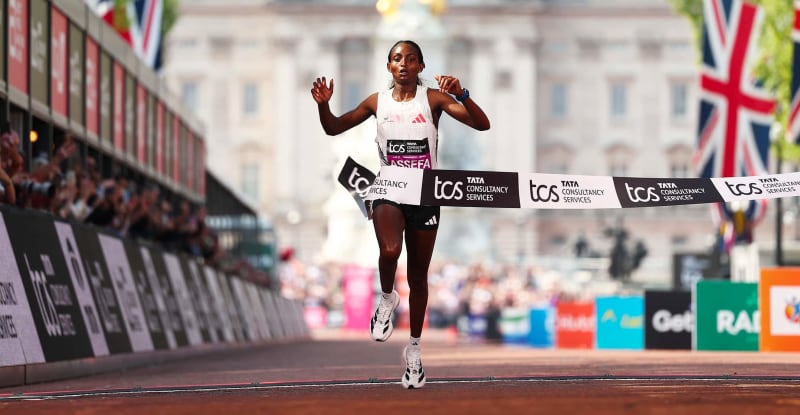
Among the women, Ethiopia has become a genuine superpower. Tigist Assefa made history in September 2023 by breaking the women’s marathon world record in Berlin in 2:11:53. Her record has since been broken and is now held by Ruth Chepngetich in 2:09:56, but Tigist remains firmly in contention. She notably won the London Marathon in 2025. Alongside her, Letesenbet Gidey, the world-record holder over 5,000 m and 10,000 m, has established herself as one of the most dominant figures in middle-distance and road running. Nor should we forget Almaz Ayana, one of the most talented distance runners of all time. She won Olympic gold in Rio by setting a world record over 10,000 m in 29:17.45, as well as bronze over 5,000 m, before making a brilliant move to the roads, running 2:17:19 on her marathon debut in Amsterdam in 2022.
For both women and men, the list of Ethiopian athletes shining on the track and roads is a long one.
The challenges ahead
Despite its success, Ethiopia faces several challenges if it is to maintain its standing in the running world. Compared with Kenya, the country appears to lack infrastructure and institutional support. Its historic rival seems to have a slight head start in terms of development, and the gap could widen in the coming years, especially if brands continue flocking to Iten in Kenya, as Kiprun did in 2023. Ethiopia needs to make the most of its exceptional results and Haile Gebrselassie’s legacy. The former marathon icon launched Yaya Village in 2009, a training center near Addis Ababa designed for elite athletes. Another center opened in 2013 around 25 minutes from the capital, at an altitude of 2,700 meters. Another of the country’s superstars, Kenenisa Bekele, had an athletics track built and opened a 30-room hotel to improve the stay of runners who choose his center.
Beyond these two initiatives, the country appears less well organized at federation level, while sponsors are also less present than in Kenyan athletics. Access to the elite level therefore remains more limited. And well beyond sport, Ethiopia’s political situation is highly unstable. Several conflicts are ongoing in the country, and relations with its neighbors Eritrea, Somalia and Egypt are often complicated.
Against this precarious backdrop, Haile Gebrselassie’s determination to keep investing in education to help the country’s young people deserves recognition. The national hero has launched several schools across the country over the past decade. A great champion and a great man, he is trying to rise above the divisions that have held Ethiopia back for far too long.
More articles

Night races: why does everyone want to run while everyone else is asleep?
From Glow Runs to low-key trail races, night running is taking off, offering a more festive experience and a different relationship with the clock.
Thu, September 10, 2026

Kenya, the distance-running powerhouse in a country where running is king
How Kenya became distance running’s powerhouse, from Kipchoge Keino to Eliud Kipchoge and the generations shaped by its unique culture.
Thu, September 10, 2026

Running Tattoos: When a Finish Becomes a Work of Art
Race memories in ink, from marathon finish times to GPS traces, with tattoo artist Agathe Cossement on the risks and precautions.
Thu, September 10, 2026