
2026 Boston Marathon: John Korir sets historic course record
 © Boston Athletic Association
Boston never disappoints. But some years stand out more than others. The 130th edition of the Boston Marathon delivered all the magic that unfolds between Hopkinton and Boylston Street. Everything was in place for a great race: clear skies, cool temperatures around 5°C, a light tailwind and a stacked field. As on every Patriots’ Day, thousands of spectators lined the course and witnessed the total dominance of John Korir and Sharon Lokedi. The two Kenyan athletes retained their titles in style, with Lokedi clocking 2:18:51 and Korir, most notably, 2:01:52. Korir smashed a 15-year-old course record. A stratospheric performance on one of the most demanding marathon courses around. Here is the story of a day that will go down in marathon history.
A spectacular men’s race, dominated by a magnificent John Korir
The race starts fast. Very fast indeed. Taking advantage of the downhill opening miles, several outsiders including Rory Linkletter, Zouhair Talbi and Hendrik Pfeiffer move to the front and set a hard tempo. Behind them, the favorites watch and wait. John Korir and Benson Kipruto stay safely tucked into a dense pack of around 20 runners. A classic Boston strategy. You don’t win the race in the first 15 kilometers.
The passage through Wellesley College and its legendary Scream Tunnel provides the first real thrill. The crowd roars, and the runners respond. American Clayton Young is even seen dropping back from the pack to high-five spectators. But the real race comes later.
Around halfway, things begin to heat up. Lemi Berhanu attacks. He is the first to reach halfway, in 1:01:43. But this time, John Korir responds immediately and refuses to let him go. At this stage, staying in contact with the lead pack is crucial. Milkesa Mengesha joins the action and makes a solo move of his own. For several kilometers, the race turns into a full-on game of cat and mouse, with attacks coming from all directions. That’s the Boston Marathon.
Then comes Newton. And in Newton, the natural selection begins. The hills come one after another, and the runners slow. As Heartbreak Hill approaches, John Korir decides it is time. A sharp, controlled, almost cold acceleration. He catches Milkesa Mengesha, drops him… and never looks back.
Behind him, Alphonce Simbu and Benson Kipruto try to limit the damage. But the gap keeps growing. Thirty seconds, then more. Up front, Korir is flying. Literally. His stride is smooth, his expression closed and focused. He descends toward Boston with remarkable ease. He looks back several times, knowing that both chasers have a strong finish. But today, he is simply too good. At last, he reaches Boylston Street, alone out front.
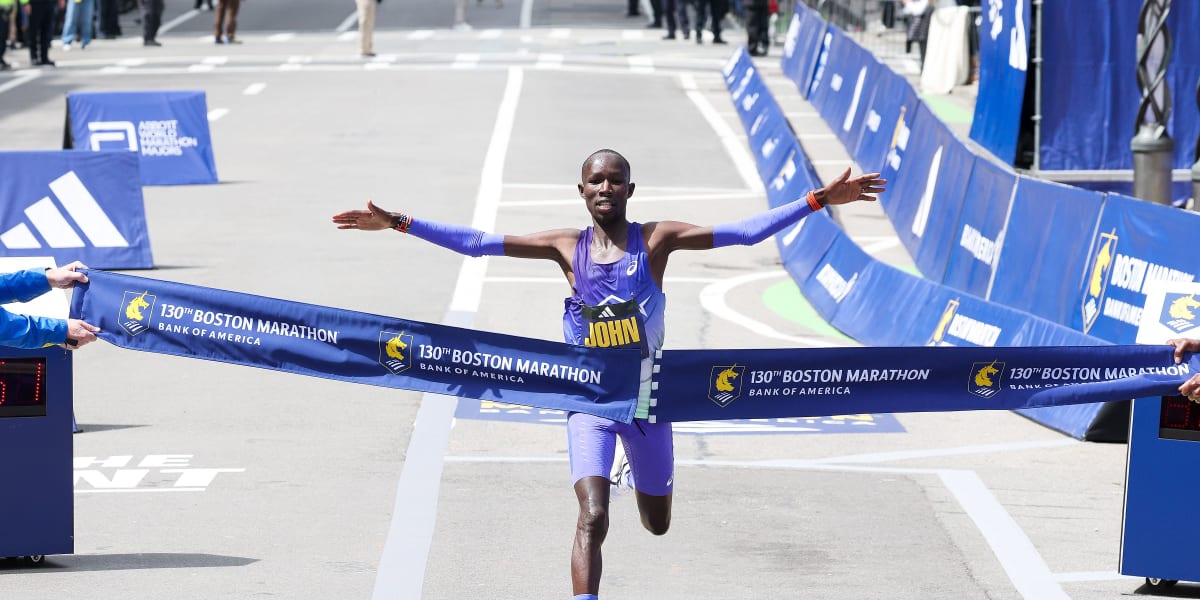
Beaming and cheered by an extraordinary atmosphere, John Korir crosses the line in 2:01:52, setting a new course record 15 years after Geoffrey Mutai’s mark. A spectacular performance that will inspire marathon fans everywhere, on a course that forgives nothing. He confirms his place among the world’s best marathoners right now.
Behind him, the battle is incredibly tight. Alphonce Simbu digs deep to take second in a sprint ahead of Benson Kipruto. This year’s podium is extraordinary, with every athlete finishing inside the old course record. On paper, Boston promised one of the deepest elite fields in race history… and it delivered. The race was spectacular from start to finish, with attacks throughout and a breathtaking finale for John Korir.
I knew I would be defending my title, but I didn’t expect to run that fast. For many years, I had the course record in mind (editor’s note: 2:03:02, set by Geoffrey Mutai in 2011), and I thank God for finally reaching it today.
Men’s Results
1. John Korir (Kenya) 2:01:52 (new course record)
2. Alphonce Simbu (Tanzania) 2:02:47
3. Benson Kipruto (Kenya) 2:02:50
4. Hailemariam Kiros (Ethiopia) 2:03:42
5. Zouhair Talbi (United States) 2:03:45
6. Tebello Ramakongoana (Lesotho) 2:04:18
7. Charles Hicks (United States) 2:04:35
8. Richard Ringer (Germany) 2:04:47
9. Alex Masai (Kenya) 2:05:32
10. Milkesa Mengesha (Ethiopia) 2:05:35
11. Clayton Young (United States) 2:05:41
12. Ryan Ford (United States) 2:05:46
13. Joe Klecker (United States) 2:05:56
14. Rory Linkletter (Canada) 2:06:04
15. Yemane Haileselassie (Eritrea) 2:06:06
16. Nicholas Kipkorir (Kenya) 2:06:07
Sharon Lokedi retains her crown in commanding fashion
Ten minutes after the men, the women’s field sets off. It is a deep, international lineup, with 18 nationalities represented. The opening miles are calmer than the men’s race. A compact group of around 20 runners forms quickly. Americans Dakotah Popehn and Kodi Kleven animate the early stages, but without creating a real split.
With halfway reached in 1:11:02, everything remains wide open. Then, gradually, the field begins to thin. Annie Frisbie takes a shot on her own. Behind her, the favorites bide their time. Among them is a quiet but well-positioned presence: Sharon Lokedi.
As in the men’s race, everything will be decided in the Newton Hills. Approaching Heartbreak Hill, the group shatters. Only a few contenders remain: Sharon Lokedi, Irine Cheptai and Loice Chemnung.
Then comes the key moment. Sharon Lokedi accelerates. A crisp, decisive attack. Irine Cheptai tries to follow… but cannot hold on. Lokedi steadily opens the gap, meter by meter, stride by stride. On the descent toward Boston, she is impressive. Powerful, relaxed and untouchable. This is her third time racing in Boston. She knows the course inside out. She also set the course record here last year in 2:17:22, after a memorable duel with her great rival Hellen Obiri. Obiri is absent today, having chosen to race London, and the pace is a little slower, which clearly plays into Lokedi’s hands.
She reaches Boylston Street smiling. A smile after a race of complete control. Sharon Lokedi wins in 2:18:51, completing a historic back-to-back. Behind her, Loice Chemnung takes second, while Mary Ngugi-Cooper completes an all-Kenyan podium.
American Jess McClain also deserves special mention for an outstanding performance, recording the best performance by an American woman in Boston history.
Women’s Results
1. Sharon Lokedi (Kenya) 2:18:51
2. Loice Chemnung (Kenya) 2:19:35
3. Mary Ngugi-Cooper (Kenya) 2:20:07
4. Mercy Chelangat (Kenya) 2:20:30
5. Jess McClain (United States) 2:20:49
6. Irine Cheptai (Kenya) 2:20:54
7. Workenesh Edesa (Ethiopia) 2:21:52
8. Annie Frisbie (United States) 2:22:00
9. Emily Sisson (United States) 2:22:39
10. Carrie Ellwood (United States) 2:22:53
11. Bedatu Hirpa (Ethiopia) 2:23:58
12. Dakotah Popehn (United States) 2:24:04
13. Elena Hayday (United States) 2:24:45
14. Kodi Kleven (United States) 2:24:48
15. Amanda Vestri (United States) 2:24:49
16. Isobel Batt-Doyle (Australia) 2:25:06
The Americans deliver on home soil
And then there are the Americans. Because in Boston, naturally, they are expected to deliver. This is their monument, their most prestigious marathon, their most historic appointment, the race to be at when you want to matter on the global stage. And this year, with one of the deepest fields in race history, they did not disappoint. Among the men, Zouhair Talbi finished fifth in 2:03:45, the fastest marathon ever run by an American, just ahead of Charles Hicks, seventh in 2:04:35 and also inside the previous American benchmark. At just 24 years old, in only his second career marathon… it is truly exceptional. And that is not all. The depth behind them is remarkable: Clayton Young in 2:05:41, Ryan Ford in 2:05:46 and Joe Klecker in 2:05:56. Five Americans under 2:06 in a marathon like Boston is unprecedented.
Among the women, Jess McClain was exceptional, finishing fifth in 2:20:49 as the top American of the day and setting a new U.S. benchmark in Boston, ahead of Annie Frisbie (2:22:00), Emily Sisson (2:22:39) and Carrie Ellwood (2:22:53), all inside the top 10. What Boston showed this year is that American marathon running is no longer carried by just a few headline names such as Conner Mantz and Clayton Young. There are now plenty of contenders, a deep pool of talent that grows stronger every year. With the 2028 Los Angeles Olympics approaching on home soil, this competition promises a fascinating battle for the three spots on the Olympic starting line. The U.S. team will be selected at a marathon organized by USA Track & Field, where the top three finishers will earn their tickets to the Games.
 © Boston Athletic Association
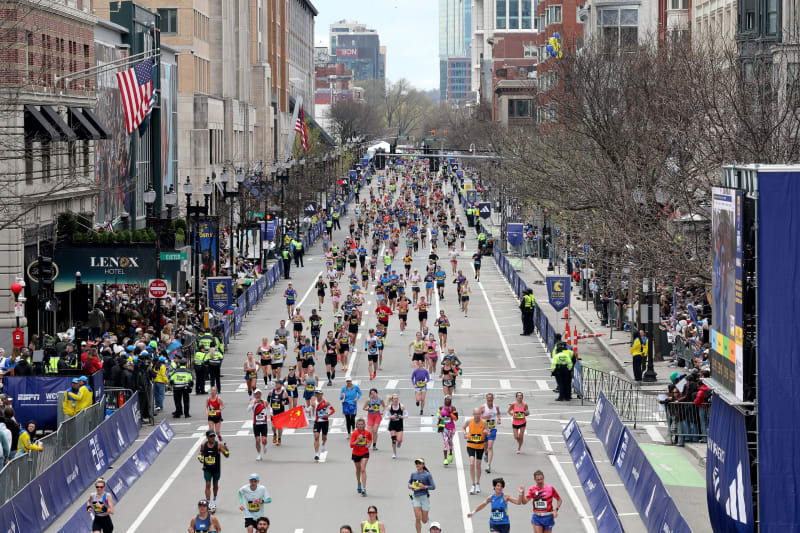
The 2026 Boston Marathon will go down as an exceptional edition. A men’s course record that confirms John Korir’s place among the greatest marathoners in history. A historic double, with both champions defending their titles. Impressive depth, with 13 men under 2:06 and 10 women under 2:23. But beyond the numbers, there is always the same thing. The emotion. Boston is a race you earn. A race you come to understand over time. A race you experience intensely, from the first mile in Hopkinton to the finish line on Boylston Street. Once again this year, it reminded us why it remains… the marathon of marathons.
✓ All the results from the 2026 Boston Marathon
Boston never disappoints. But some years stand out more than others. The 130th edition of the Boston Marathon delivered all the magic that unfolds between Hopkinton and Boylston Street. Everything was in place for a great race: clear skies, cool temperatures around 5°C, a light tailwind and a stacked field. As on every Patriots’ Day, thousands of spectators lined the course and witnessed the total dominance of John Korir and Sharon Lokedi. The two Kenyan athletes retained their titles in style, with Lokedi clocking 2:18:51 and Korir, most notably, 2:01:52. Korir smashed a 15-year-old course record. A stratospheric performance on one of the most demanding marathon courses around. Here is the story of a day that will go down in marathon history.
A spectacular men’s race, dominated by a magnificent John Korir
The race starts fast. Very fast indeed. Taking advantage of the downhill opening miles, several outsiders including Rory Linkletter, Zouhair Talbi and Hendrik Pfeiffer move to the front and set a hard tempo. Behind them, the favorites watch and wait. John Korir and Benson Kipruto stay safely tucked into a dense pack of around 20 runners. A classic Boston strategy. You don’t win the race in the first 15 kilometers.
The passage through Wellesley College and its legendary Scream Tunnel provides the first real thrill. The crowd roars, and the runners respond. American Clayton Young is even seen dropping back from the pack to high-five spectators. But the real race comes later.
Around halfway, things begin to heat up. Lemi Berhanu attacks. He is the first to reach halfway, in 1:01:43. But this time, John Korir responds immediately and refuses to let him go. At this stage, staying in contact with the lead pack is crucial. Milkesa Mengesha joins the action and makes a solo move of his own. For several kilometers, the race turns into a full-on game of cat and mouse, with attacks coming from all directions. That’s the Boston Marathon.
Then comes Newton. And in Newton, the natural selection begins. The hills come one after another, and the runners slow. As Heartbreak Hill approaches, John Korir decides it is time. A sharp, controlled, almost cold acceleration. He catches Milkesa Mengesha, drops him… and never looks back.
Behind him, Alphonce Simbu and Benson Kipruto try to limit the damage. But the gap keeps growing. Thirty seconds, then more. Up front, Korir is flying. Literally. His stride is smooth, his expression closed and focused. He descends toward Boston with remarkable ease. He looks back several times, knowing that both chasers have a strong finish. But today, he is simply too good. At last, he reaches Boylston Street, alone out front.
Beaming and cheered by an extraordinary atmosphere, John Korir crosses the line in 2:01:52, setting a new course record 15 years after Geoffrey Mutai’s mark. A spectacular performance that will inspire marathon fans everywhere, on a course that forgives nothing. He confirms his place among the world’s best marathoners right now.
Behind him, the battle is incredibly tight. Alphonce Simbu digs deep to take second in a sprint ahead of Benson Kipruto. This year’s podium is extraordinary, with every athlete finishing inside the old course record. On paper, Boston promised one of the deepest elite fields in race history… and it delivered. The race was spectacular from start to finish, with attacks throughout and a breathtaking finale for John Korir.
I knew I would be defending my title, but I didn’t expect to run that fast. For many years, I had the course record in mind (editor’s note: 2:03:02, set by Geoffrey Mutai in 2011), and I thank God for finally reaching it today.
Men’s Results
1. John Korir (Kenya) 2:01:52 (new course record)
2. Alphonce Simbu (Tanzania) 2:02:47
3. Benson Kipruto (Kenya) 2:02:50
4. Hailemariam Kiros (Ethiopia) 2:03:42
5. Zouhair Talbi (United States) 2:03:45
6. Tebello Ramakongoana (Lesotho) 2:04:18
7. Charles Hicks (United States) 2:04:35
8. Richard Ringer (Germany) 2:04:47
9. Alex Masai (Kenya) 2:05:32
10. Milkesa Mengesha (Ethiopia) 2:05:35
11. Clayton Young (United States) 2:05:41
12. Ryan Ford (United States) 2:05:46
13. Joe Klecker (United States) 2:05:56
14. Rory Linkletter (Canada) 2:06:04
15. Yemane Haileselassie (Eritrea) 2:06:06
16. Nicholas Kipkorir (Kenya) 2:06:07
Sharon Lokedi retains her crown in commanding fashion
Ten minutes after the men, the women’s field sets off. It is a deep, international lineup, with 18 nationalities represented. The opening miles are calmer than the men’s race. A compact group of around 20 runners forms quickly. Americans Dakotah Popehn and Kodi Kleven animate the early stages, but without creating a real split.
With halfway reached in 1:11:02, everything remains wide open. Then, gradually, the field begins to thin. Annie Frisbie takes a shot on her own. Behind her, the favorites bide their time. Among them is a quiet but well-positioned presence: Sharon Lokedi.
As in the men’s race, everything will be decided in the Newton Hills. Approaching Heartbreak Hill, the group shatters. Only a few contenders remain: Sharon Lokedi, Irine Cheptai and Loice Chemnung.
Then comes the key moment. Sharon Lokedi accelerates. A crisp, decisive attack. Irine Cheptai tries to follow… but cannot hold on. Lokedi steadily opens the gap, meter by meter, stride by stride. On the descent toward Boston, she is impressive. Powerful, relaxed and untouchable. This is her third time racing in Boston. She knows the course inside out. She also set the course record here last year in 2:17:22, after a memorable duel with her great rival Hellen Obiri. Obiri is absent today, having chosen to race London, and the pace is a little slower, which clearly plays into Lokedi’s hands.
She reaches Boylston Street smiling. A smile after a race of complete control. Sharon Lokedi wins in 2:18:51, completing a historic back-to-back. Behind her, Loice Chemnung takes second, while Mary Ngugi-Cooper completes an all-Kenyan podium.
American Jess McClain also deserves special mention for an outstanding performance, recording the best performance by an American woman in Boston history.
Women’s Results
1. Sharon Lokedi (Kenya) 2:18:51
2. Loice Chemnung (Kenya) 2:19:35
3. Mary Ngugi-Cooper (Kenya) 2:20:07
4. Mercy Chelangat (Kenya) 2:20:30
5. Jess McClain (United States) 2:20:49
6. Irine Cheptai (Kenya) 2:20:54
7. Workenesh Edesa (Ethiopia) 2:21:52
8. Annie Frisbie (United States) 2:22:00
9. Emily Sisson (United States) 2:22:39
10. Carrie Ellwood (United States) 2:22:53
11. Bedatu Hirpa (Ethiopia) 2:23:58
12. Dakotah Popehn (United States) 2:24:04
13. Elena Hayday (United States) 2:24:45
14. Kodi Kleven (United States) 2:24:48
15. Amanda Vestri (United States) 2:24:49
16. Isobel Batt-Doyle (Australia) 2:25:06
The Americans deliver on home soil
And then there are the Americans. Because in Boston, naturally, they are expected to deliver. This is their monument, their most prestigious marathon, their most historic appointment, the race to be at when you want to matter on the global stage. And this year, with one of the deepest fields in race history, they did not disappoint. Among the men, Zouhair Talbi finished fifth in 2:03:45, the fastest marathon ever run by an American, just ahead of Charles Hicks, seventh in 2:04:35 and also inside the previous American benchmark. At just 24 years old, in only his second career marathon… it is truly exceptional. And that is not all. The depth behind them is remarkable: Clayton Young in 2:05:41, Ryan Ford in 2:05:46 and Joe Klecker in 2:05:56. Five Americans under 2:06 in a marathon like Boston is unprecedented.
Among the women, Jess McClain was exceptional, finishing fifth in 2:20:49 as the top American of the day and setting a new U.S. benchmark in Boston, ahead of Annie Frisbie (2:22:00), Emily Sisson (2:22:39) and Carrie Ellwood (2:22:53), all inside the top 10. What Boston showed this year is that American marathon running is no longer carried by just a few headline names such as Conner Mantz and Clayton Young. There are now plenty of contenders, a deep pool of talent that grows stronger every year. With the 2028 Los Angeles Olympics approaching on home soil, this competition promises a fascinating battle for the three spots on the Olympic starting line. The U.S. team will be selected at a marathon organized by USA Track & Field, where the top three finishers will earn their tickets to the Games.
© Boston Athletic AssociationThe 2026 Boston Marathon will go down as an exceptional edition. A men’s course record that confirms John Korir’s place among the greatest marathoners in history. A historic double, with both champions defending their titles. Impressive depth, with 13 men under 2:06 and 10 women under 2:23. But beyond the numbers, there is always the same thing. The emotion. Boston is a race you earn. A race you come to understand over time. A race you experience intensely, from the first mile in Hopkinton to the finish line on Boylston Street. Once again this year, it reminded us why it remains… the marathon of marathons.