
In recent running history, a handful of races have been made even tougher by extreme weather. An unusual, non-exhaustive podium featuring two marathons.
Table of contents
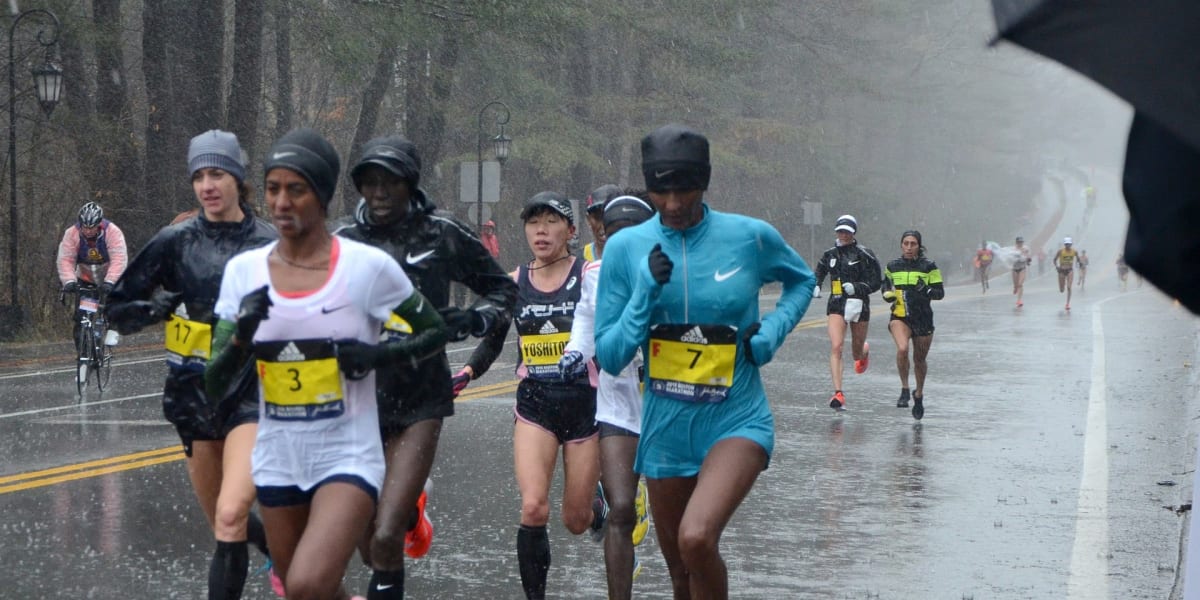
2018 Boston Marathon
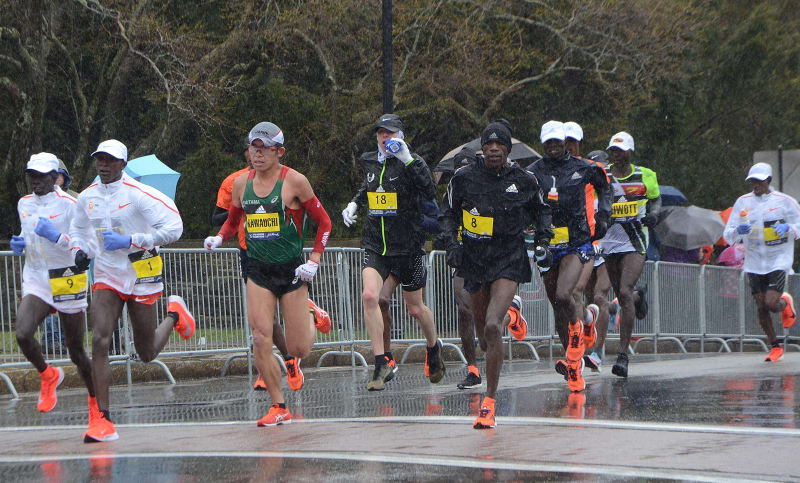
The Boston Marathon is the world's oldest annual marathon. First run in 1897, one year after the Athens Marathon, it is part of the famous World Marathon Majors, alongside the marathons of Berlin, Chicago, London, New York and Tokyo. Every year, tens of thousands of runners line up at the start. There were somewhat fewer in 2018... That year, torrential rain battered the Massachusetts city, accompanied by violent winds. The race took place on April 16, but temperatures barely rose above freezing. In those conditions, many runners, including professionals, decided not to start. One man appeared unfazed by the weather: Japanese runner Yuki Kawauchi, an amateur. Not quite an amateur in the usual sense, though: he was known to have run more than 100 marathons under 2:20. A true professional amateur, working as a civil servant during the week and racing in his spare time...
That day, braving the rain and cold, he eventually beat the pre-race favourite, Kenyan Geoffrey Kirui. Kirui led the field until the 40-kilometre mark before watching the Japanese runner surge away to victory in 2:15:54. An amateur had beaten the reigning world champion, who had won the race the previous year. Incredible... In the women's race, American Desiree Linden took down all the favourites, posting Boston's slowest winning time in 40 years, 2:39:54. Several leading women also dropped out in the opening kilometres as the appalling conditions took their toll...
 © GR 5555 / under Creative Commons
2010 Ultra-Trail du Mont-Blanc
Founded in 2003, the UTMB became one of the world's most iconic trail races in just two decades. Three countries, 166 kilometres and 9,500 metres of elevation gain... The difficulty is what gives the race its prestige. But in 2010, the organisers needed extraordinary resolve to stop the race after it had started. Here's what happened on Friday, August 27, 2010. That day, severe snowstorms swept across Mont Blanc. The race still got underway in the late afternoon, after hours of uncertainty and waiting for the 2,300 runners entered that year. All those men and women had spent months preparing for this unique event... But as the bad weather intensified, the race was stopped at 9:15 p.m., just under three hours after the start and immediately before the runners reached the Col du Bonhomme, a technical section of the course in the Vosges massif. ”The weather report forecast heavy, intense rain that was not expected to ease before late morning » race director Catherine Poletti explained, dismayed but guided by her responsibility.
She added, « over 6 kilometres, the course markers were ripped out in an especially hazardous mountain section« . The risk of runners getting lost or falling was simply too great. Once every runner had been brought back, a new start was given at 10:15 a.m. in Courmayeur on Saturday morning for the 1,253 runners still present, with a modified course avoiding the danger zone. Their organisational marathon had been brought to an abrupt halt by the weather... But in light of the recent events that have affected trail running, the organisers can only be praised for their courage that day.
1994 New York City Marathon
November 6, 1994. Once again, the weather and the marathon were a bad combination. Strong winds and low temperatures hit New York, which was preparing to host its biggest annual event: the 25th edition of the New York City Marathon. The American crowds braved the rain and gusts to be there. Horrible weather? It did not matter. The marathon is sacred. The streets of the Big Apple were packed and about to witness an extraordinary finish. After missing a turn a few kilometres from the finish in Central Park, Mexican number 10 German Silva eventually won the 1994 edition in 2:11:21, two seconds ahead of compatriot Benjamin Paredes after passing him in the closing metres (see the video below). Silva would win the following edition too, improving his time by 21 seconds, and the legend of “Wrong Way Silva” was born. In the women's race, Kenyan Tegla Loroupe finished first, becoming the first African athlete to win the New York City Marathon She would win the following edition as well... In 2016, Tegla Loroupe founded the Athlete Refugee Team (ART), made up of athletes who have suffered through violent and unjust conflicts.
Her finest victory over the wind.
More articles
From Pavement to the Big Screen: Running Takes the Spotlight
Running has made its mark on the big screen. Marathons.com picks ten of the greatest films about the sport, entirely subjectively.
Wed, September 9, 2026

Abdi Nageeye and Sheila Chepkirui win the 2024 New York City Marathon
More than 55,000 runners lined up for the 2024 TCS New York City Marathon, won by Abdi Nageeye and Sheila Chepkirui.
Wed, September 9, 2026
Jimmy Gressier joins Kiprun in ambitious partnership shaking up the running world
Jimmy Gressier joins Kiprun in a major partnership with international ambitions for the French running brand.
Wed, September 9, 2026