
Tokyo World Championships: Tigst Assefa takes on the rest of the women’s marathon field

A world record holder, Olympic champions and outsiders ready to spring a surprise... The women’s marathon at the Tokyo World Championships has all the ingredients of a classic. Tigst Assefa leads the rankings, but the depth behind her promises a gripping race. Could Manon Trapp be the one to benefit?
No women’s championship marathon had ever brought together so many athletes under 2:20. Tigst Assefa’s arrival, along with her astonishing records, has reshaped the entire picture. But championship racing is different: times matter less than pacing, energy management and experience. Tokyo, with its potentially oppressive September conditions, could deliver an unexpected script on 14 September from 12:30 a.m. French time.
Tigst Assefa, the undisputed queen
In 2:11:53 in Berlin in 2023, Tigst Assefa smashed the world record. Five years ago, that time would have seemed simply impossible. At 28, the Ethiopian embodies a new era in women’s marathon running, one in which the pace men were running a decade ago has become a women’s benchmark. Assefa has the unique ability to run at 3:07 per kilometre... and repeat it for 42 km. Her secret? A rapid transition from middle-distance running, with a 1:59 800 m best, to the marathon, exceptional pain tolerance and remarkable running economy. But recent history is a reminder that even queens can stumble. She dropped out of Boston in 2024, proof that her formula is not infallible. Tokyo will be a test, then: total dominance or her first major championship defeat?
The Ethiopian armada: strength in depth
Sutume Asefa Kebede, the dangerous teammate
With a best of 2:15:55, Sutume Asefa Kebede arrives as one of the few athletes capable of staying with Assefa if the pace turns brutal. She has won several major international marathons, including Dubai and Seoul, and knows exactly how to run in a pack. Her goal? Use the attention focused on Tigst to launch a surprise attack.
Tigist Ketema, the next generation
In January 2024 in Dubai, Tigist Ketema made headlines with a time of 2:16:07 in her first major marathon. At just 25, she represents the next wave of Ethiopian talent. Less experienced but full of ambition, she could be the surprise addition to the podium if the race turns hard.
➜ With Assefa, Kebede and Ketema, Ethiopia fields a trio capable of controlling the race and setting an unforgiving pace.
Kenya: championship experience
Peres Jepchirchir, the big-meet specialist
When championships come into the conversation, it is impossible to overlook Peres Jepchirchir. Olympic champion in Tokyo in 2021 and a two-time world half-marathon champion, the Kenyan has what the others lack: peerless tactical awareness. Her 2:16:16 best places her high in the rankings, but more importantly, she knows how to win when the field is stacked.
She has already shown in Boston and New York that she can win in difficult conditions. Tokyo 2025 could give her the chance to deny Assefa a title that many already regard as hers.
Magdalyne Masai, the model of consistency
With a PB of 2:18:58, Magdalyne Masai is not a record-breaker, but her consistency is formidable. Her ability to run around 2:19 whatever the circumstances could carry her to a world championship podium, particularly if the heat or an overly fast start cracks the favourites.
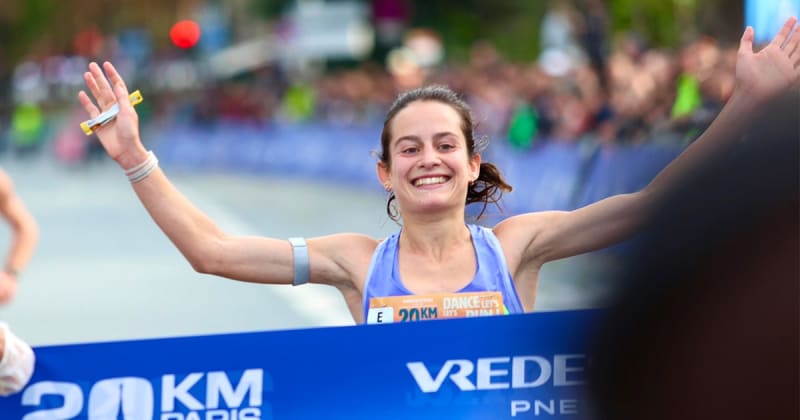 © The only French woman in the marathon field, Manon Trapp hopes to be smiling as she crosses the finish line. © STADION-ACTU
The outsiders to watch
Lonah Chemtai Salpeter, the experienced contender
European champion in 2022, Lonah Chemtai Salpeter of Israel already has an impressive résumé: a bronze medal at the 2022 World Championships in Eugene and several wins on the international circuit. Her 2:17:45 PB proves she has the speed. But it is her mental toughness that stands out most. Capable of battling on her own for kilometres, she could surprise if the race blows apart early.
Stella Chesang, Uganda’s rising star
A former 10,000 m specialist, Stella Chesang has made the switch successfully. With a time of 2:18:26, she has already broken into the world’s top 20. At just 28, she represents a rising generation in Uganda. Less experienced than the leading contenders but blessed with considerable staying power, she could hang on to the front group all the way to the finish.
Susanna Sullivan, the American lurking in the wings
With a 2:21:56 PB, Susanna Sullivan does not have the tools to challenge for the win. But she could target a top-10 finish, which would already be a major result for an American. In a championship race, she can take advantage of a broken rhythm and pick off places.
Manon Trapp... why not?
Ranked 15th in the world at the start, with a 2:23:38 clocking in Seville in 2024, Manon Trapp is the only French athlete entered in the classic distance after French record holder Mekdes Woldu withdrew in mid-August. She has plenty to offer despite a field far too strong to make victory a realistic target. The Savoyard will also have revenge on her mind after missing out on selection for last year’s Paris Olympics. A top 10 at the finish? Perhaps even better, we hope.
That is Assefa’s world record. For comparison, the championship record is 2:18:11, set by Gebreslase in Eugene in 2022. In other words, if the race is fast, Assefa could blow the historical benchmarks apart.
The weight of history
The women’s marathon at the World Championships is more open than the men’s race. East Africa dominates, but European and Asian athletes have occasionally forced their way into the conversation. In Doha in 2019, Kenya’s Ruth Chepngetich triumphed in suffocating heat. In Eugene in 2022, Ethiopia’s Gotytom Gebreslase won in 2:18:11.
Tokyo 2025 could crown Assefa, but it could also offer another reminder that championships always produce surprises: managing the aid stations, adapting to the conditions and handling repeated attacks.
Possible race scenarios
Assefa runs away with it: The Ethiopian sets a pace close to 2:14–2:15, and nobody can stay with her.
A tactical race: Jepchirchir bides her time while everyone watches Assefa. The pack stays together until 35 km, before a final sprint.
The pack explodes: Tokyo’s heat punishes the fast starters. Outsiders such as Salpeter or Chesang take advantage and snatch a medal.
The women’s marathon at the 2025 World Championships looks like the race of the year. Tigst Assefa starts as the favourite, but the depth behind her is extraordinary. Jepchirchir brings experience, Kebede and Ketema represent the next generation, while Salpeter and Chesang embody the outsiders’ boldness. Tokyo could crown an undisputed queen... or deliver one of those surprises that only marathon history can produce.