
Marathon Running After 60: Less Volume, More Know-How

Running a marathon after 60 is no longer unusual. More and more runners are reaching this symbolic milestone while still eager to take on the 42.195 km. Age brings its share of challenges, including slower recovery, a changing metabolism and less explosive muscles. But it also brings an invaluable asset: experience. So how should training, nutrition and recovery evolve to keep performing and, above all, enjoying the process?
Training: finding the right rhythm
After 60, balance is everything. The mistake would be to assume you need to back off completely and stick to easy runs. The marathon still demands a solid foundation: regular long runs, race-pace work and some intensity to keep the engine firing. The difference is that recovery between sessions becomes the key factor. Where a 30-year-old runner might string together three hard sessions in a week, a runner in their sixties needs to prioritise quality over quantity.
Mariko Yugeta, the first woman in her sixties to break three hours for the marathon, is a perfect example. Now over 60, the Japanese runner can still cover the distance in 2:52. “Age shouldn't be an excuse; it simply demands smarter preparation ”, she told the Guardian. Her approach is built on carefully judged runs, measured intensity and plenty of consistency rather than maximum mileage.
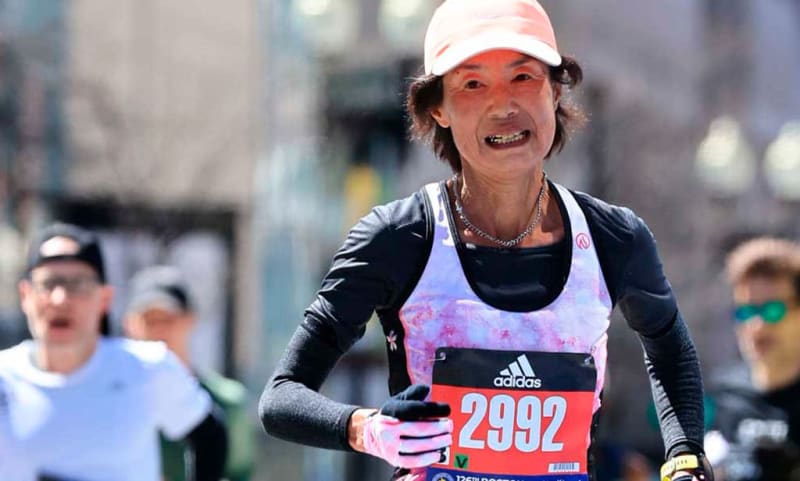 © On her long runs, Mariko shows that discipline and enjoyment can go hand in hand after 60. © Abbott World Marathon Majors
Intervals still have their place, but in an adapted format: 200- or 400-metre repeats to maintain speed, or 1,000- to 2,000-metre blocks at marathon pace to lock in rhythm, rather than overly long and demanding sessions. Hills are valuable allies too, building strength without placing excessive stress on the joints. The idea is simple: keep improving without wearing the body down unnecessarily.
Strength training becomes essential
Muscle loss accelerates with age, and running alone is no longer enough to maintain the strength needed to withstand a marathon. Strength work is an insurance policy: core exercises to stabilise the stride, work for the quads, hamstrings and glutes to help prevent injury, and proprioception exercises to maintain good coordination.
Jeannie Rice, 77 and the holder of several age-group records, shows how a well-rounded training approach can extend a running career. She also spoke to the Guardian : “I want to show that age doesn't have to be a barrier. ” Thirty minutes twice a week is enough to improve running form, protect the joints and remain competitive.
The over-60 marathoner's plate
Metabolism changes with age, and protein needs increase to preserve muscle mass. Carbohydrates remain essential, but complex sources such as wholewheat pasta, basmati rice and sweet potatoes are the better choice for steady energy and fewer digestive swings. Experience helps runners anticipate what their stomach can and cannot tolerate, a crucial advantage after 60. An ideal plate consists of 50% complex carbohydrates (wholewheat pasta, rice, quinoa), 25% lean protein (fish, chicken, eggs or plant-based alternatives) and 25% vegetables for vitamins, minerals and fibre. These proportions help maintain a steady energy supply, which is essential over the marathon distance.
Hydration: the blind spot to watch
The sensation of thirst diminishes with age. Yet dehydration remains a serious trap during a marathon. Drinking at regular intervals, even when you do not feel thirsty, becomes essential. Alternating water with an energy drink helps maintain electrolyte balance and avoid cramps or a sudden loss of energy. “Eliud Kipchoge drinks Maurten (energy drinks and gels), so I used it in Osaka for the first time, Mariko Yugeta told our colleagues at Runners World. When you are aiming for a world record, you have to study what the best athletes do and look for ways to apply it to your own race. ”
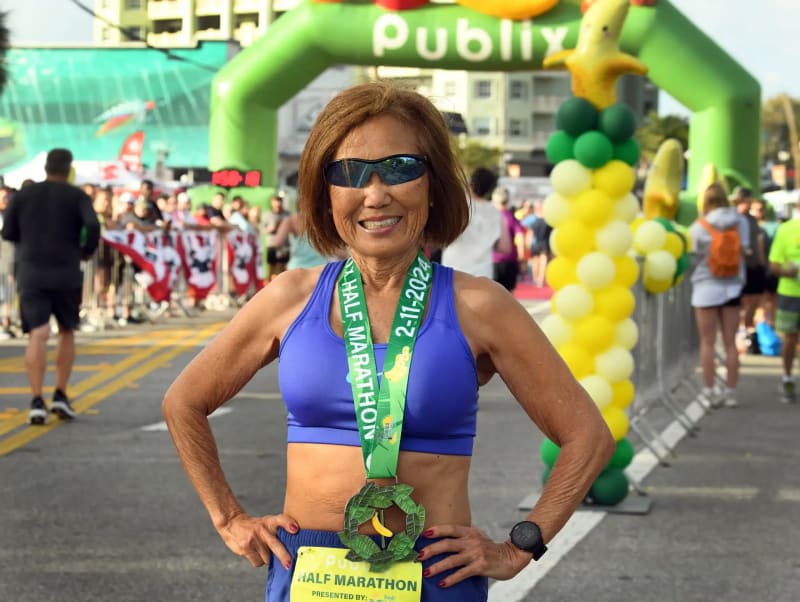 © Jeannie Rice tackles every kilometre with determination: 77 years old and still setting records. © TIM SHORTT/ FLORIDA TODAY / USA TODAY NETWORK
Recovery, the cornerstone
At 60 and beyond, recovery should no longer be viewed as optional, but as a central part of performance. Quality sleep, naps after hard sessions, self-massage, active walking and yoga are all tools that can help prevent injury and speed regeneration. Jeannie Rice highlighted its importance to the Washington Post : “I'm just a normal, ordinary person. I don't do anything special, I'm just lucky and blessed. ” Listening to your body becomes a strategic skill: every sign of fatigue or pain deserves attention.
And this is not only a women's story. Several male runners have also made their mark on the record books after 60, thanks to their ability to recover effectively between sessions, a crucial factor in extending a career and avoiding injury later in life. Irishman Tommy Hughes ran a marathon in 2:30:02 after turning 60, setting a world record in his age group. Derek Turnbull of New Zealand completed the London Marathon in 2:41:57 after turning 65, adding several other elite-level performances in his age group. As for Ed Whitlock of Canada, he became the first man over 70 to break three hours for the marathon, running 2:59:10. He had already run 2:52:47 at the age of 69.
The mind, a secret weapon
Experience becomes the greatest asset. Runners in their sixties know how to manage the tough patches, put lost seconds into perspective and turn effort into enjoyment. Mental strength more than makes up for the seconds lost physiologically, transforming the race into a celebration rather than a battle against the clock. The marathon is as much a test of the mind as of the legs. Here, experience plays a decisive role. Runners in their sixties are no longer caught out by the excitement of the start, know how to manage the tough patches and do not obsess over lost seconds. Motivation is no longer dictated solely by the finish time, but also by the pleasure of sharing a challenge and proving that, even after 60, you can still complete a marathon with a smile.
Running a marathon after 60 is not an isolated feat. It is the result of intelligent preparation, tailored nutrition, prioritised recovery and a mindset sharpened by years of practice. Every kilometre becomes a victory, every finish a celebration. And at the finish line, the message is clear: age does not set the limits; it simply changes the way you move beyond them.