
Percent or degrees: the truth about gradients in running

Running on hilly terrain, as you do in trail races, means tackling climbs and descents. On the road, the gradients are usually gentler, but they still have a major impact on effort and finishing time. How is a gradient measured? What is the difference between a percentage and degrees? Marathons.com explains it all.
Everyone knows the road signs showing the percentage gradient of a dangerous descent or a mountain pass climb. Cyclists pay particularly close attention to this information, especially uphill, because the gradient is a reliable measure of difficulty. In running, whether it’s a marathon, half marathon or 10K, gradients are seen as the sworn enemy of fast times, even when they are modest. In trail running, this factor is just as crucial: it slows your progress, determines when you switch from running to hiking and influences whether you use poles. More and more GPS watches now provide this information, helping runners manage their effort more effectively. Despite the importance of gradients, many people still don’t know how they are calculated and, above all, confuse percentages with degrees.
How do you calculate the percentage gradient between two points?
You need two pieces of information:
➜ The horizontal distance between points A and B
➜ The difference in elevation between points A and B
Road signs express gradients as percentages. The formula is:
Gradient percentage = (difference in elevation between A and B / total distance between A and B) x 100
For example, the Grand Serre vertical kilometer in Isère is considered one of the steepest VKs in the world, gaining 1,000 m over 1.8 km. The gradient percentage is calculated as follows:
(1000 / 1800) x 100 = 55.5
The average gradient of the Grand Serre VK is therefore 55.5%, meaning that for every 100 horizontal metres covered, you gain 55.5 metres of elevation. In other words, every metre takes you 55.5 centimetres uphill. That’s an exceptionally steep gradient!
How is that different from expressing a gradient in degrees?
Although percentage is the most common way to describe a gradient, you will sometimes see degrees used instead. The two are very different. If maths isn’t your thing, stay with us: we’re about to revisit a few trigonometry concepts that may take you back to high school.
Gradient in degrees = tangent of the elevation angle expressed in degrees x 100
A quick diagram helps make the formula easier to understand.
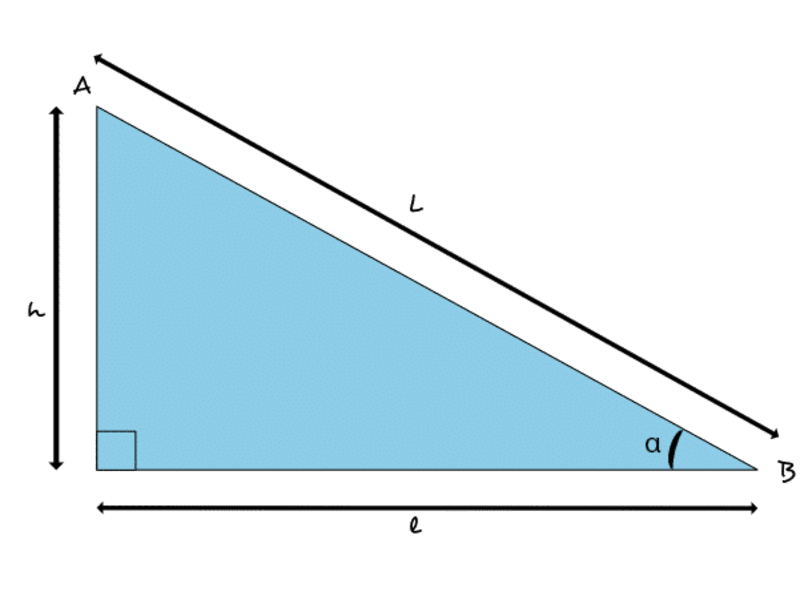
Point B is the bottom of the climb, for example the start of the Grand Serre VK. Point A is the top of the ascent, in other words the VK finish at the summit.
The value L represents the distance you have to cover between the start and finish of the race, or 1.8 km. The value h is the elevation gain between points B and A, in this case 1,000 m.
The value ⍺ represents the angle formed by the gradient relative to a horizontal plane. To calculate it, you first need to determine the value l, the horizontal distance between B and A.
If you know the gradient percentage, you can determine its angle in radians using the arctangent function. Yes, it gets a little complicated:
Gradient in degrees = arctan (elevation gain / horizontal distance)
Lost you? Don’t worry, you didn’t need to study " advanced maths" to understand the essentials.
➜ A gradient can be expressed as a percentage or in degrees.
➜ A 55% gradient is not the same as a 55-degree gradient. Remember your geometry lessons: a 90-degree angle is a right angle, so a 90-degree gradient is a vertical line. To climb it, you’ll need to swap your trail shoes for a harness and rope!
➜ Online converters can convert a gradient expressed as a percentage into degrees.
➜ Degrees are not commonly used to express a gradient, but if you come across them or are talking about a climb, don’t confuse percentages with degrees. The simplest option? Talk about climbs and descents only in percentages. You’ll avoid mistakes and everyone will understand you!