
Running and Sleep: In Morpheus’ Arms
 © STADION-ACTU
A familiar question keeps coming up: do marathoners, and regular runners more broadly, sleep better than sedentary people? The relationship between running and sleep is complex, bringing clear benefits as well as paradoxical effects. Moderate physical activity promotes deep, restorative sleep, while overtraining and pre-race stress can disrupt the night. We explore the subject with input from Marie Bouchard, an elite athlete and resident in Physical Medicine and Rehabilitation.
Running and deep sleep: a winning combination?
Deep sleep is the most restorative phase of the sleep cycle, essential for muscle recovery and memory consolidation. Numerous studies suggest that aerobic exercise, including running, increases the amount of time spent in this phase. A 2017 study by Alexandra Kredlow, now a researcher at Harvard, found that regular physical activity improves sleep quality, notably by increasing time spent in deep slow-wave sleep. The reverse is also true: good sleep makes the body stronger. Another study, conducted in 2020 by B.A. Dolezal, found that moderate runners, training for 30 to 45 minutes three to four times a week, had better sleep architecture than sedentary people, with fewer nighttime awakenings. At first glance, the research suggests that the relationship between exercise and sleep works both ways.
As for the effect of a single bout of physical activity on sleep, the findings from the American authors’ analysis are modest and scientifically variable in reliability. The good news is that, contrary to what was long believed, exercising in the hours before bedtime is no longer discouraged. Late sessions were thought to impair sleep, particularly by increasing the time it takes to fall asleep, but recent research does not confirm these disruptions, at least in good sleepers. The simple advice is to keep evening sessions lighter.
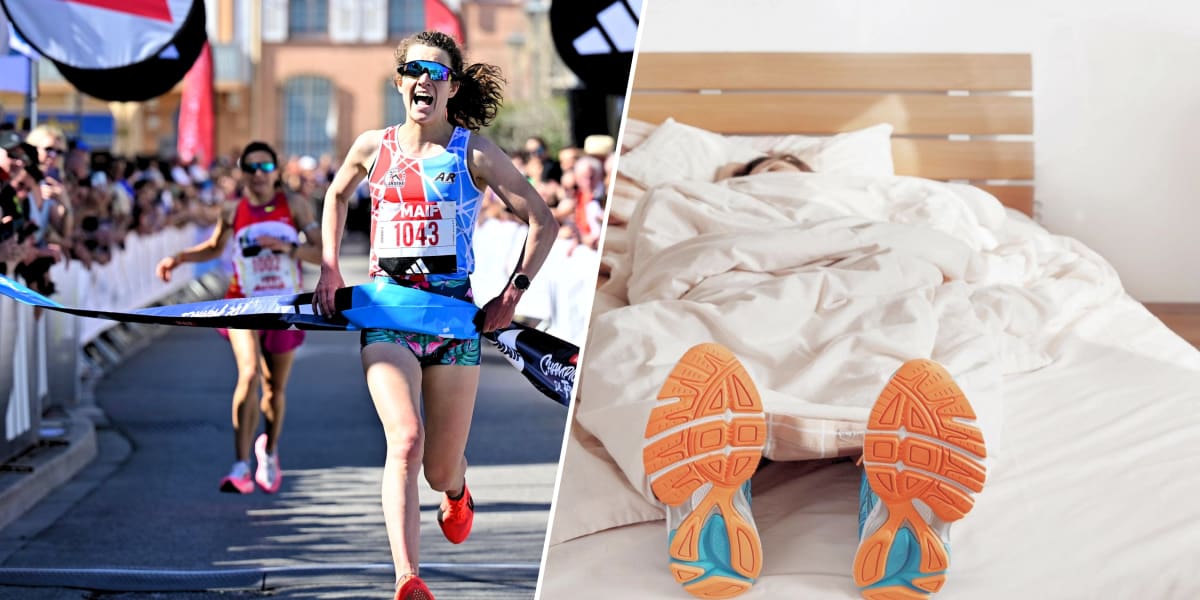
Marie Bouchard (pictured), an athlete and resident in Physical Medicine and Rehabilitation, shares her overall view: “I’m lucky not to have any sleep problems. I don’t think the advice should be different for the general population and for runners. That said, I’m sure sport helps you sleep well: exercise means greater energy expenditure, so the body naturally wants and needs to rest afterward in order to recover properly. A balanced diet also affects sleep, for example, having a slightly lighter lunch helps reduce the post-lunch slump that follows a heavy meal. Drinking plenty during the day and less in the evening helps prevent waking up to drink or go to the bathroom.“
 © STADION-ACTU
The role of the parasympathetic nervous system
The parasympathetic nervous system plays a key role in recovery and physiological balance, particularly after moderate exercise. It helps the body return to a state of calm by slowing the heart rate, stimulating digestion and lowering blood pressure, making it easier to fall asleep and improving sleep quality. This branch of the autonomic nervous system, associated with rest and digestion, is activated mainly through the vagus nerve, whose influence extends from the heart to the digestive and immune systems. Studies show that intense exercise, such as a marathon or an interval session, prolongs sympathetic arousal, with elevated adrenaline and cortisol levels delaying the transition to a relaxed state. Hence the advice to keep evening sessions light! To optimise recovery, avoid training too late, moderate your training load before a competition and adopt good sleep habits: a regular bedtime, post-exercise nutrition focused on protein and complex carbohydrates, and careful hydration in the evening. Short naps are also a valuable tool for athletes, supporting nervous-system recovery without eating into nighttime sleep thanks to their brief, targeted format. By incorporating these practices, runners can maximise the benefits of the parasympathetic system, which is essential for performance and the body’s regeneration.
What about physical activity when sleep problems are involved? When it comes to insomnia, whose severe forms affect more than 10% of the population, the research is ultimately less extensive than you might expect. In July 2024, a Japanese study was carried out on nearly 600 people. “Our results suggest that the effects of physical exercise on sleep are greater in people with insomnia than in other populations,” the authors concluded, arguing that this non-drug intervention should be included in good-practice recommendations for insomnia.
Bear in mind that during sleep, we process and store the information that reached us throughout the day. Your brain regenerates just like the rest of your body, but it does not stop working. Among other things, it continues the process of memory consolidation.
Marathons and sleep: the paradoxical effect
Many runners report restorative sleep after their weekly long run. Yet sleepless nights are common in the build-up to a marathon. While a casual runner may enjoy the benefits of exercise and sleep like a log, sport can sometimes have the opposite effect on a marathoner’s sleep. Between stress and excitement, runners’ sleep can suffer before a race. A 2019 study found that 70% of endurance athletes experience sleep problems before a competition, driven by cortisol and anxiety. Marie Bouchard agrees, though she puts her own spin on it: “There’s no doubt that the nights before races are often the worst because of the excitement around the event, but with my busy weeks I don’t have that ‘problem’ anymore. On the contrary, I think I use competition weekends to catch up on rest! Training around night shifts probably plays a part: you go over the patients you’ve seen, you stay on alert, and sleep isn’t very good… so yes, managing stress is one of the key factors in sleep“. And watch out for excessive training too, which can lead to chronic fatigue... and insomnia.
The most important thing when assessing your needs, and especially your sleep, is to know yourself well. By listening to your body and understanding how it works, you can more easily spot the signs of sleep deprivation. For example, if you lack the drive to train, lose explosiveness, become more irritable or even depressed, a lack of sleep may be partly responsible. Marie Bouchard, whose residency makes her nights even more complicated, offers a few more tips: “After a night shift, often a 25-hour day with no more than two or three hours of sleep, I sleep as soon as possible and avoid scrolling on my phone. I’ll often sleep from 11 a.m. to 4 or 5 p.m., then go out for an easy aerobic run, and have no trouble sleeping through a full night afterward. I ALWAYS sleep with earplugs, even when it’s quiet; they put me in my own bubble. Ideally, the bedroom should also be fairly cool and, if possible, completely dark.”.
The devil may wear Prada, but he’s mostly hiding in the details.
And shhhhhh... listen to your body.