
The Myth of the Post-Marathon Beer
 © ASO
© ASOYou look forward to it. Then you savour every drop. Like the ultimate reward, an invaluable dose of comfort. The beer shared at the finish of a marathon quenches your thirst and delivers immense pleasure. Some even say it helps recovery. But is that belief justified? Or is that little post-race pint more of a false friend best treated with caution?
“Already on the lips, this foamy gold, its freshness amplified by the head, then slowly across the palate, happiness softened by bitterness. (…) Immediate wellbeing punctuated by a sigh, a click of the tongue, or a silence just as eloquent. The deceptive sensation of a pleasure opening out forever.” Philippe Delerm captures it perfectly: that first sip of beer you sometimes dream about mid-race, and crave desperately the moment you cross the finish line. Beer has a magical quality for distance runners: it represents the end of the effort and the post-race reward, comfort and freedom from guilt all at once. Who feels guilty about sipping a cold one after running more than 40 kilometres flat out? Beer is a common thread across many sports, the traditional partner of the post-match drink and post-race get-togethers with friends. The legend even has it that this hop-based beverage helps recovery… But are beer and sport really compatible?
A recovery drink… really?
To understand what we are talking about, we need to go back to how beer is made, long before its spectacular arrival in your glass. Beer requires several ingredients: water, malt made from cereal grains, usually barley, wheat or rye, hops and yeast for alcoholic fermentation. We will skip over the optional additives used by some producers, which have little to do with the genuine craft beer championed by purists. Once all these components are assembled, the process involves five stages:
Mashing the grains in hot water to convert the starch into sugar, then producing a wort to which the hops are added;
Fermentation in a tank, using yeast to convert the sugar into alcohol and carbon dioxide;
Maturing the beer in a conditioning tank;
Filtering it to obtain a “pure” liquid;
Packaging it in bottles, cans or kegs.
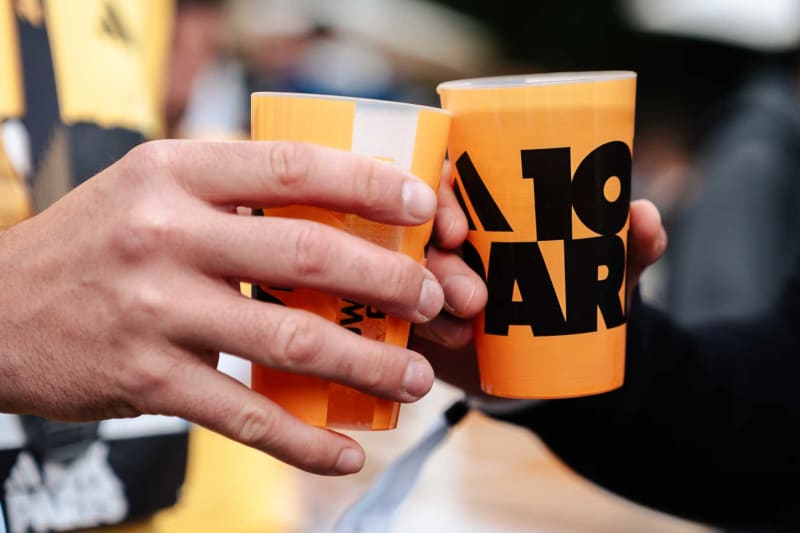 © Two finishers from the 2025 adidas 10K Paris © ASO
So it is clear that beer contains carbohydrates above all, specifically maltose. After exercise, glycogen stores need to be replenished because physical activity has depleted them. One point for beer!
Because it is made from grains, beer also contains some vitamins and minerals: B6, B12, magnesium, potassium and amino acids. But these nutrients, which matter during post-exercise recovery, are present only in very small quantities, and of course they are easy to get from plenty of other foods. It is a bit like people defending their wine consumption by pointing out that it contains polyphenols and supports cardiovascular health… Let us award beer half a point, no pun intended, just to acknowledge that it has a few redeeming qualities.
➜ Read our article: “The Marathoner's Playlist”
Alcohol, the false friend
However tasty it may be, and however divine that first post-race sip might feel, beer is still an alcoholic drink first and foremost. Our societies treat alcohol as inseparable from celebration and conviviality, while people drinking soft drinks are often viewed with suspicion. Even so, attitudes would benefit from changing, particularly within the sporting community, because alcohol is far from an athlete’s best friend.
Contrary to popular belief, beer is dehydrating. Just because it is made with water does not mean it meets the needs of an athlete who has been sweating for hours! More generally, alcohol causes dehydration because it affects antidiuretic hormone, or vasopressin, which reduces water reabsorption in the kidneys and increases urine output. Hops also stimulate kidney function, further increasing urine production and excretion. Who has never noticed how abundant and clear their urine is after drinking a beer? Alcohol is also processed by the liver, which has already been put under strain by intense exercise. During a race, the muscles produce waste products that the liver has to deal with, on top of its role in maintaining blood glucose levels. Suffice to say, this organ is not having a great time during a marathon, especially as blood is directed primarily towards the muscles. After exercise, the liver therefore deserves your full attention, and a dose of alcohol certainly will not help it!
Finally, beer’s carbonation can upset the digestive system, which has already been pushed hard by endurance exercise, during which the body has endured dehydration, unusual food intake, particularly highly concentrated energy products, and the repeated vibrations caused by foot strikes. What about the sparkling waters often recommended for recovery, then? These waters are often useful because they are highly mineralised, helping replenish stores after physical exertion. It is their mineral content, not their carbonation, that contributes to post-exercise recovery. In short, beer’s bubbles will not help you recover!
The idea of beer as a marathoner’s friend is therefore a myth as tough as the hardened feet of a distance runner. Beyond the immediate pleasure it provides, it is clearly not advisable after physical exertion. One alternative is to choose a non-alcoholic beer, containing less than 1.2% alcohol, which can deliver just as much pleasure as “the real thing” without the drawbacks. And if you can do without that post-race pint, reach instead for a good old bottle of water: nothing better has yet been found for quenching your thirst and rehydrating!