
 © Boston Athletic Association
What if we learned how to start? What the world’s biggest marathons do better on the start line
Published on Wed, August 5, 2026
We’ve all been there. The gun goes off and, instead of opening up your stride on clear pavement, you’re stuck in a packed mass, elbows out, feet hunting for somewhere to land. A road race start is supposed to be the climax after weeks of training. In reality, it can feel like a slow-motion brawl. Yet a few thousand kilometers from French start lines, other organizers cracked the code a long time ago. A comparative look behind the scenes of starts that actually work.
Tokyo: discipline as culture
Let’s start with the most radical example. At the Tokyo Marathon, around 320,000 runners fight for 40,000 bibs through a lottery every year. The ratio is dizzying. And yet anyone lucky enough to hit the streets of Japan’s capital comes back with the same unanimous takeaway: the organization, flow and collective respect on the start line feel almost miraculous.
The recipe boils down to a few simple principles, enforced with absolute rigor. Runners are assigned to numbered corrals based on their seed times, and access to the start area is tightly controlled, with a hard cut-off time to enter your corral. Miss it and the gate closes. Literally. No negotiating, no special favors. The fast runners go first, everyone else rolls out progressively, sometimes with several dozen minutes between waves. The system is owned, explained and followed.
What strikes Western runners most is the complete absence of shoving. No elbows, no slipping between barriers, no jittery crowd surge in the minutes before the start. “ Everyone’s there to have a good time and respect each other; I didn’t see the slightest hint of pushing in the start corrals,” says a French runner who took part in the 2025 edition. Discipline isn’t an external rule book there, it’s part of Japanese running culture, deeply rooted in a country that’s been obsessed with distance running for decades. Ekiden, a centuries-old team relay followed by millions every year, has trained generations of runners to value the group and execute with precision.
Tokyo isn’t gentle across the board, though. Its nine time limits ruthlessly pull several hundred runners each edition, including participants who flew across the world to be there. The rule is applied to the letter, no appeals. There’s a downside: runners in later waves sometimes end up with less real time to cover the distance, since the cut-off system doesn’t always account for the gap between waves. But when it comes to the start itself, Tokyo remains a world reference that’s hard to match.
Boston: radical meritocracy
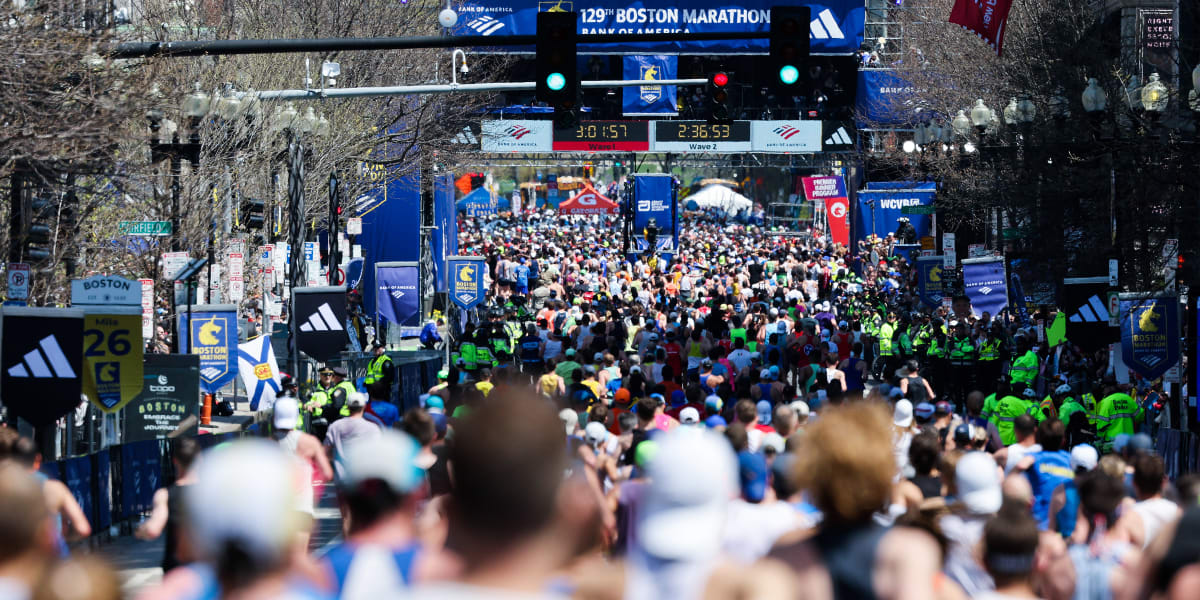
In Hopkinton, outside Boston, the start placement problem was solved at the root by asking a very simple question: what if only those who truly earned it could sign up? The Boston Marathon is the only one of the six World Marathon Majors that runs on strict time qualification. No lottery, no charity bib without proof. To register, you need an official marathon time under a qualifying standard, which varies by age and sex. For men aged 18 to 34, the 2026 standard required sub-2:55. For women of the same age, 3:25. Times that immediately rule out the vast majority of recreational runners.
But the machine goes further. Since 2012, the BAA has accepted qualifiers from fastest to slowest until the 30,000 spots are gone. The result: simply having a “BQ” (Boston Qualifier) hasn’t been enough for years. For the 129th edition in 2025, you needed to be 6 minutes 51 seconds under your age standard to make the cut. A record. In 2026, despite tougher standards, the cut still sat at 4:34 under the new threshold. Thousands of legitimately qualified runners were left out. People chasing Boston no longer talk about “BQ” but “BQ minus ten” ten minutes under their standard to feel reasonably safe.
That draconian selection has a direct impact on start quality. Boston’s corrals group runners with extremely homogeneous times. Every bib is assigned based on your qualifying performance, and each corral holds around 1,000 runners with near-identical pace profiles. In 2026 the BAA even expanded the number of waves from four to six, “ to create a continuous flow through every stage of the morning, from bag drop and bus loading all the way to the start line,” in the words of operations director Lauren Proshan. Crowd scientists were brought in to calibrate optimal density. When crowd management becomes a science, starts turn into choreography.
New York: the bridge as opening scene
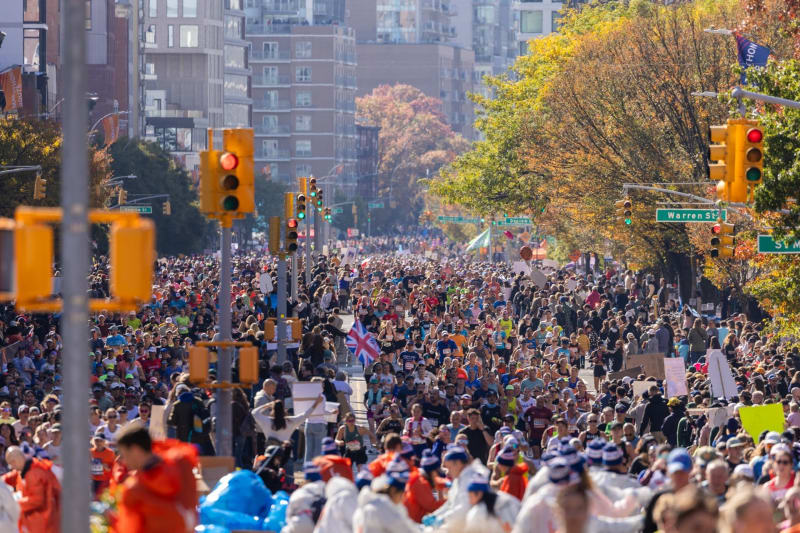
The New York City Marathon doesn’t solve chaos so much as turn it into a show. With more than 50,000 finishers, it’s the biggest race in the world, and staging a start of that size on Staten Island streets is a pharaonic logistical challenge. NYRR’s answer is a wave-and-color system that quite literally splits the field into several parallel races.
Four waves, three color starts per wave blue, orange, green and six corrals per color, labeled by letters. All in, more than 72 distinct sub-groups head onto the Verrazzano-Narrows Bridge between 9:50 a.m. and 11:00 a.m. The blue and orange starts use the upper level of the bridge; the green start goes from the lower level. The three streams don’t merge until mile 8. A mass choreography designed so every runner has breathing room from the first strides.
 © TCS New York City Marathon
“ With bib 25074, Wave 2, Orange Start, Corral A, I can choose to start from any corral in the orange and green starts, or even wait for the third wave,” explains a New York veteran who’s run the race 37 years in a row. That flexibility you can always drop back, never move up gives runners unexpected room to adjust while preserving the system’s integrity. And since final ranking is based on net time, there’s no stress if you cross the line a few minutes after your wave’s cannon.
The result is striking. “ You’re in the middle of a dense crowd; some faces look lit up, ecstatic, eyes wet, while others, head down, seem untouched by the emotion of this start,” says a French runner as she crosses the Verrazano. The mass is there, but it isn’t frightening. It impresses, it moves you, and Sinatra replaces the pistol shot in the soundtrack of finishers’ collective memory.
London: logistics raised to an art form
In Blackheath, southeast London, the 59,000 runners of the London Marathon 2026 found an operation polished down to the smallest detail. Three separate start areas blue, red, green based on time goals, each reachable from a different Underground station, with clearly marked routes guiding runners from the platform to their corrals. The Tube is free all day with your bib. “ There are loads of people, but it’s smooth,” sums up Nathan, a young French marathoner back from London and that line alone says a lot compared with some of our big races back home.
It’s down to the millimeter, perfectly dialed in, from bag drop to toilets you can reach without queuing.
Starts for the mass field roll between 10:00 a.m. and 10:40 a.m. depending on the zone, and the three flows merge around mile 3 at Charlton to become one. Corrals open sequentially, bag drop moves fast, “ down to the millimeter, perfectly dialed in, from bag drop to toilets you can reach without queuing,” in Nathan’s words again. No rush, no human traffic jam. Same story at the finish: T-shirts, medals, bag collection everything chains together without friction.
That smoothness isn’t luck. London Marathon Events, the organization behind it, works with flow-management experts and tweaks the setup each year based on runner feedback. Your bib color dictates your assembly area, your access points and your entire morning logistics. Everything is communicated three weeks before race day, with detailed travel maps. Predictability is a luxury runners quietly but deeply appreciate.
Berlin: calm, big-league efficiency
The Berlin Marathon is world-famous for fast times, with twelve world records set there, including Eliud Kipchoge’s in 2022. But the quality of its start-line organization deserves as much attention as what happens on the clocks.
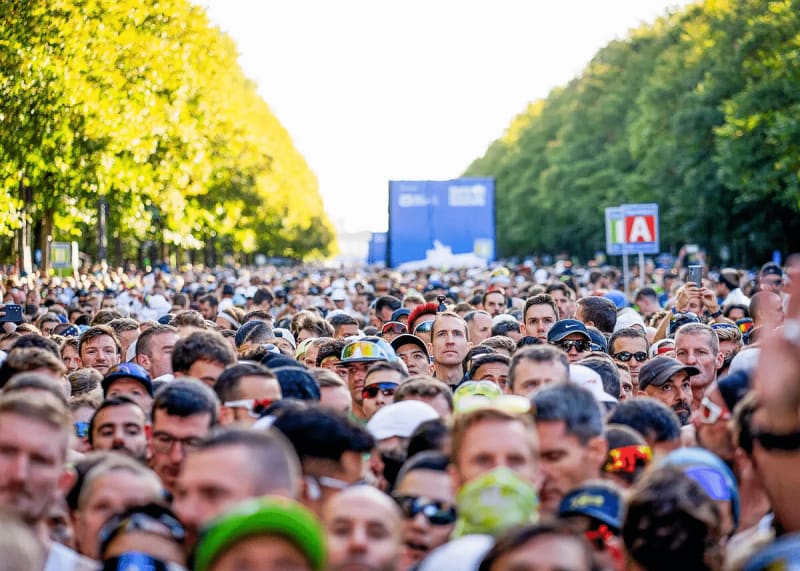
From Straße des 17. Juni, in the heart of the Tiergarten facing the Victory Column, around 55,000 runners set off in four waves between 9:15 a.m. and 10:40 a.m., each clearly identified and structured by target time. “ It takes me less than 30 minutes to get to my corral, Corral E in the second wave for runners aiming to finish between 3:15 and 3:30,” says a runner who took part in 2025. In Berlin, you can jog to your corral from your hotel, along park paths that naturally feed into the main avenue. No mandatory shuttles, no start village on the other side of town the race comes to you.
 © SCC Events
Alan Parsons Project blasts like a countdown before each start, creating an atmosphere that’s solemn and electric at the same time. The vibe is warm, volunteers are plentiful and well briefed. “ Running the Berlin Marathon was a dream. Everything was smooth, from the hotel to bib pickup,” says Alan, a Belgian runner met at the UNICEF 10K. Another runner says he had to climb a barrier because no entry point was open to his corral a reminder that even the best systems have their hiccups. But it’s the exception that proves the rule.
What all this says about us
So what fundamentally separates these starts from what we sometimes experience in France at certain road races? A few things stand out. First, selection upstream. Boston pushes it to the extreme by making access conditional on performance. Not every country can or wants to copy a model where the very essence of mass-participation racing is openness. But Majors like London, Berlin and New York have shown you can manage 50,000 to 55,000 runners with exemplary flow simply by being strict about seeding, nailing pre-race communication, and having enough volunteers to shepherd the streams.
Then there’s collective culture. Tokyo represents an ideal that’s hard to transplant wholesale because of cultural differences. But the absence of pushing isn’t about nationality; it’s about clear rules, explaining what’s at stake to runners, and infrastructure that doesn’t let chaos take hold by default.
I organize events to offer the best possible conditions for elite athletes. If I’d wanted, I could have taken 25,000 runners in Lille. A lot of events turn people away for safety reasons.
Finally, communication. In London, your bib color tells you which Tube station to use, which corral to go to, your start time, and how to get there. In Boston, your bib number is your exact rank in that day’s global field. In New York, corral numbering is laid out in the runner guide with engineer-level precision. Nothing is left to improvisation, nothing invites cheating or slipping through. When the rules of the game are crystal clear and the system is visible, runners follow them naturally or almost.
And France in all this?
French organizers aren’t short on goodwill. Jean-Pierre Watelle, organizer of the Lille Half Marathon and the Meeting de Liévin, told us plainly: “ I organize events to offer the best possible conditions for elite athletes. If I’d wanted, I could have taken 25,000 runners in Lille. A lot of events turn people away for safety reasons.” Capping entries, widening start chutes, checking proof of performance the levers exist, and some organizers are already pulling them.
But the boom in running creates an equation that’s hard to solve with today’s tools alone. Twelve and a half million French people run now about a quarter of the population. Big races sell out in minutes. Economic pressure sometimes pushes events to accept more bibs than a start can reasonably handle. And corral culture still needs work: some runners fake their seed times, others jump barriers, and many simply don’t know the rules.
The Majors are a step ahead because they’ve invested in flow management as a discipline in its own right with budgets, specialists and years of iteration. France’s most ambitious races have everything to gain from taking notes, not to copy blindly, but to absorb the essentials: a well-run start is the first gift an organizer can give their runners. Before mile 1, before the stopwatch, before anything else.