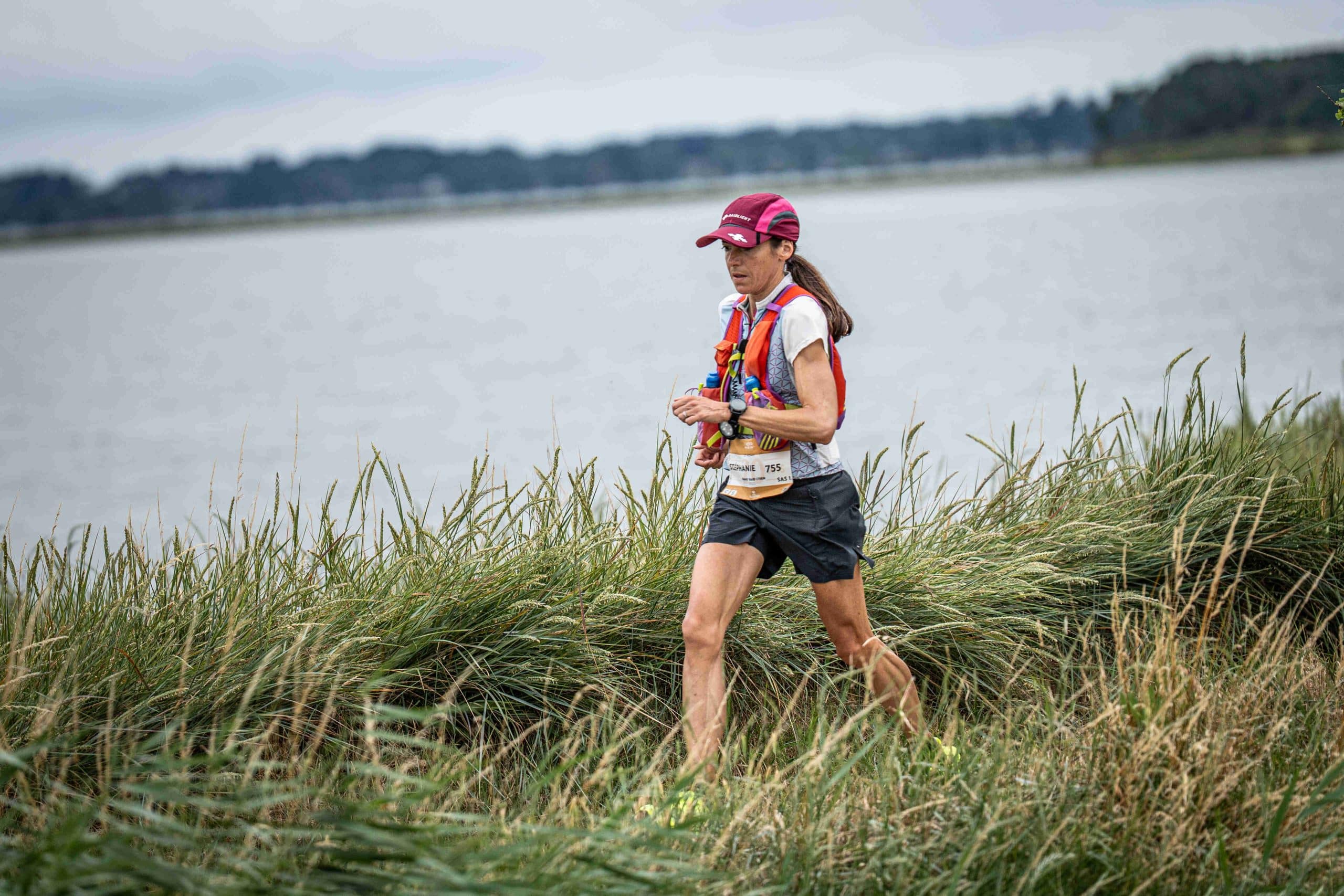
Explorer and ultrarunner Stéphanie Gicquel, future 24-hour world record holder ?
Driven from the start by a love of adventure and the pursuit of the perfect stride, Stéphanie Gicquel, an ultrarunner, never imagined becoming the French 24-hour champion or holding the national record in the discipline. In 2026, she is embarking on a new challenge: attempting to break the 24-hour world record.
✓ Meeting a woman of a thousand talents.
Drawn to exploring the world, especially hot deserts, and curious about everything around her, the young native of Carcassonne filled the long summer days with sports, unaware that she was already developing remarkable physical abilities. Self-taught, none of her family guided her toward a club that would match her profile or interests. Only today, thirty-five years later, looking back, does she realize how athletic she already was. “Since there were no screens, I was outside all the time, and my goal was to replicate the moves I saw on TV, in figure skating or gymnastics. I loved the complexity of the movements. What always thrilled me was mastering something difficult. I could spend six hours straight every day of the summer. I loved being outdoors, but at the time, I never really intellectualized it.”
Driven by a strong desire to travel, the teenager from Languedoc dreamed of studying in Paris, inspired by the heroes of Balzac. Already sensitive to language, she saw only one path to escape the confines of her family life: study in order to travel. “First, I wanted to discover Paris, then the world, because I saw Paris as a gateway. I dreamed of it through the descriptions in my French literature books.”
Her determination led her through the universities and grandes écoles of the capital, in environments she had never encountered before, from commerce to law to economics. “I did everything to reach these goals, even though these worlds were very far from my family background. People told me it was impossible, reserved for certain people. I put sport aside, thinking that the more I worked, the more likely I was to succeed. Whereas in reality, balancing with physical activity actually improves performance.”
Arriving at HEC, she confronted a new reality: a young woman from a modest background thrown into an elite environment. “I quickly realized I still had many codes to learn to build my own projects. I understood that traveling meant independence. In fact, I dreamed of being an adventurer, without putting a word to it.” She then entered the corporate world, a way to repay student loans and fund her first projects. “Whenever I discover a new environment, I want to stay there for a while.” This new universe, which she chose to explore, temporarily put her dream of traveling on hold. “People often think there was a break, but in reality, it’s the same curiosity that has guided me every time.”
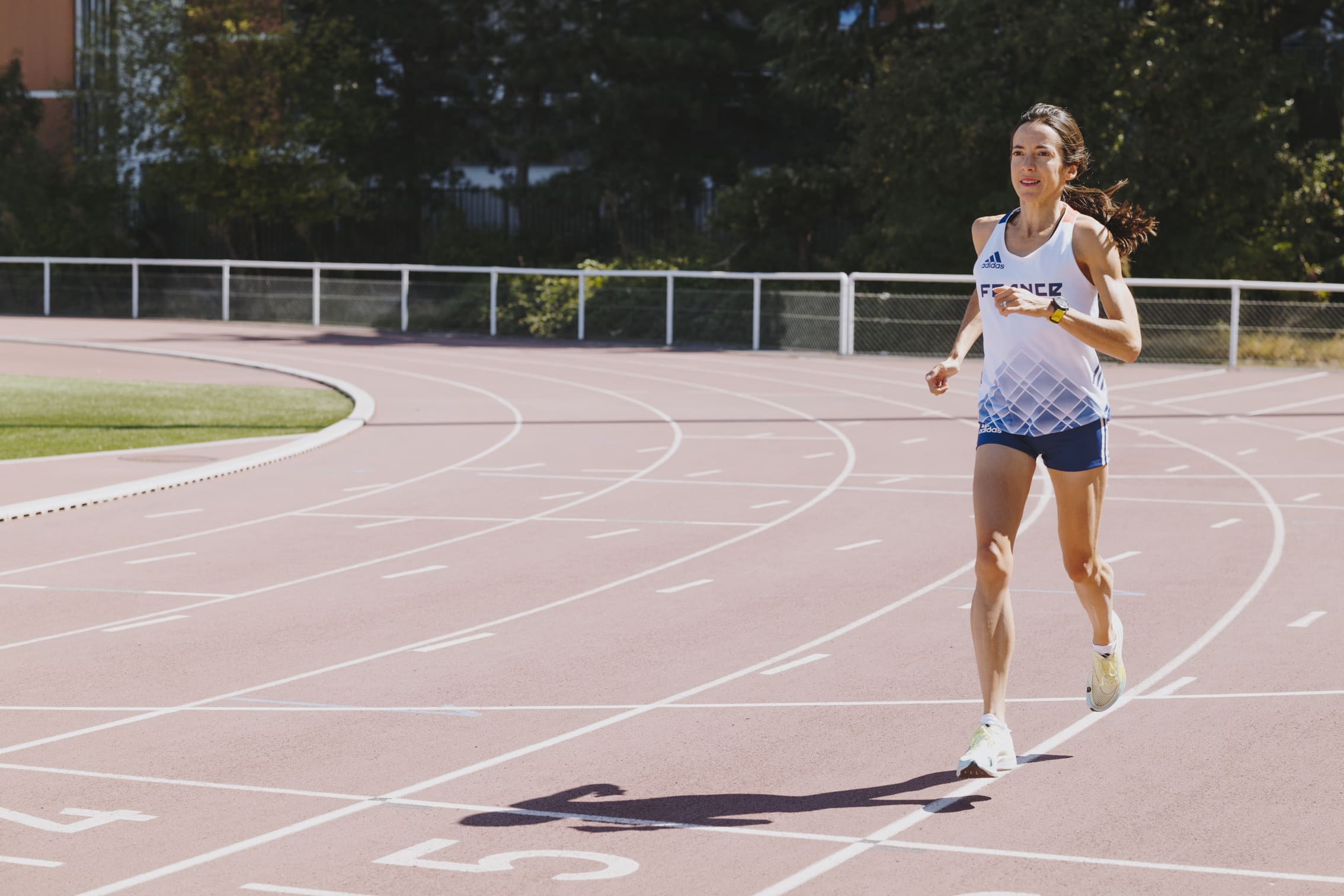
Finally, her projects began to take shape. Drawn to the unusual, her dreams of traversing “hot and then cold deserts” came true. “Being in these environments, surrounded by people who needed more rest, I realized I had a real appetite for the very long. I wasn’t tired; I could keep going.” Yet never satisfied with adventures, around the age of 35 she embarked on a new journey: high-level sport. “I’m well aware that it’s unusual, because typically elite athletes move toward adventure sports afterward, not the other way around.” Always driven by the desire to push further, she tests her limits “without exceeding them,” and continues to surprise with her ability to navigate from one world to another. From lawyer to adventurer, then to elite athlete, perceived as more structured and constrained, she constantly explores.
A passionate writer, Stéphanie hones her craft through her experiences. Initially running a blog highlighting athletes and adventurers, she now regularly shares her story on LinkedIn to inspire others and writes editorials for various magazines. Today, she is the author of three books. “Writing has manifested itself in different ways throughout my journey. My goal is more than just doing something; it’s to do it well. What matters is that I’m happy with the finished product.”
Yet literature is not her only passion. She has always been fascinated by the scientific aspect of things. “I think the two are connected, especially in running; the scientific side allows you to understand and find explanations. And at the same time, there’s a more dreamy, almost literary side in the physical engagement with nature.”
| From exploring the world, sport, and humanity arises the joy of running
Throughout her 43 years, Stéphanie has sought to explore. Exploration brings to her, and above all, brings to the world. For her, whether in science, technology, or sport, humanity always progresses by venturing where it has never gone before. “Exploration is somewhat intrinsic to humans.” There is personal adventure, where one surpasses one’s own limits, and exploration, where one crosses frontiers never reached before. “If one day I run 275 kilometers in 24 hours, no woman will have done it before. I will experience something unique, something I can describe in terms of sensation, which will surely advance science.”
She isn’t entirely sure where this need for movement comes from. “I feel it’s ultimately close to resilience. If I weren’t like this, I might lose the sense of life. It’s my way of feeling alive.” According to her, social pressures often hinder taking action: “When you go off, disconnected from the world and without your phone, you free yourself from the mental load that prevents you from entering a zone of discomfort.”
Before her high-level career, Stéphanie ran for pleasure and to prepare for her expeditions. “I ran marathons to build endurance, without specific preparation. Running was training, like ski-pulka or ski touring.” Her taste for endurance developed naturally through her expeditions and continued afterward. “When you discover vast spaces while running at an easy pace, without worrying about speed, it’s magnificent.”
This quest for disconnection, this feeling of becoming one with nature, drives her. Running allows her to access places otherwise unreachable. The joy also comes from sensations—the smoothness of a stride, the precision of a movement. Technical sessions remind her of her childhood. Every phase of her training has its charm: observing nature, building endurance, track sessions, and exchanges with researchers. “The pleasure is in the everyday.”
« I think literature and science are connected, especially in running: thanks to the scientific aspect, you can understand and find explanations. At the same time, there is a more dreamy, almost literary side in the direct encounter with nature. »
Stéphanie Gicquel
| High-level sport as a springboard to a new adventure
Guided by this new conviction that “endurance could also exist within the world of competition,” Stéphanie decided, seven years ago, to run with a different perspective. She quickly stood out and moved toward high-level competition, with a clear goal: to join the French national team and go “as far as possible in this new environment.” Her medals, therefore, are no coincidence. “I had this conviction, just like when I wanted to cross Antarctica. I felt that if I put everything into it, I would succeed.” What she didn’t imagine at the time was that one day she would aim for a world record. “It was the European Championships in Verona that opened my eyes to this possibility.”
In high-level sport, the body is pushed to such extremes that it becomes natural to need breaks. “We train so much that I love the recovery phases, when I can do other activities. I couldn’t see myself running all the time.” Based mostly in Paris, she never feels deprived, even during rest periods. Like any work, some moments are more demanding than others. “When it rains, it’s cold, and we have to run on a loop because the volume is too high, it’s better to move aside, even if it’s less enjoyable. Sometimes it’s a bit tedious, but it doesn’t take away the desire to continue.” She doesn’t feel an irresistible need to run, but the flame remains.
Her training rhythm varies depending on her goals. Each preparation is different, but that for a 24-hour race is the most demanding. The ultradistance specialist must account for numerous factors. “The longer it is, the more you face external factors,” such as environmental stress or nutrition management. She works with nutritionists and scientists to identify the causes of difficulties encountered. Temperature, for example, can be decisive. “If you are exposed to 35 °C for a long duration, as the hours pass, you may be forced to abandon.” It is therefore not just a question of training volume; a multitude of related factors come into play. “If you combine running volume with all the preparation, it’s the most time-consuming thing for an athlete. But since we don’t have the same financial support as Olympic disciplines, it’s hard to dedicate all the necessary time. It’s almost about achieving the impossible.”
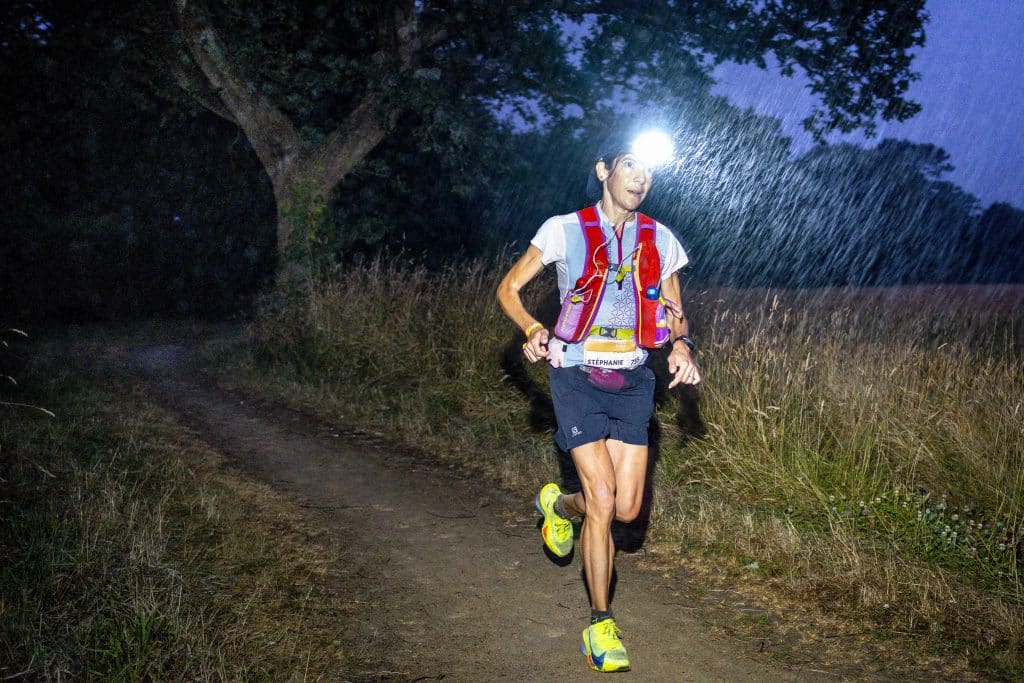
To avoid burning out or getting overwhelmed, Stéphanie Gicquel limits herself to two 24-hour races per year. This choice is motivated by three reasons: preserving her speed, remaining multidisciplinary, and maintaining a practical balance. “The level in ultradistance is so high that it’s no longer enough just to last 24 hours; you also have to be able to run them at a certain pace. I like to keep faster phases, like at the beginning of the year when I ran three marathons in a row.” She enjoys varying the formats—trail, marathon, 100 km…—a diversity essential to sustaining her motivation and aligned with her quest for completeness. Becoming “the fastest ultrarunner” is her goal, with the world record in sight, but without neglecting shorter distances.
Until now, she has never followed a fully dedicated 24-hour training plan. This time, she is committing fully, with the world record as her guiding objective. “I’ve already done weeks of 260 to 320 km to prepare for a 24-hour race. But I’ve never been able to follow an ideal plan under optimal conditions. That makes me think I still have significant room for improvement. Handling the volume well is clearly my strength.” To aim for top-level performance, she knows what she needs: time, a suitable location, and the right conditions. “No other races, finding an appropriate place, and above all bringing together the right elements: staff, competition to create emulation, and favorable weather.” For a 100 km training block, she usually runs 200–220 km per week, with progressive increases. “No two weeks are ever identical.” In ultradistance running, it’s impossible to stop for more than ten days without losing speed. Hence the importance of consistency and strength training, which she systematically integrates to preserve her body over the long term.
During races, when time feels long and the environment doesn’t provide the same fulfillment as her explorations, she draws on what she has learned in extreme settings. In a 24-hour race, she always focuses on a detail—clouds, colors, faces. “I try to draw strength from everything around me.”
| “I don’t just want to run, but to understand and share.“
Thanks to her triple role as explorer, writer, and elite athlete, Stéphanie Gicquel works alongside scientists on research protocols, notably with researchers from INSEP. This collaboration is reciprocal: sometimes the scientists reach out to her, and other times she contacts them to improve her performance. These exchanges allow her to leverage her field data for the benefit of the wider public. “To prepare for the 100 km of Millau, I questioned when and where to do a descent on flat terrain during my hypoxia training camp. The teams at CNEA Font-Romeu supported me, as did the INSEP researchers specializing in environmental stress.” Many questions guide her practice. “I wonder what would be the most optimal location for my world record attempt. The researchers know the conditions of humidity and heat perfectly. They help me improve my performance, and I provide them with my field data so that it can benefit as many people as possible.”
Sharing knowledge is essential for Stéphanie. Convinced that extreme sports and ultra-endurance offer the most insight into understanding the human body, she gives lectures and regularly visits schools to foster reflection on these subjects. “Human beings are, above all, enduring beings. Studying endurance is studying what the human body is capable of.”
| A long-term career, designed for endurance
“The day it no longer suits me, I’ll stop. But for now, I feel I still have room to grow.” She trains, but always with the goal of exploring. When she first started, she never imagined going this far. “The body requires so much adaptation that you really have to take the long view for a career. Otherwise, you risk injury and losing motivation.” Each year, she refines her practice, learns, and evolves.
The ultrarunner has found a discipline that allows her to improve despite the passing years. “It’s not a fatality. I’m convinced you can be more performant at 40 than at 20, provided you put in more effort and energy.” Aware that most of her competitors are younger, she doesn’t let it bother her. “It’s a positive not having been in elite sports at 20. I have no point of comparison and I don’t tell myself that I can’t do better.”
Today, Stéphanie Gicquel, the runner who has crossed deserts and once faced death on her expeditions, is pushing her limits in another dimension: elite sports. After achieving her goal of wearing the French national team jersey, a new horizon awaits her in 2026—the 24-hour world record, a performance destined for history.
Sabine LOEB
Journalist