 © Mother Runner Micki
Caitriona Jennings: “An incredible feeling”
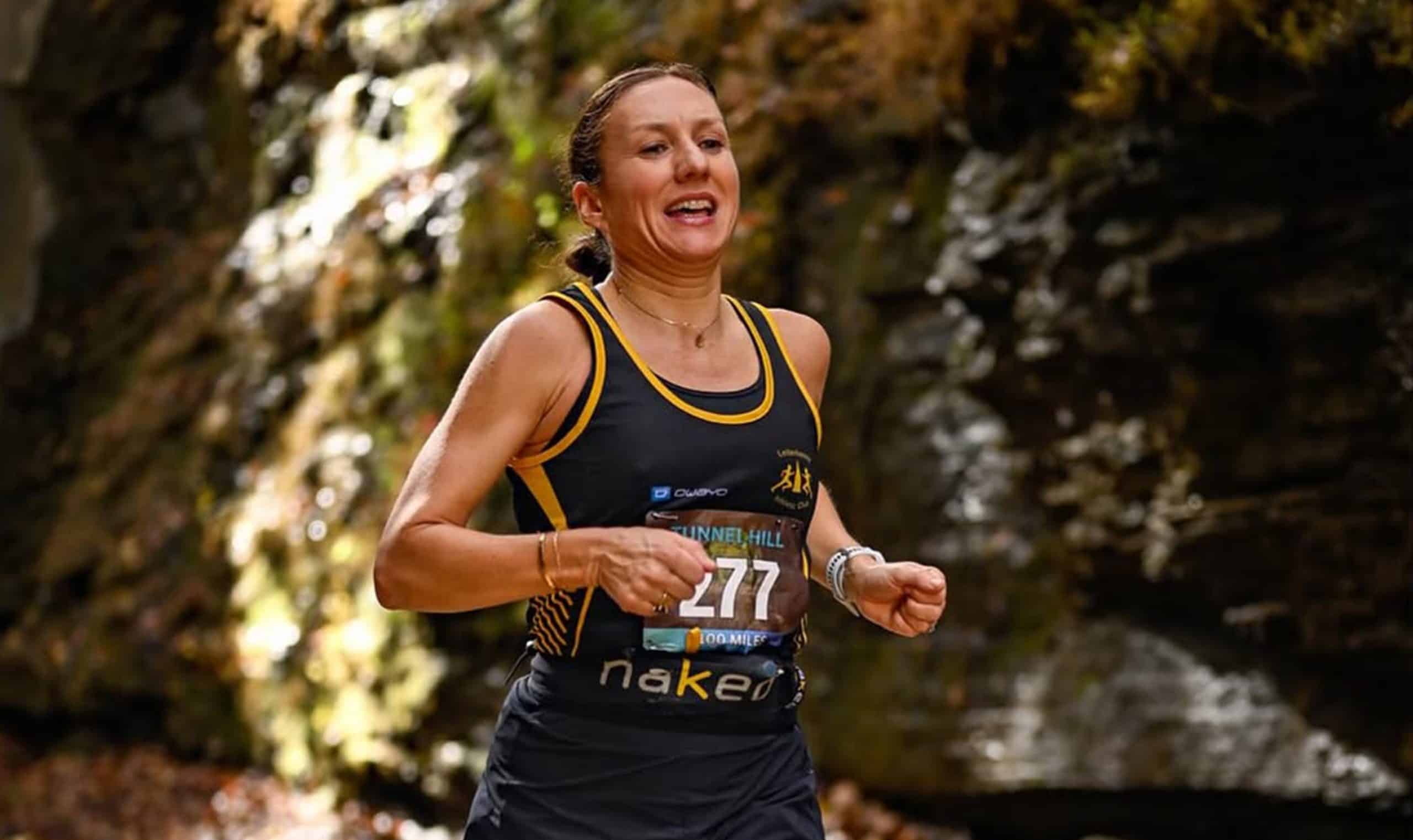
On November 8, Irish runner Caitriona Jennings broke the women’s 100-mile world record at Tunnel Hill, an American race held in Illinois. The ultra-marathoner delivered an outstanding performance, completing the course in 12 hours, 37 minutes and 04 seconds. We met a determined athlete who never stops pushing her limits. World class.
| What does it feel like to be the fastest woman in the world on 100 miles ?
Oh, it’s an incredible feeling — a little surreal. I think it took a while for it to really sink in. I feel very, very fortunate to be in this position, and I’m just grateful that I had the opportunity, that everything went well on the day, and that I was able to run a good race when it mattered.
| In the final kilometers of your performance, did you have any particular thoughts going through your mind?
Yes. The race started at 7 a.m. and finished at 7:37 p.m. The sun set around 5 p.m., and it was fully dark from about 5:15 onwards. So the final two and a half hours of the race were run in complete darkness. I remember passing the second-to-last aid station, which was 10 miles to go. It was at the top of what was essentially a net downhill run to the finish. When I went through there, I knew I had a really good chance of getting it. My husband was crewing for me, and throughout the day he had been very composed, very focused on what he needed to do — my nutrition, everything. But at that particular aid station, I could hear it in his voice: he was getting really excited. That made me very excited as well. Of course, I still had 10 miles to go — it’s still a good distance, still over an hour of running — but at the same time, it felt very manageable in my head. I’d run that distance so many times, and I remember thinking, “I feel like I’m going to do this.” That was a very positive and emotional feeling.
| Over those 10 miles, what can actually happen during the race?
A lot can happen. You can go too fast and your legs can cramp. I had never run the distance before, so there was still a lot of unknown. While the downhill might seem easier in theory, you’re actually putting more stress on your quads, so it’s a time when you’re more vulnerable. It was dark, I was wearing a head torch, and at one point it started slipping. I tried to fix it by tightening it and ended up breaking it. So a few things did go wrong in the last 10 miles. That said, I had a sense of reassurance — a belief that I would do it — and that was a really nice feeling. The final aid station was about three miles from the end, and at that point I started thinking, “I hope I still do it. I think I can still do it.” You’re so close, everything seems fine, but you don’t want to believe it until you’re actually over the line. There’s still time for something to happen, and you can hemorrhage a lot of time at that stage of a race.
The final aid station was about three miles from the end, and at that point I started thinking, “I hope I still do it. I think I can still do it.” You’re so close, everything seems fine, but you don’t want to believe it until you’re actually over the line.
Caitríona Jennings
| You had to slow down at the beginning of the race…
Yes. I decided to run at or just below world record pace, which actually felt very slow early on. But I knew that 13 hours later, it wouldn’t feel slow at all. I had to be disciplined, patient, and avoid wasting energy. Holding back early was absolutely worth it later in the race.
| From 100 kilometers to 100 miles: can you describe what happens between the two?
It’s an extra 62 kilometers — a huge step up. Everything has to be reconsidered, especially nutrition. My 100km best time is just over seven hours, but I knew I’d be running for around 13 hours at 100 miles. I had to think about real food, muscle strength, cramping, and how my body would hold up. Mentally, it’s a completely different challenge — being alone with your thoughts for that long and staying positive and focused. Those were the main differences I identified, and I trained specifically for them, doing a lot of research and adapting what worked best for me.
| You were extremely focused before and during the race. Can you tell us more about your A goal, B goal, and C goal approach to staying in a positive mindset?
I knew it was crucial to stay positive. There was a high probability that things could fall apart, and I run because I love it. I wanted to challenge myself without risking a negative experience. I had very high expectations for myself, but I also wanted the day to be a success regardless of the outcome. That’s why I had multiple goals — so I could still feel satisfied and content, whatever happened.
| Nowadays in running, we hear so much about performance, but for you, enjoyment seems to matter more…
Yes, and that was even a learning experience for me. Normally, I’m very focused on competition and results, but because this was such an unknown, I shifted my mindset. I’d like to bring that attitude into future races and not always be so outcome-driven.
| You are the Irish male and female record holder — that’s not something we see very often…
Yes, I broke both the Irish male and female records. The Irish male record is 13 hours, 18 minutes and 33 seconds, I broke both, which was pretty sweet. I’m sure there are a lot of men in Ireland thinking, “I can’t let a woman hold that record now.” Hopefully it encourages people to go after it. It’s rare, and it’s nice to see.
| Let’s step back : how does a young woman from Donegal reach the level you are at today, through the Olympics and everything you’ve achieved along the way?
I think I was very fortunate to grow up in a family that was incredibly focused on sport. I have two older sisters, and all three of us played every sport under the sun — it didn’t really matter what it was, we just played everything that was available. I started swimming at the age of four and competed at underage level. I also played basketball, badminton, volleyball, some of the Irish Gaelic sports, and I was running and cycling as well. Around the age of 12 or 13, I started triathlon, which I really enjoyed and was quite good at, probably because of my swimming background.
I represented Ireland at underage level in triathlon on four occasions. As I got older, went to university and started working, running became my main focus. It was my favourite of the three sports, the most time-efficient, and very social. When I moved to a new city, joining a running club was an easy way to meet people. At that stage, I wasn’t running with the intention of qualifying for the Olympics. That came later, when I realised my results were consistently improving and that longer distances suited me. I qualified for the London Olympics at the Rotterdam Marathon in 2012 and represented Ireland in the marathon. Unfortunately, that race didn’t go to plan — I got injured — but I finished it. With time, I was able to take positives from that experience, and I brought those lessons with me into ultra-running. Since then, I’ve increased the distances and found an incredible global ultra-running community. It’s given me a wonderful group of friends internationally, and it’s allowed me to carry the joy of running forward.
| After the Olympics, you started increasing the race distances…
Actually, I took a step back after the Olympics. I had a stress fracture in one foot, recovered from that, and then immediately got a stress fracture in the other foot. A bone density scan showed my bone density was very low, and it was clear my body needed a break from running. I started rowing for a while — my sister is a rower and qualified for the Rio Olympics — and she encouraged me because weightlifting, which is part of rowing, helps increase bone density. I spent about a year rowing with the Irish squad in Cork. I enjoyed it, but not in the same way I enjoyed running — it felt more like a chore than a passion. When I returned to running, my focus had shifted. I didn’t want to chase marathon times again, and ultra-running offered a new challenge. I was invited to represent Ireland at the 50km World Championships in 2015, and you never say no to an Irish vest. I loved it, and I realised my endurance — always my strength in the marathon — translated well to ultras. It was a really positive way to continue in the sport with a different focus.
| If you had to compare the emotions between the Olympic marathons and your performance last November, how would you describe the difference?
Qualifying for the Olympics brought an immense sense of joy, accomplishment, and disbelief — it was a lifelong dream. With longer races, you never truly know until you finish, and accomplishing that was a huge moment in my life. Setting the world record felt similar — that sheer joy. I don’t know which was better. The Olympic dream was a much longer journey, whereas the world record attempt was something I only decided to pursue a few months beforehand. My family was there for both, which made it very special. I honestly can’t pick a winner — and maybe that’s a good thing.
| Two daughters at the 2012 Olympic Games… your parents must have felt very lucky!
Yes, absolutely. It’s a testament to how encouraging they were. Sport was a huge part of our lives growing up. It wasn’t as common back then, but we joke that my dad wanted sons to play Gaelic football — and when he had daughters instead, he turned us into multi-sport athletes.
| How do you balance your private life with training?
I work in aircraft leasing as VP of aircraft trading, which is a demanding, full-time job. I really enjoy it, but it can be time-consuming. Running helps offset the stress — it clears my head, gives me space to think, and allows me to enjoy nature. There are times when finding the balance is difficult, but I’ve always worked alongside training, even leading up to the Olympics. You learn to adjust and accept that balance isn’t always perfect. I usually train in the mornings or at lunchtime, especially because my company is US-based and I often have late calls. I live near a seaside village called Dalkey and often run to work along the coast. At weekends, I train in parks around Dublin or back home in Donegal, where the quiet country roads and hills are perfect for training.
| After achieving such a huge performance, what goals do you set next?
The performance brought a lot of media attention in Ireland, and I was keen to use that platform positively — for the sport and for people’s health. I am keen to experiment with some ultra trail running over the next year and i have entered a couple of races in the US. I will also continue to focus on the ultra road races including Comrades Marathon in June and the World Championships 100 km in September this year.

Charles-Emmanuel PEAN
Journalist