 © Sradni / Le Matin.ma
Marrakech Marathon: Abdelhadi Labäli Beats the Clock, Hayat Benhniya Sets a New Record
In the cool air of a Moroccan dawn, the 2026 Marrakech International Marathon shifted into a higher gear. Abdelhadi Labäli stopped the clock at 2:07:34, while Hayat Benhniya made history by setting a new course record in 2:24:48. Carried by more than 16,000 runners and a city buzzing with energy, the Red City confirmed its status as a major stronghold of African distance running, from the marathon to the half marathon.
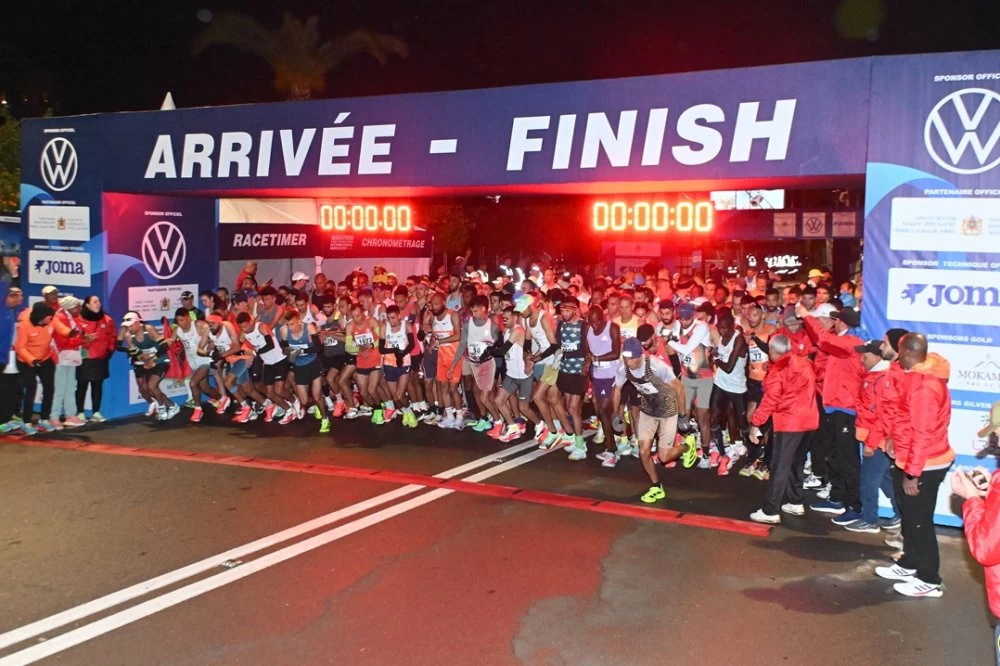
In Marrakech, the marathon never truly begins with the starter’s gun. It starts much earlier, in that suspended moment when the city slowly emerges from the night. Palm trees appear in silhouette, the air remains surprisingly cool for January, and once-silent streets gradually fill with lean, focused figures, already absorbed in their own calculations.
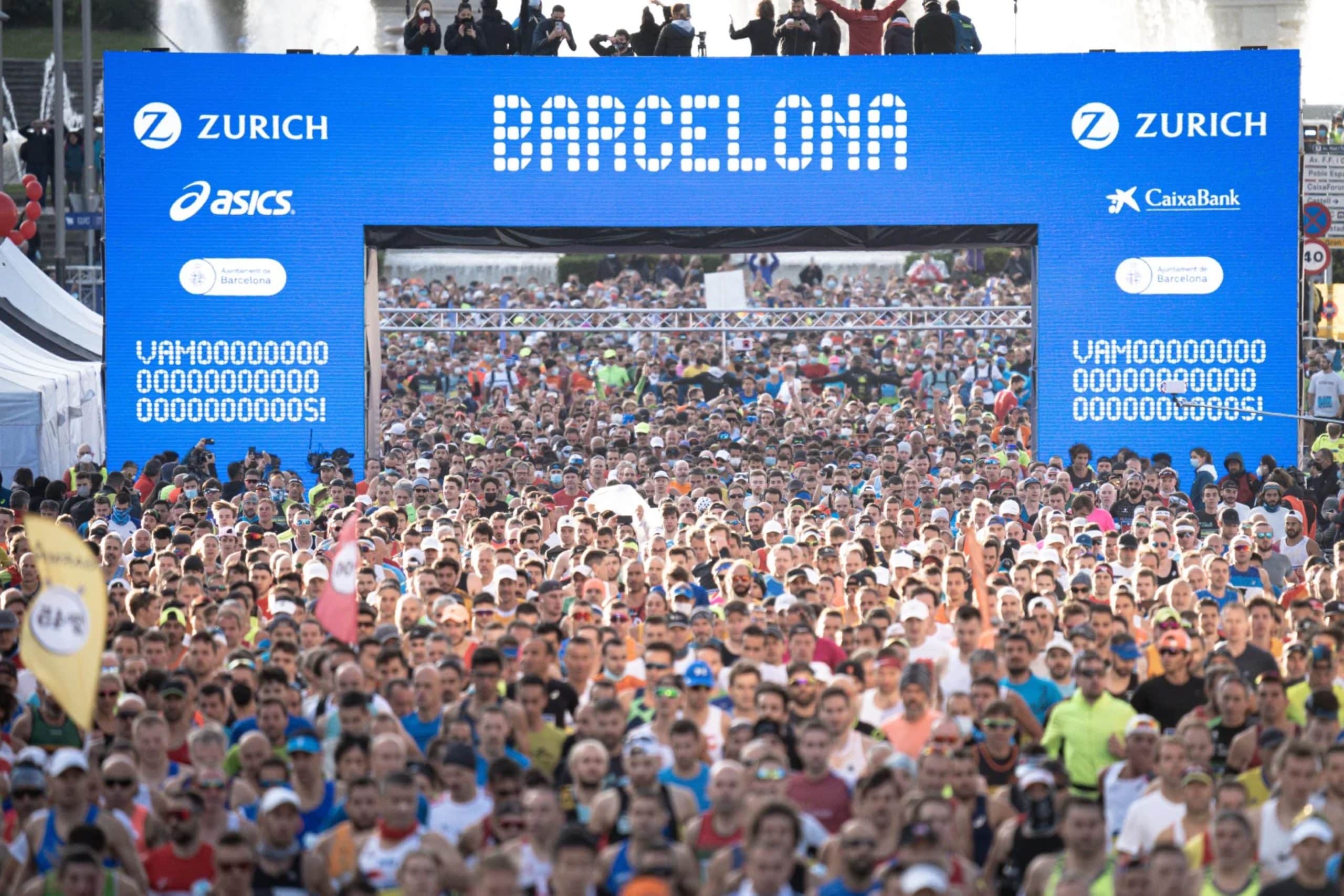
On Sunday, January 25, Morocco’s tourism capital once again transformed itself into a vast open-air stadium. For its 36th edition, the Marrakech International Marathon welcomed more than 16,000 runners from all backgrounds, confirming a momentum that is now firmly established. Held under the High Patronage of His Majesty King Mohammed VI, the event reflects the steady rise of Moroccan distance running, blending sporting ambition, international visibility and a level of popular enthusiasm rarely seen.
| Abdelhadi Labäli: Perfect Timing, the Right Move at the Right Moment
From the opening kilometers of the men’s race, the scenario took shape without any rush. The redesigned course, intended to be smoother and faster, encouraged restraint. A compact lead group quickly formed, featuring Moroccan, Ethiopian and Kenyan athletes, all chasing far more than a simple finishing position.
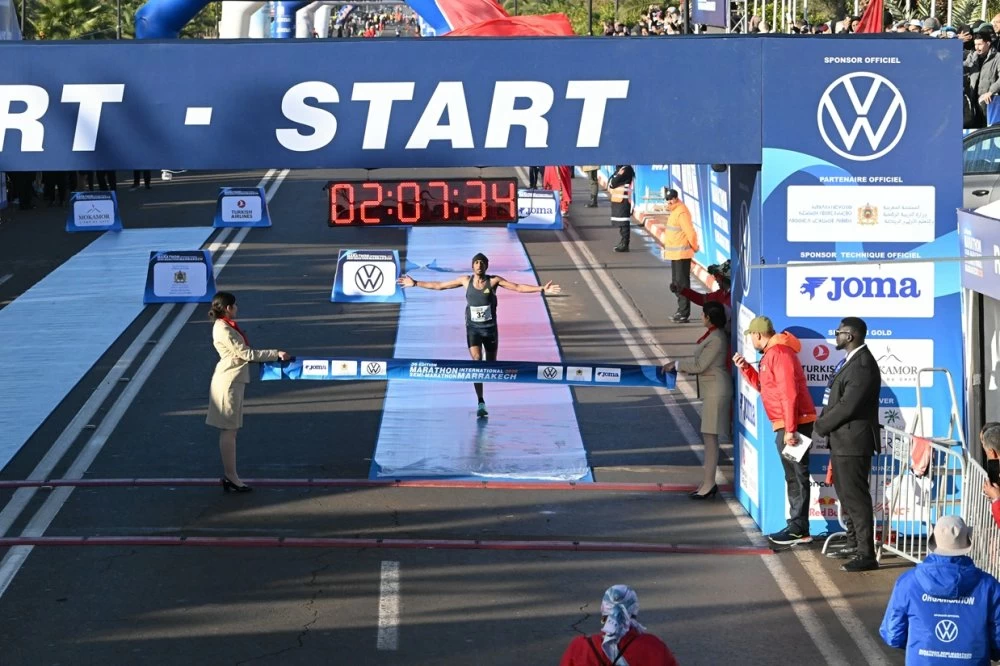
Wearing bib number 32, Abdelhadi Labäli was among those who chose to observe before acting. For a long time, he remained tucked into the lead pack, alongside Ethiopian runner Mekonen Hayimro Yele and Morocco’s Youness Benar. The kilometers clicked by at a strong but controlled pace, with no wasted motion, as the city gradually came alive along the course.
The decisive moment came in the second half of the race. Taking advantage of the long straight roads and gentle false flats through the palm grove, Labäli gradually increased the pace. Nothing dramatic—just a sustained acceleration that slowly wore down his rivals. The gap opened, the group shattered, and the race tipped in his favor.
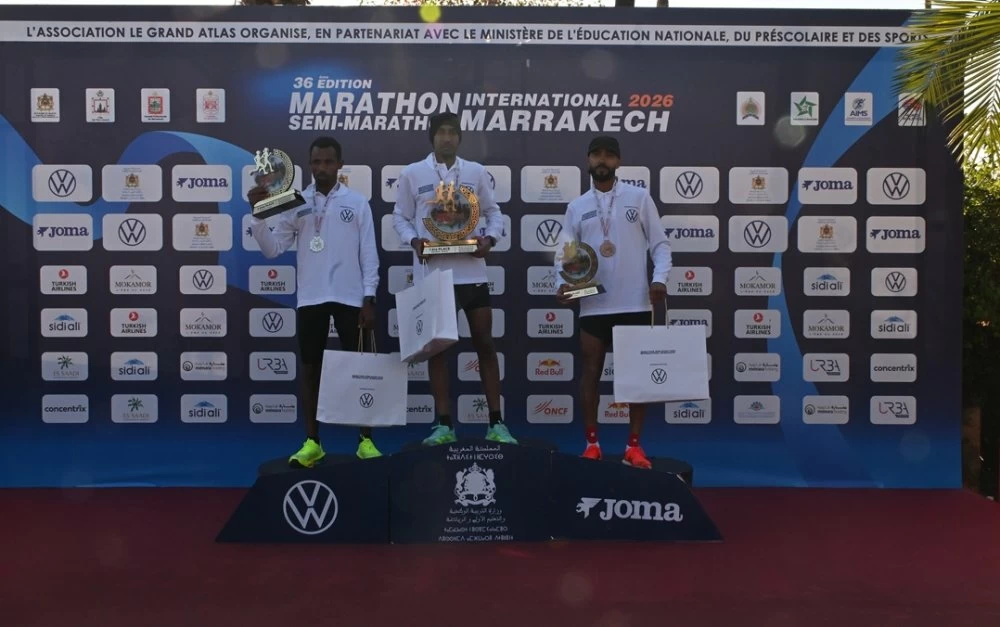
At the finish, the Moroccan claimed victory in 2:07:34, capping a marathon that was tactically flawless. Behind him, Mekonen Hayimro Yele secured second place in 2:08:19, while Youness Benar completed the podium in 2:08:42. Daniel Kiprono Sang (2:09:20) and El Mahjoub Dazza (2:09:39) rounded out a top five that reflected the exceptional level of this edition.
Speaking shortly after the finish, Labäli summed up his success with clarity, explaining that “winning the Marrakech International Marathon is the result of significant preparation efforts” and that it represented “extra motivation to keep working and aim for even better results in upcoming races.” A straightforward, almost clinical analysis—much like his 26.2 miles.
| Hayat Benhniya: A Queen and a Record in Marrakech
The women’s race unfolded on a knife edge for much of the way before breaking open in the final kilometers. Early on, a Moroccan trio pulled clear, setting a fast yet perfectly controlled pace. Hayat Benhniya, Oumaima Saoud and Kaoutar Farkoussi kept a close watch on one another, fully aware that the smallest mistake could prove costly.
Driven by a crowd that grew louder with every kilometer, Benhniya waited patiently. When the decisive surge came, the gap opened almost naturally. In the closing stretch, the local favorite flew toward the finish, lifted by a dense and vocal crowd.
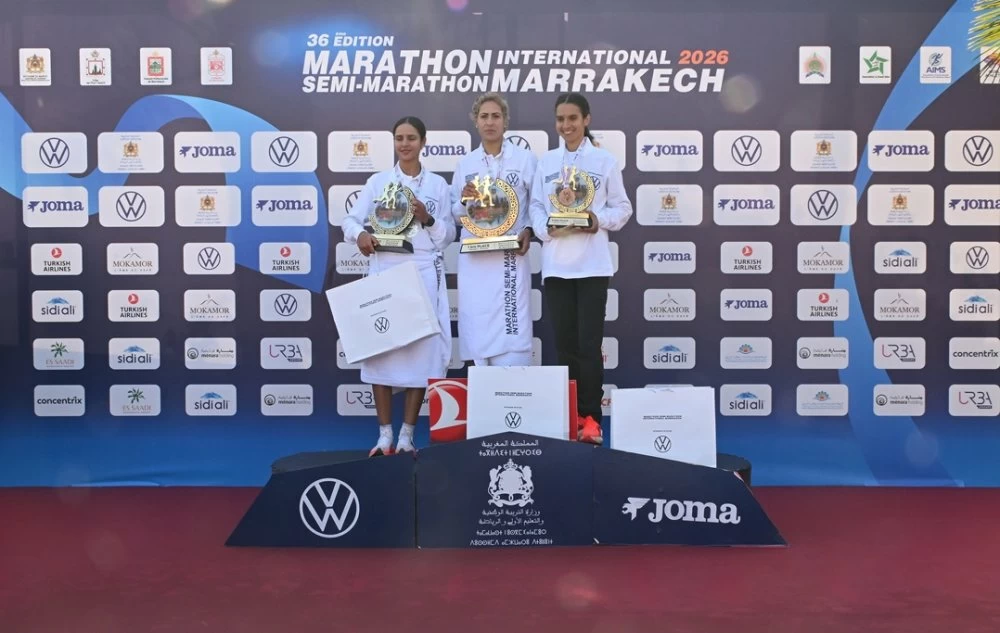
Crossing the line in 2:24:48, Hayat Benhniya didn’t just win the race—she erased the course record previously held by Fatima-Ezzahra Gardadi (2:24:59). Behind her, Oumaima Saoud finished second in 2:25:05, with Kaoutar Farkoussi third in 2:26:18. A meaningful all-Moroccan podium, symbolizing the rapid rise of women’s distance running in the country.
At the finish, Benhniya was visibly emotional, saying that “the title and the improved Marrakech Marathon record represent a defining moment in my athletic career.” She also emphasized how “solid preparation played a major role in this performance,” while expressing her determination to “keep shining and continue flying the Moroccan flag at international competitions.”
| Half Marathon: Maximum Density, Razor-Thin Finishes
The half marathon confirmed that Marrakech is not just about the full distance. In the men’s race, victory came down to the smallest of margins. Hicham Ouladha took the win in 1:02:00, edging out Chakib Lachgar and Ayoub Karym, both clocked at 1:02:01, after a breathtaking sprint finish.
Times that rank this edition among the fastest on the African continent—and beyond. Such depth reflects a particularly rich national talent pool over the distance. In the women’s race, Fatima Ezzahra Birdaha proved the strongest, winning in 1:09:40, ahead of Meryem Azrour (1:09:46) and Nazha Machrouh (1:10:28). Once again, a 100% Moroccan podium highlighted the strength and depth of the country’s distance program.
| A Fast Course, Smooth Organization, a City on Fire
The Marrakech Marathon lived up to its reputation as a fast race. A single-loop course, minimal stop-and-go, a few false flats to test pacing, and above all ideal weather conditions at the start—everything was in place for elites and amateurs alike to chase personal bests or qualifying standards.
On the organizational side, the event met international standards: electronic timing, frequent aid stations, reinforced security, constant medical support and a massive volunteer presence. All of it wrapped in a unique atmosphere, blending music, nonstop encouragement and iconic passages near the Koutoubia Mosque and along the ancient city walls.

This evolution was praised by athletes and officials alike, including Mohamed Knidiri, president of the Association Le Grand Atlas, who said the results “reflect the international reach of Moroccan athletics,” while also highlighting “an organization that meets international standards.” He specifically pointed to “the outstanding men’s half marathon times”and “the record performance in the women’s marathon” as symbols of a thoroughly successful edition.
| Marrakech: A Laboratory for Moroccan Distance Running and a Global Showcase
With more than 16,000 participants spread across the marathon, half marathon and popular 5 km race, the event confirmed its place as a major fixture on the African running calendar. Organized by the Association Le Grand Atlas in partnership with national and local sports institutions, the Marrakech International Marathon has become a true launchpad for emerging talent. Present at the awards ceremony, Mohamed Knidiri once again praised the quality of the organization, the elite-level men’s half marathon times and the record-breaking women’s marathon performance.
The victories of Abdelhadi Labäli in 2:07:34 and Hayat Benhniya in 2:24:48, with a course record to her name, give this 36th edition a special resonance. Marrakech has proven that it offers far more than a spectacular backdrop. Winter after winter, the Red City is becoming a preferred stage for world-class distance running.
✔ Full results of the 2026 Marrakech International Marathon

Dorian VUILLET
Journalist