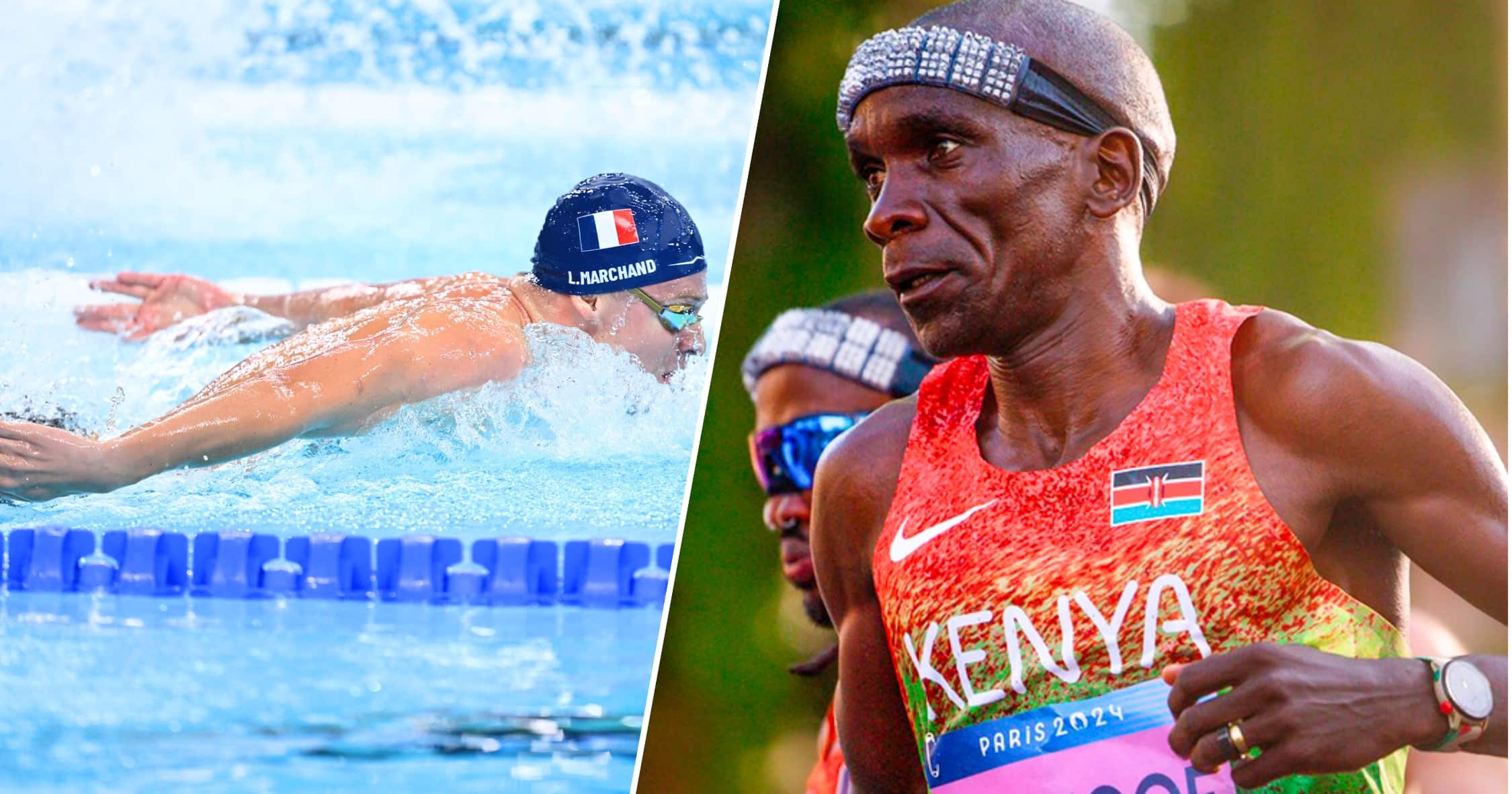
 © KMSP / NN Running Team
“A Big Engine Isn’t Enough”: Which Pro Athletes Are Truly Built for the Marathon?
They ride bikes, swim laps, pull oars, or rack up miles with a ball at their feet. But could they really run fast — very fast — over 26.2 miles? Behind the fantasy of multi-sport champions who can shine anywhere, the marathon follows its own unforgiving rules. Physiology, biomechanics, durability: beyond pure track and field, which professional athletes actually tick the right boxes to perform on road racing’s ultimate distance? A breakdown, guided by science and real-world experience.
The debate has been lively. Between the flamboyant cyclist Tadej Pogačar, French swimming sensation Léon Marchand, and marathon GOAT Eliud Kipchoge, who would be most comfortable tackling an event as demanding as an Ironman? With no definitive answer, a more relevant question emerges: outside of elite athletics, which pro athletes are genuinely best equipped to run a competitive marathon?
| Physiology First — Always
In the marathon, hierarchy is not decided by running form alone. The first filter is physiological. A high VO₂max, a strong lactate threshold, and the ability to stack heavy training weeks without breaking down. These qualities exist well beyond track and field.
For Guillaume Millet, professor of exercise physiology and a leading endurance specialist, the framework is clear. Marathon performance rests on a well-defined trio — VO₂max, threshold, running economy — with a fourth concept now playing a central role: durability. “Durability is the ability to prevent physiological parameters from deteriorating with fatigue, to sustain performance for as long as possible,” he explains. A factor often overlooked when imagining champions switching sports. Because having a big engine is not enough. You also need to run it for hours — without mechanical failure.
| Cycling: Ready-Made Endurance, Fragile Legs
Among professional cyclists — especially climbers — the aerobic base is formidable. Some have already tested the waters. Chris Froome, for instance, has regularly included running in his training blocks, openly acknowledging that his cardiovascular system kept up easily… while his muscles took much longer to adapt. Guillaume Millet confirms this pattern. “A cyclist can have a VO₂max that’s extremely high — sometimes higher than a marathon runner’s — and an excellent threshold. But their running economy is often poor at first, and more importantly, their resistance to muscle damage is very low.”
Former pros who have transitioned to amateur marathoning tell the same story: breathing feels effortless, while the body struggles to keep up. Once the mechanical adaptation is absorbed, however, times can drop quickly. For the sharpest profiles, breaking 2:30 becomes realistic.
After a very solid marathon debut last fall (2:34 at the Frankfurt Marathon in October 2024), former French sprint star Nacer Bouhanni returned to the distance in Valencia in December. The rider from the Vosges region — owner of 70 professional victories, including three stages at the Giro d’Italia and three at the Vuelta a España — aimed to go under 2:30. He finished in 2:31:33. In late October, Tom Dumoulin, former Giro winner, also made his marathon debut, completing the Amsterdam Marathon in 2:29:21, without appearing to push the limit.
| Long-Distance Triathlon: The Textbook Case
If there is one non-athletics sport naturally aligned with the marathon, long-distance triathlon stands out. Jan Frodeno, Olympic champion and three-time winner of the Ironman World Championship, has often emphasized that the marathon is the race’s strategic core — where everything is decided.
Triathletes who attempt a “dry” marathon tell the same story. Running without prior cycling fatigue completely changes the perception of effort. The pace feels faster, yet paradoxically more comfortable. According to Guillaume Millet, this smooth transition is no coincidence.
“Triathletes have learned pacing, effort management, mental fatigue control. These are fundamental marathon skills that can’t be reduced to VO₂max or threshold alone.” That mastery of long-effort execution explains why many former triathletes deliver strong road performances right away.
| Rowing: Massive Potential, Mechanical Limits
On paper, rowers are dream candidates. They boast some of the highest VO₂max values in world sport. Yet their transition to the marathon is rare. Body size plays a major role.
“Rowers often have exceptional engines, but their muscle mass heavily penalizes running economy,” Millet explains. Among heavyweight rowers, repetitive impact quickly becomes a limiting factor. Lightweight rowers, however, have shown more promising results.
In fact, Millet considers them the most intriguing theoretical profiles. “If I had to name a non-athletics athlete with the best average marathon potential, I’d say a lightweight rower — provided they take the time to rebuild their body for running.” The engine is there. The machine still needs reengineering.
| Football: It’s About the Position, Not the Sport
Not all footballers are marathon-ready. But some profiles stand out. Box-to-box midfielders and modern full-backs combine high mileage with sustained intensity. Endless-engine players like Blaise Matuidi or N’Golo Kanté are often cited for their extraordinary endurance. As a tongue-in-cheek prank, Kanté was even listed as a marathon world-record holder (2:01:39) on Wikipedia for a few minutes in 2018 — before the “performance” vanished into digital folklore.
Jokes aside, the limitation is structural. “Football builds intermittent endurance — acceleration and recovery — whereas the marathon is continuous and monotonous,” Millet reminds us. Adaptation is possible, but it requires genuine reprogramming. Breaking three hours is accessible for many well-prepared former players. Chasing sub-2:30 is another universe entirely.
| Swimming: A Strong Heart, Legs to Be Built
Middle- and long-distance swimmers possess highly developed cardiovascular systems. Léon Marchand himself has pointed out that swimming builds an engine — but not impact tolerance. “A swimmer doesn’t run. He swims,” Millet states bluntly. “The complete absence of impact makes the transition to running mechanically very delicate.” Tendons, calves, plantar fascia quickly become the final judges. A transition is possible, but it demands time, patience, and a high tolerance for risk.
| The Marathon, an Unforgiving Judge
The marathon never lies. It rewards powerful engines — but above all, bodies capable of absorbing repetition. “At a high level, all marathon runners have excellent VO₂max values. What makes the difference is the ability to maintain performance without degradation as fatigue sets in,” Millet summarizes.
Could an athlete from another sport one day rival the best marathon specialists? The door isn’t completely closed — but it’s narrow. “If someone truly had the genetics to run extremely fast over the marathon, there’s a good chance they would have discovered it early,” the physiologist tempers. And sometimes, deep inside an anonymous pack, a former cyclist, rower, or footballer reminds us that 26.2 miles remain, above all, a matter of endurance, patience… and clarity.
➜ Discover the marathon calendar
Dorian VUILLET
Journalist
 21/02/2026
 21/02/2026
 03/02/2026