
Millau 100K: Stéphanie Gicquel breaks eight hours for the first time since 1972
 © 100 km de Millau
At the Doyenne, French runner Stéphanie Gicquel claimed her third victory in 7:58:25, setting a new record. In the men’s race, Michaël Bouche won at the first attempt over the distance.
It took 54 editions for a woman to complete the Millau 100K in under eight hours. On Saturday, 26 September, Stéphanie Gicquel finally broke that barrier in 7:58:25. Her emotion at the finish, after crossing the line in Victory Park, reflected the physical and mental scale of the achievement. At 44, she claimed her third win, following victories in 2023 and 2025, and finished 10th overall among 1,500 runners.
Twenty minutes faster in three years
Her progress at Millau can be summed up in three times: 8:21 in 2023, 8:02:34 in 2025, and now 7:58:25. That is more than 20 minutes faster than her first victory, on a course with 1,200 metres of elevation gain run entirely on roads. Her average pace was around 4:47 per kilometre.
The record was not part of the original plan. “The idea was to prepare as thoroughly as possible for the French 100K Championships, but there was no question of holding back in this race ,” she said at the finish, speaking of an event that “has held on to its values.” The French 100K Championships take place this Saturday, 3 October. Stéphanie Gicquel will therefore race two 100Ks one week apart, an impressive turnaround.
Building a lead one kilometre at a time
Stéphanie Gicquel did not build her race around a sudden surge or a decisive attack. Instead, she relied on experience and patiently took control. At 25 kilometres, Fanny Tastet, from Tarbes, was still leading in 1:49:13. Stéphanie Gicquel and Julie Raynaud followed at roughly the same pace, around 1:51. At the 42-kilometre mark, after the loop through the Tarn Valley, the defending champion had moved into the lead in 3:12:04, while Fanny Tastet had been dropped.
The gap, initially one minute, then grew steadily. After halfway, it reached 12 minutes on the return from Saint-Affrique, leaving Stéphanie Gicquel with little more to do than manage her advantage. After 7:43 of racing, she had just 3 km left to cover, and eight hours was well within reach.
Julie Raynaud finished second in 8:16:41, almost 49 minutes faster than last year, while Cécile Kempf of Gaillac took third in 8:34:14. Stéphanie Gicquel summed up the significance of her time with a cycling comparison: “I’m a kind of Jeannie Longo, opening the way ,” she said, hoping that those who follow her “will get closer to 7:30.”
I came within a few seconds in 2025, but I was convinced I could achieve this goal. Now it’s done. Thank you so much for all the encouragement I received during the race. I’m sorry I couldn’t thank everyone in return, as I was struggling a little towards the end because of the intense heat.
The race started at 8:00 a.m. under grey skies, with the thermometer reading 10°C. The heat then set in and began to take a heavy toll on the runners from midday onwards.
Women’s results
1 - Stéphanie Gicquel: 7:58:25
2 - Julie Raynaud: 8:16:40
3 - Cécile Kempf: 8:34:13
4 - Asmaa Roques: 8:47:49
5 - Fanny Olszak: 9:18:18
A first-timer upsets the men’s favourites
Toni Caporale took the lead from the gun and passed 25 kilometres in 1:31:50. Gabriel Noutary, a three-time winner, was on his heels, with Michaël Bouche three minutes back. At the end of the first loop, Gabriel Noutary had reclaimed the lead despite injuring his knee three weeks earlier. Michaël Bouche was third, 2:28 behind.
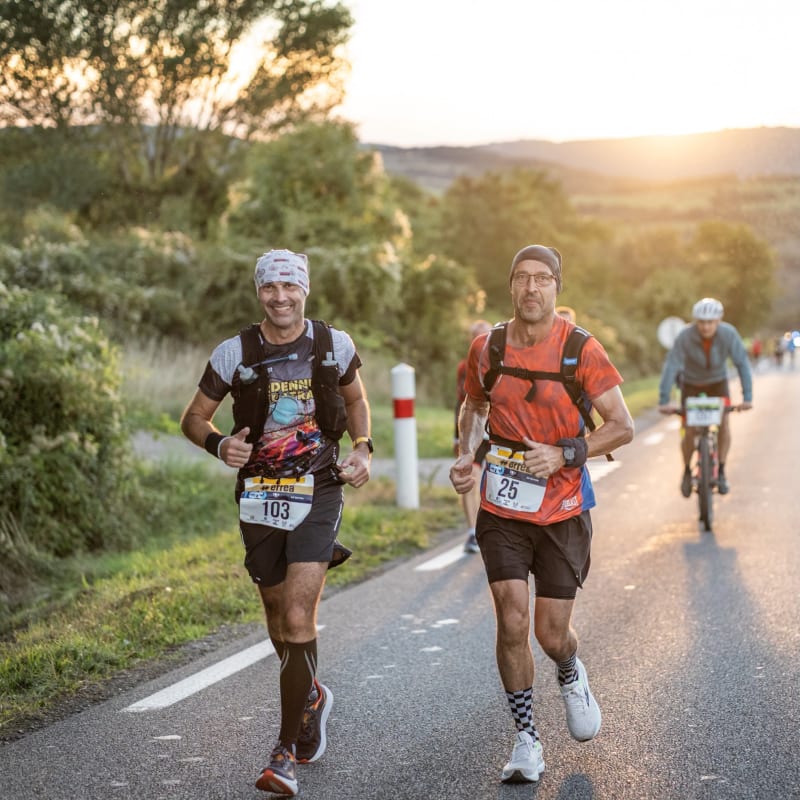
The turning point came between Millau and Saint-Affrique. Michaël Bouche, 37, who holds a licence with the club in Bucy-lès-Pierrepont in the Aisne, had previously run only marathons and won the Course du Viaduc two years ago. He climbed the Tiergues hill with impressive ease, passed both rivals and had built a 5:26 lead by 75 kilometres. Behind him, Gabriel Noutary struggled in the heat, while Toni Caporale, despite showing the strain, rallied over the final kilometres.
 © Millau 100K
 © Millau 100K
The first-timer held on despite a difficult finish, stopping the clock at 6:57:19. He joined the select group of runners to break seven hours at Millau. Toni Caporale finished second in 7:10:55, with Gabriel Noutary third in 7:17:09. Aurélien Connes, from Saint-Affrique, completed his 20th appearance in fifth place in 7:26:47. At the finish, Michaël Bouche admitted that he had raced “with fear”, driven on by the runners ahead of him. He also said he had drawn strength from the Aveyron, where he has already won an ekiden: “This is my lucky place.”
 © Millau 100K
Men’s results
1 - Michaël Bouche: 6:57:19
2 - Toni Caporale: 7:10:55
3 - Gabriel Noutary: 7:17:09
4 - Julien Gueydon: 7:25:43
5 - Aurélien Connes: 7:26:47
Stéphanie Gicquel’s next target: the world record
Millau is part of a bigger project. This summer, Stéphanie Gicquel won the Ultra-Marin for the fifth time, covering 175 km in 17:13, an unprecedented achievement at an ultra of more than 100 miles with over 1,000 starters. She prepared for the season at altitude in Font-Romeu. The French ultrarunner holds the national 24-hour records on the road, with 253.6 km, and on the track, with 249.3 km in Phoenix in 2024. She also owns the French best for 100 miles, at 14:17.
Stéphanie Gicquel is now targeting an athletics world record for an ultradistance race. To prepare, she will race one 100-miler per month at the end of 2026 and the beginning of 2027, first in North Carolina and then in Arizona. Before that, she will be in Paris in October for her various roles, notably on the French Athletics Federation’s elite athletes’ commission, as well as for her work with scientists studying heat acclimation.