
Berlin Marathon 2026: Tigst Assefa storms to victory despite rupturing her Achilles
 © SCC Events
The marathon is a challenge like no other. A unique distance that demands total commitment, pushing the body right to its limits. And sometimes beyond them. The 2026 Berlin Marathon will be remembered for all sorts of reasons. For its speed, once again: Guye Adola claimed his second Berlin title in 2:02:50, a personal best. Above all, Tigst Assefa ran a stunning 2:11:04, the third-fastest time in history. But what will stay with us from this edition are the images of the Ethiopian, still on world-record pace at 40K, suddenly limping after partially rupturing her Achilles. She dug deep to find the strength to finish. Rare images that testify to the exceptional champion she is. On the same day, Esther Pfeiffer, Manon Trapp and Alisa Vainio, all chasing national records, did not even make it to the finish. A look back at a race like no other.
This Berlin Marathon had started taking shape in early summer. When Sabastian Sawe, who had run an incredible 1:59:30 in London in the spring, was announced as a contender to break two hours once again. When Tigst Assefa also announced her intention to attack the world record and break 2:10. On paper, the 52nd edition promised to be one of the most spectacular in history. Then came the hammer blow at the end of August: Sawe withdrew after suffering an injury in training. On race day, the ambitions remained huge. That is Berlin Marathon tradition.
Among the men, Guye Adola and Gabriel Geay looked like the favourites in a field targeting 2:01 pace. Among the women, Assefa led from the first kilometre, with her regular pacemaker tasked with taking her all the way. Behind her, three Europeans had chosen Berlin as the place to break their national records: Esther Pfeiffer for Germany, Manon Trapp for France and Alisa Vainio for Finland. But the marathon rarely delivers the ending you expect. That is also why it fuels the wildest dreams. The 2026 edition reminded everyone of it: the marathon always has a few surprises in store.
Tigst Assefa wins heroically despite rupturing her Achilles
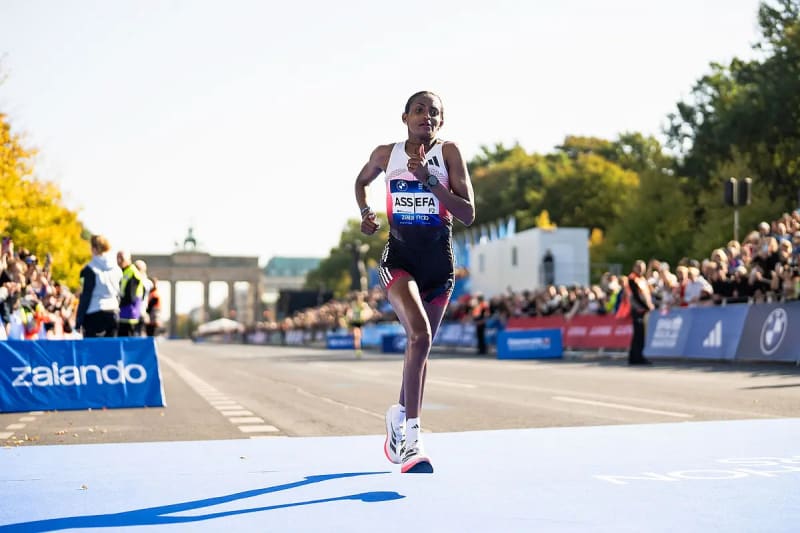
The images went around the world. Tigst Assefa limping beneath the Brandenburg Gate. She crossed the line in 2:11:04, her face etched with excruciating pain. Then she collapsed. Haile Gebrselassie himself came to help her up and assist her away from the finish area.
The world record had been within reach. But her right Achilles had other ideas… It began to trouble her at 31K before giving way two kilometres from the finish. We may have witnessed one of the most heroic performances of all time. NBA fans will remember Kobe Bryant sinking two free throws in 2013 immediately after rupturing his Achilles against the Warriors. An act of resilience that left a mark on sports fans everywhere. This Sunday on the streets of Berlin, Tigst Assefa was determined to finish. Even with a ruptured Achilles. What extraordinary mental strength. What a champion.
At the end of all that suffering came a monumental time: 2:11:04. It is the third-fastest performance in history, behind Ruth Chepngetich’s world record of 2:09:56 in Chicago in 2024 and Fotyen Tesfay’s 2:10:51 in Barcelona last March. Assefa lowered her personal best by 49 seconds, erased her own course record set here in 2023 (2:11:53) and claimed her third Berlin victory, after 2022 and 2023.
And yet the Ethiopian had far more in her legs that day. She reached halfway in 1:04:57, perfectly on course to challenge Chepngetich’s world record. At 30K (1:32:15), the projection was still inside record pace. At 40K, she went through in 2:03:00, on track for 2:09:44. Only a few minutes of suffering remained. But the pain became too intense. The Ethiopian suddenly began to limp. Her stride was no longer effective; she simply could not push off her foot. Her pace collapsed: 8:04 for the final 2.195 kilometres, roughly 3:40/km, instead of her usual 3:05/km tempo. Every stride became harder than the last. The runner grimaced, clenched her teeth and finally crossed the line. She collapsed at the end of the effort and was immediately attended to. Completely spent, she did not even take part in the podium ceremony.
 © SCC Events
She began feeling pain after 31 kilometres. From around 40K onwards, it became increasingly severe. Over the final two kilometres, the tendon was losing fibres one by one, stride after stride, until it ruptured completely at the end. […] With a tendon in that condition, I have no idea how she managed to finish. When you watch the footage, she was running on one leg; the other was only touching the ground. […] She is obviously upset, but nobody can be happy about losing a world record in the final two kilometres.
Surgery the next day, a return to London in 2027?
The diagnosis came through on Monday. Her manager, Gianni Demadonna, confirmed a rupture of the right Achilles. According to him, Assefa ran the final few hundred metres with virtually no functioning tendon, landing on her heel.
After first being treated at a Berlin hospital, she was transferred to Bavaria and operated on by Dr Johannes Gabel, a foot and ankle surgery specialist at BG Unfallklinik in Murnau, south of Munich. Her team expects around seven months for a full recovery, although there are no guarantees. The 29-year-old will surely be determined to recover in time for the London Marathon at the end of April 2027, where she will seek to defend her title.
 © SCC Events
The cruelest part of this story? Tigst Assefa knows the Achilles all too well. Her marathon career was born from an injury to that very tendon. In 2018, after several Achilles injuries, she left the track to focus on the road, where more protective shoes made running possible. But in 2019, she suffered another tendon injury. She returned to the highest level in 2022, and the years that followed saw her dominate the marathon with major wins in London and Berlin, an Olympic silver medal in Paris and a world silver medal in Tokyo. This latest tendon injury is yet another setback in the Ethiopian champion’s career. But if any athlete can return to the highest level after this, it is Tigst Assefa.
Warmest greetings to everyone. My surgery went well. I am overwhelmed by the tremendous support I have received from around the world. From the bottom of my heart, I would like to thank every one of you for your incredible support and kindness.
2026 Berlin Marathon results: Women
Place | Athlete | Country | Time |
1 | Tigst Assefa | Ethiopia | 2:11:04 |
2 | Bedatu Hirpa | Ethiopia | 2:16:53 |
3 | Dera Dida | Ethiopia | 2:16:55 |
4 | Bekelech Gudeta | Ethiopia | 2:18:58 |
5 | Alemitu Tariku | Ethiopia | 2:19:01 |
6 | Pascaline Jelagat | Kenya | 2:20:23 |
7 | Misgane Alemayehu | Ethiopia | 2:20:27 |
8 | Ludwina Chepngetich | Kenya | 2:21:25 |
9 | Evaline Chirchir | Kenya | 2:21:32 |
10 | Aminet Ahmed | Ethiopia | 2:21:45 |
Behind Assefa, there was a chasm. Nearly six minutes later, Bedatu Hirpa edged Dera Dida by two seconds for second place, while Ethiopia swept the top five. Last year’s champion, Kenya’s Rosemary Wanjiru, finished 13th in 2:24:04.
Trapp, Vainio, Pfeiffer... a wave of DNFs at the Berlin Marathon
The marathon can be a hard law to accept, even when preparation has gone perfectly. Sometimes, when it is not your day, it is simply not your day.
Alisa Vainio, stopped at 5K
First up was Alisa Vainio. The Finn had been billed as one of Europe’s best chances. Crowned European marathon champion in Birmingham in August and Finland’s record-holder at 2:20:39 since winning in Seville in February, she arrived in Berlin in superb form. Her target was clear: break 2:20. Her speciality? She races a huge number of marathons. Just 15 days before Berlin, she had lined up in the Finnish Championships marathon, winning in 2:27:47, little more than a training run for her... Berlin was already her fifth marathon of the year. She was also targeting a double with Valencia in early December.
That consistency is remarkable when you consider the enormous demands the marathon places on the body. Unfortunately, the German cobbles did not bring her a good day. At 2K, her left foot caught. Pain and stiffness spread through her entire posterior chain. Already struggling from the opening stages, she chose to pull the plug at 5K.
Manon Trapp, simply not her day
For France, all eyes were on Manon Trapp. More than a year after the Tokyo World Championships, where she finished 32nd, the Entente Savoie Athlé runner was finally returning to a marathon with a time goal, for the first time since Seville in 2025, where she ran 2:23:38, then a French record. A demanding summer block in Font-Romeu, a new coach in Thomas Vandormael, a race organised by her sponsor and one of the fastest courses in the world: everything was in place for her to challenge Mekdes Woldu’s French record of 2:23:13.
The opening was promising. She passed 5K in 16:58, on personal-best pace. At 15K, in 50:53, she was even ahead of the French-record schedule. Still in contention at halfway, reached in 1:11:48... But around 22K, the Frenchwoman stopped. It was not her day. It happens, even to the best.
Esther Pfeiffer, too much pressure on her shoulders?
Esther Pfeiffer was the most eagerly awaited local athlete. Germany’s half-marathon champion, she was coming off an outstanding year on the road, with a 30:45 10K in Laredo, Spain, and a 67:25 half marathon here in Berlin. At 29, however, this was only the second marathon of her career, three years after winning in Cologne in 2:37:00. A major social-media presence, followed daily by 107,000 people, she had made her goal clear: break Irina Mikitenko’s German record of 2:19:19, which has stood since 2008. Her husband Hendrik, an Olympic marathoner in Tokyo, was even there to pace her.
The opening kilometres were run at record pace. But around 14K, long before a marathon should become difficult, her race was already over. In a video posted to Instagram after the race, viewed nearly a million times, she explained that she had suffered severe stomach pain. The pressure she had placed on herself had tied her stomach in knots. She had slept for just two hours the night before. Too much stress, and therefore no performance. She will come back stronger, no doubt.
Guye Adola claims a second Berlin title
Without Sabastian Sawe, the men’s race had lost its overwhelming favourite, and with him the hope of another sub-two-hour performance. But not its suspense.
The lead pack stayed tightly bunched for a long time. Ten men were separated by the same second at 5K. Nine reached halfway together in 1:01:01. Selemon Barega pushed the pace at the front for a long spell, but at 30K Adola, Geay and several outsiders were still in the mix.
Then Guye Adola decided to take control. He covered 30 to 35K in 14:21 and found himself alone out front. Nine seconds clear at 35K, 18 at 40K... No one would see him again. He won in 2:02:50, a personal best, nine years after making his marathon debut here, where he pushed Eliud Kipchoge hard. It was his second Berlin title after 2021, and his second win of the year after Rotterdam in the spring. Take a bow.
Behind him, Gemechu Dida Diriba took second in 2:03:19. After losing contact, Gabriel Geay battled back to claim third in 2:03:59; the Tanzanian will have to wait a little longer for his first Major victory. Barega, who had done so much work at the front, finished fifth in 2:04:58. Ethiopia therefore completed a one-two on the Berlin roads.
2026 Berlin Marathon results: Men
Place | Athlete | Country | Time |
1 | Guye Adola | Ethiopia | 2:02:50 |
2 | Gemechu Dida Diriba | Ethiopia | 2:03:19 |
3 | Gabriel Geay | Tanzania | 2:03:59 |
4 | Getaneh Molla | Ethiopia | 2:04:55 |
5 | Selemon Barega | Ethiopia | 2:04:58 |
6 | Asefa Boki | Ethiopia | 2:05:32 |
7 | Andamlak Belihu | Ethiopia | 2:05:55 |
8 | Shura Kitata | Ethiopia | 2:06:04 |
9 | Yuhei Urano | Japan | 2:06:09 |
10 | Tadu Abate | Ethiopia | 2:07:16 |
 © SCC Events
A world record gone with two kilometres to go. National records left out of reach. Ambitions cut short before halfway. On paper, the 2026 Berlin Marathon could look like a failed edition. It was anything but. The spectacle delivered. Because the marathon is not just a time. It is a distance that forgives nothing, where sometimes you have to accept losing everything for a chance to win it all. Tigst Assefa understood that right up to the rupture. So did Esther Pfeiffer, Manon Trapp and Alisa Vainio by daring to aim high. The world record did not fall in Berlin. But Assefa proved it is no longer far away. One thing is certain: the marathon still has plenty of surprises in store. And this is only the beginning of the season...Find all the results from the 2026 Berlin Marathon on the official website.