
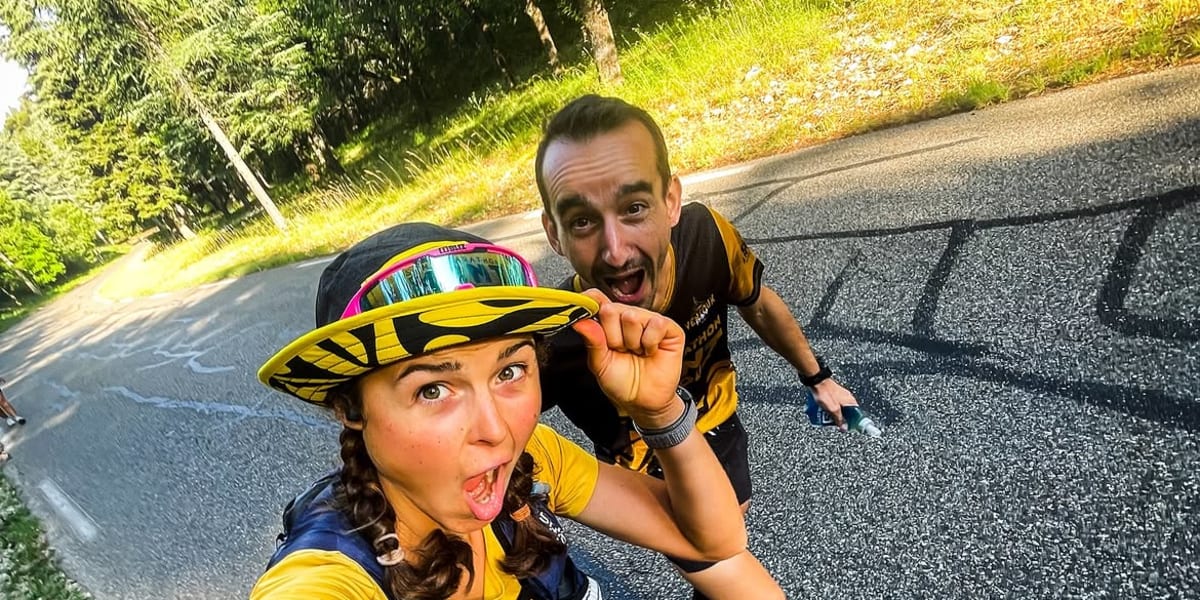
Behind every race, one figure keeps moving long after the pack has almost disappeared. They are not chasing a podium or a personal best, and they rarely appear in photos. Yet they may know the final minutes of a race better than anyone. The race sweeper brings up the rear, watches over struggling runners, reports withdrawals and stays with the last finishers all the way to the line. It is a discreet role at the crossroads of safety and support, offering a different way to experience a race: when the goal is no longer to go fast, but to make it to the end.
They are the last person to close out the race. Invisible to most, the race sweeper accompanies the final runners, looks after those who are struggling and stays with them to the end, sometimes long after the leaders have crossed the finish line. An exceptionally discreet presence, but an essential one to the smooth running of a race. The role is aptly named. The sweeper must stay behind the last competitor, make sure no one is left alone on the course and pass any problems on to the organisers. Depending on the event, they may also accompany a runner in difficulty, call for medical assistance or help dismantle the course once the last runner has gone through. It is a behind-the-scenes mission, far from podiums and cameras, one that many runners do not even notice. Louna Rizzi, known as lapetitefurette on Instagram, knew almost nothing about the role before trying it herself. A trail and cycling enthusiast, she signed up as a volunteer at the Semi-Marathon du Ventoux and was initially assigned to an aid station. A friend eventually suggested that she sweep the course with him. “Come and sweep with me. I’ll get bored on my own, it’ll be fun.”
She agreed. The day before, Louna had already ridden up the Ventoux during the Cinglée du Ventoux. The following day, she spent more than four hours walking behind the final runners in the half marathon. An unusual way to recover, but above all, a revelation. “It wasn’t a sporting challenge for me to sweep the course,” admits the newcomer to the ranks of these volunteers. “I enjoyed it because I was moving, and it gave me a chance to recover from the day before.” Her stint did not go unnoticed. After the Semi du Ventoux, several of the final runners found Louna on Instagram after coming across a video by former journalist Patrick Montel, posted on his @radiomontel account, in which she appears. Some wrote to thank her again.
From the back of the race, everything looks different. The leaders are long gone, there are fewer spectators and the clock becomes almost secondary. On the slopes of the Ventoux, the final runners walk more than they run. “Up front, people start pushing themselves, whereas at the back there’s much more of a friendly atmosphere. There’s no competition anymore, just competition with yourself.” But behind that more relaxed atmosphere, the sweeper still has to stay alert. Some runners are running out of water, others are struggling physically and the cutoff is drawing closer. They have to talk, encourage, observe and sometimes negotiate with the organisers.
At the Ventoux, some participants who were slightly beyond the cutoff were allowed to continue to the summit with the race’s approval, even though they would not be officially ranked. “We told them they could go all the way and that they would get their medal, it just wouldn’t be timed.” Above all, Louna discovered that the final runners do not always need advice about their stride. Sometimes, they simply need someone to talk to. One participant ended up telling her part of her life story as she considered dropping out. “She treated me a bit like her therapist,” Louna says with a smile. She listens, talks and encourages. The determined runner eventually made it to the summit. Another participant, who was pregnant and slightly beyond the cutoff, also benefited from their encouragement. These moments sum up the mission rather well: being there without taking the race away from the runner. “You need patience, empathy and the ability to adapt to anything.”
Encourage, don’t pressure…
Christelle Lemaire knows that feeling well by now. A volunteer at sporting events in Morbihan for more than ten years, she discovered the role of race sweeper last year at the Nordic walking event of the Ultra Marin. Having been involved in sport for years, she wanted to see the other side of a race. “I got to see what it could bring to a runner, and I wanted to experience for myself what being a race sweeper involved.”
With two other volunteers, she brought up the rear for several hours. A GPS tracker, a first-aid kit and a direct line to race headquarters: behind the image of a volunteer walking calmly with the final runners lies a genuine safety role. They have to report a withdrawal, check that a runner is fit to continue, alert the organisers if there is a problem and sometimes turn back to find someone who has stopped. “The race sweeper is there for safety. You’re finishing the race and bringing it to a close, but above all, you’re making sure everything runs smoothly throughout.” It is a responsibility that is anything but trivial, especially when fatigue gradually turns a runner into a vulnerable person.
We were more like stepping stones, or aircraft carriers, helping them reach the finish line.
Christelle is keen to stress one point: being a race sweeper is certainly not about imposing your own pace. The runner remains in charge of their race. The volunteer watches their breathing, posture and coordination, checks that they still have water and steps in when something seems wrong. “The idea was to let the runner remain in their own race space,” she explains. Some want to talk, while others would rather move forward in silence. A good sweeper has to know the difference. “That little message: ‘I see you, I’m listening.’” Christelle sums it up. A presence more than constant company. And sometimes, that presence is enough to get someone moving again. As the finish approached, Christelle and her two colleagues took turns around the final runner, picking up the pace slightly when the cutoff threatened, then returning to her rhythm. “We were more like stepping stones, or aircraft carriers, helping them reach the finish line.”
It is a neat way to sum up the role: the race sweeper does not run in place of the final runner, but can give them just enough energy to keep going. They also need to know when to do the opposite: tell someone it is time to stop. Know when to say no. Severely damaged feet, failing equipment, excessive fatigue or heat: some situations no longer allow you to push someone to the finish. The sweeper must assess the situation, talk it through and, if necessary, alert race headquarters or the emergency services. It is probably one of the most delicate parts of the mission, because it means supporting a runner while sometimes accepting that their race must end. A difficult line to find between encouragement and safety.
… all the way to the last runner
That is what makes the role so distinctive. The race sweeper is not there to perform, but to help someone else achieve their goal. It obviously requires a reasonable level of fitness, but Christelle believes the essentials lie elsewhere. “Above all, you have to be mentally available for the other person in that moment.” For several hours, you have to stay focused, available and able to deal with the unexpected. “This isn’t our race or our comfort. We’re looking after things so that it goes well for the others.” This also explains why race sweepers are so rarely seen. They only appear alongside the final runners, when most spectators have already left and the first volunteers may already be starting to pack up.
 © Anaïs Soliac / TOMA Intérim
There is another character who accompanies this final stretch of the race: the broom wagon. Not necessarily present at every event, it follows the final miles and can become a little world of its own behind the pack. At the Marathon de la Bière, Anaïs Soliac, communications manager at TOMA Intérim, has spent the past two years behind the wheel of a 4L with a very particular history. The car took part in the 4L Trophy in 2022 before becoming a communications vehicle for the company. Since 2024, it has also found a place behind the marathon runners. In 2025, Anaïs and her team covered the 42 km in around seven hours, following “Dupond and Dupont” and other particularly festive runners.
This year, the mission took a more eventful turn: the 4L accompanied a pair of Germans who had never run before taking on a marathon, followed by one of the event’s oldest participants. Until the mechanics decided to bring up the rear too. After the 30th kilometre, a major fuel leak and an engine beginning to overheat in the high temperatures eventually forced the team to park the car. It marked the end of the 4L’s career as a broom wagon, after two years spent travelling at the pace of the final runners. But the anecdote says something about this particular position at the back of the race: here too, there is less focus on the clock than on encounters, solidarity and the unexpected. “It’s a mission I loved: friendly, full of encounters and solidarity, and inevitably with a few stories to tell,” Anaïs says matter-of-factly.
They’re just as strong as the leaders, because the goal is to cross the finish line and push yourself to the limit.
The same welcome for everyone
In Vannes, when Christelle and the final participants finally approach the port, their families are there, the cheers resume and the tension lifts. “When they see us arriving at the port of Vannes, it’s a moment of release for everyone.” Then comes the emotion. “I’ll admit, we cry with the last runner.”
That is also why the role can make you want to come back. You spend hours accompanying someone you did not know at the start, watching them, encouraging them and sometimes urging them to continue, before seeing them cross the line. Louna came away from the Semi du Ventoux with a similar conviction. After spending several hours with those bringing up the rear, she now sees differently the runners she had barely noticed before. “They’re just as strong as the leaders, because the goal is to cross the finish line and push yourself to the limit. Whether you’re first or last doesn’t matter.” A race stripped of some of its focus on time, rankings and stakes, but not of its importance.
Christelle is also determined that this importance should carry through to the final metres. “It matters a lot to me that the last runners receive the same kind of welcome as the leaders when they arrive.” Because a race is not defined solely by the person who wins it. There is also the runner who takes four, five or six hours to reach the line, the one who doubts themselves, the one who walks, the one who wants to drop out but eventually starts again, and the one who arrives long after the spotlight has moved elsewhere. Behind them, there may be three volunteers, a GPS tracker, a broom wagon and a few words of encouragement. But until they arrive, the race goes on.

More articles

Investigation: The new running addicts: why they start… and never stop
Running was never your thing. Then one day you started, and now you’re a regular finisher. But have you ever wondered why you run so much?
Wed, September 9, 2026

BlablaRun Club brings runners together on the streets of Nancy
Every Tuesday, BlablaRun Club brings Nancy runners together at Place Stanislas, with three pace groups to choose from.
Wed, September 9, 2026

10K of Magical Aid Stations: the race where every sip makes your head spin
The Food Runners Club’s 10K of Magical Aid Stations returns for a festive sixth edition, where drinks, community and fun matter more than the clock.
Wed, September 9, 2026
Beer Marathon 2026: 8,500 runners won over by Montbrison’s fourth edition
An officially certified French Athletics Federation marathon where aid stations smell like craft beer, villages transform into medieval fairs, and spectators vote for the most festive town on the course. In Montbrison, they don’t just organize a race — they reinvent the rules of running, one beer mug at a time.
Sun, May 24, 2026