
adidas Adios Pro 5: everything you need to know about adidas’ new marathon super shoe
Published on Thu, September 24, 2026
 © adidas
Officially launched on September 22, the all-new adidas Adizero Adios Pro 5 brings together the brand’s best innovations. It draws directly from the very best in the range, its bigger sister, the Adios Pro Evo 3. But this new super shoe is designed to work for more runners, with added support and comfort. Although adidas has radically reworked the shoe, replacing the famous EnergyRods with a carbon ring, it retains the franchise’s look and DNA: helping every runner chase road-racing records. We take a closer look at one of the models most popular with competitive runners, and one that is sure to appear on the start lines of major marathons in the months ahead.
From the Pro Evo 3 to the Pro 5, the same DNA: speed and lightness
Since 2023, the Adizero range has been flying off the shelves and onto the start line. Whether amateur or elite, runners in the three stripes are everywhere, and especially on the podiums: in 2025, seven of the 12 World Marathon Major winners raced in adidas. adidas athletes have broken five world records in Adizero shoes since 2023 and won more than 30 major road races, including eight Majors. In short, when it comes to making shoes that go fast, the German brand knows what it’s doing.
This year has been a particularly significant one for adidas and for running as a whole. On April 26 at the London Marathon, Sabastian Sawe (1:59:30) and Yomif Kejelcha (1:59:41) became the first two men in history to run under two hours in an official marathon. On the same day, Tigst Assefa lowered her own world record by nine seconds in an all-women’s race, clocking 2:15:41. All three were wearing the Adizero Adios Pro Evo 3. For adidas, those results confirmed one thing: the formula works.
But that pair, a genuine road-racing rocket, remains an elite-only proposition: 97 grams on the scales, an ultra-limited release and a staggering €500 price tag. The Adios Pro range is anything but a second choice, though: last year in Berlin, Rosemary Wanjiru won in the Adios Pro 4, while Alexander Mutiso Munyao finished second in the men’s race in the same shoe.
That is the shoe the new Adizero Adios Pro 5 replaces, and this time the new model gets a serious overhaul, taking on the key innovations from its bigger sister. The geometry is almost identical to the Evo 3’s (39 mm at the heel and 35 mm at the forefoot, compared with 39 and 36 mm), but the Pro 5 weighs around 80 grams more, largely due to its upper and Continental outsole. In return, adidas promises greater stability, comfort and, above all, durability. The new model can therefore be seen as a more accessible alternative to the Pro Evo 3, designed for a wider audience: runners who want to chase a marathon PB without emptying their bank account.
 © adidas
 © adidas
An average weight of 177 g, representing a 12% reduction and making it 23 g lighter than the Adios Pro 4.
New ENERGYRIM carbon structure
This is the big change in the Adios Pro 5. Since 2020, every Adios Pro had relied on ENERGYRODS, carbon rods modelled on the metatarsals and sandwiched into the foam. The structure was unique, setting it apart from the conventional carbon plates used by other brands across the full length of the shoe. This time, adidas has gone in a different direction, dropping the rods in favour of ENERGYRIM, a technology already seen on... the Pro Evo 3. This carbon-infused structure sits like a ring around the midsole. The aim is to preserve the stiffness of a super shoe while leaving a continuous block of foam beneath the foot.
The new structure has allowed adidas to add more foam to the midsole. The brand claims improved performance, with 9% more energy return.
 © adidas
The new Lightstrike Pro foam boosts performance with 9% more energy return.
Underfoot: Lightstrike Pro foam and a 4 mm drop
While the Pro 5 inherits the Evo 3’s ENERGYRIM, it does not use its foam. Instead, it retains the latest version of Lightstrike Pro, whereas the Pro Evo 3 uses Lightstrike Pro Evo. The new foam is notable for combining PEBA with modified TPU (A-TPU). That is another major change: until now, the foam used in the Adios Pro range had been made from TPEE. This new hybrid combination is a major reason for the Adios Pro 5’s substantial performance gains.
In terms of geometry, the heel remains at 39 mm, while the forefoot increases from 33 to 35 mm. The drop therefore falls from 6 to 4 mm. Two millimetres may not sound like much. But if you normally run in an 8 or 10 mm drop, your calves and Achilles tendon will be placed under greater strain, especially over the closing miles of a marathon. Our advice is straightforward: if you want to race in the Adios Pro 5, spend more time training in low-drop shoes and, above all, test it over several sessions at marathon pace before race day.

Developed in the field with elite athletes
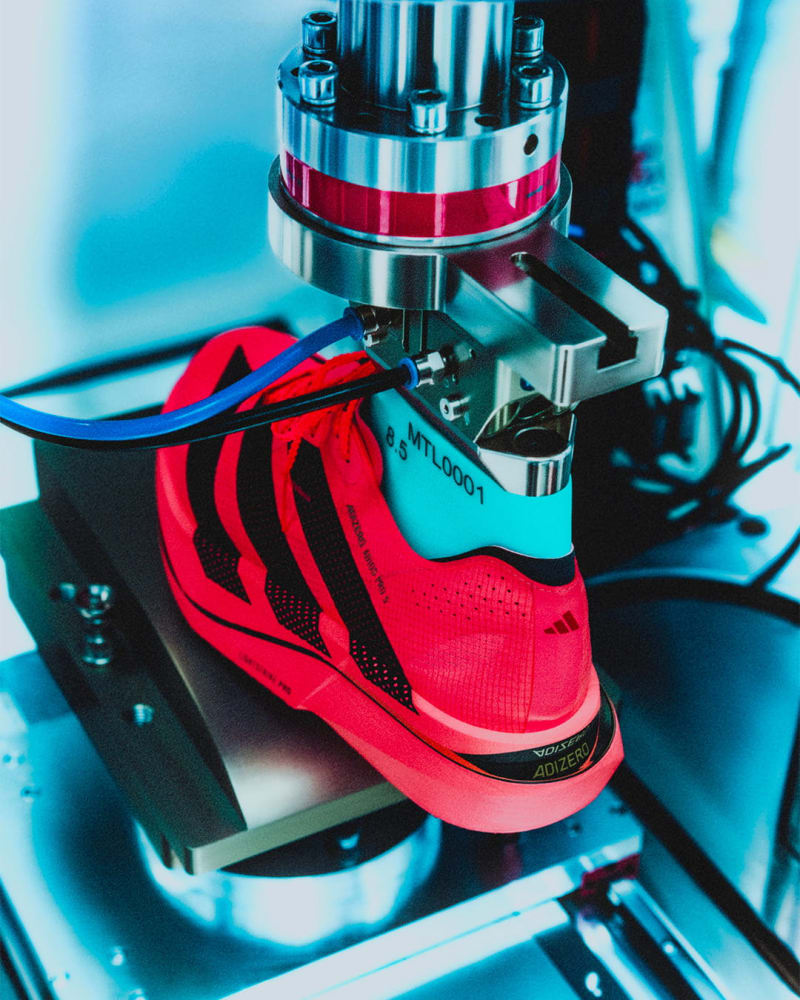
To develop the Adios Pro 5, adidas turned to the elite. More than 25 athletes in Kenya, Ethiopia and the United States helped adidas’ teams design the shoe. And not just any athletes: world-record holder Sabastian Sawe was directly involved in its development. Those trials were supplemented by long-term wear testing, internal validation and biomechanical studies conducted by independent laboratories. adidas therefore describes the Adios Pro 5 as the most extensively tested shoe in Adizero history. Perhaps this is the future of high-end performance: ultra-precise laboratory testing leading to a more personalised shoe...
 © adidas
 © adidas
 © adidas
Who is the Adios Pro 5 for?
The Adios Pro 5 will almost certainly be the choice of many runners lining up for a marathon this autumn. But it is not for everyone. This remains a racing shoe, designed for regular to experienced runners who are focused on performance. For easy runs or newer runners, a more versatile pair would be the better option.
Every record we have helped athletes break has taught us more. The Adizero Adios Pro 5 turns those lessons into our most advanced racing shoe yet, enabling more runners to push themselves and target their best performances.
Timing matters, too. If your marathon is only a few weeks away, now is not the time to change shoes. A new drop, at just 4 mm, a different fit and unfamiliar sensations mean race day is the wrong moment to discover all of that. You are better off racing in the pair that has carried you through your training and saving the Pro 5 for your next goal.
Finally, the price. At €260, the Adios Pro 5 is slightly more expensive than the previous version, which retailed for €250. That puts it around the middle of the current carbon-plated racing shoe market, while keeping it well below the new Nike Alphafly 4 at €280.
 © adidas
With the Adios Pro 5, adidas has made a radical change to its Adios Pro range: the ENERGYRIM carbon ring replaces the EnergyRods. The technology is directly inspired by its bigger sister, the Adios Pro Evo 3, the shoe worn for the first official sub-two-hour marathon in history. The result is a super shoe that is 23 g lighter, more stable and, above all, far more accessible financially. For experienced runners targeting a PB at their next marathon, it is clearly one of the shoes to watch right now. The question is whether it will enjoy the same podium success as the Adios Pro 4 at the world’s major marathons.
Find the adidas Adizero Adios Pro 5 for €260 on adidas.com from September 22.