

One foam keeps showing up in almost every shoe that’s breaking times. We met the creators of Pebax at Arkema to find out why.
Look at the label on any pair of race shoes sitting in your living room. Chances are there’s a small, discreet logo on it, almost lost in the big brands’ marketing. Pebax®. A word that sounds more like a codename than a selling point, and yet. From Kipchoge to the spikes that blew up the 400 m hurdles records in Tokyo, and across most marathon podiums since 2016, this French foam has slipped under almost every foot that matters in world athletics.
Arkema, the company behind Pebax®, sells only pellets. No outsoles, no logo on a shoebox, just raw material that then goes to processors and finally to brands, who shape it to their own recipes. To understand why this almost anonymous material became the quiet star of running, we headed to Arkema’s research center in Normandy, where Karine Loyen leads the global Research & Development (R&D) team for the product. A trained chemist, she cut her teeth in pure research before moving into development, the phase that’s all about finding new applications for in-house products, with sport becoming one of her team’s biggest playgrounds.
Her way of summing up 45 years of the material’s existence comes down to an image she keeps coming back to: a building set. Pebax®, created in the 1980s, has “been around forever,” she admits, but it’s still “like a Lego you keep tweaking, constantly adapting it to innovations and what brands are asking for.” That built-in modularity, she says, is how this old polymer has kept pace with the performance jump in the shoes that use it, without ever falling behind.
A chemical Lego born in the 1980s
First surprise: Pebax® is nothing new. The material has been around since the 1980s, long before the super-shoe boom. Karine Loyen likes to compare it to a building set. It’s a thermoplastic polyamide, in other words a plastic that can be melted and reshaped again and again, and its structure combines two kinds of molecular blocks assembled like bricks. On one side, rigid polyamide blocks; on the other, flexible polyether blocks. By changing the proportion of each “brick,” chemists can dial in a material that’s more or less soft, more or less snappy, without ever changing the basic ingredients.
That design flexibility first let Pebax® establish itself well outside the general public’s radar. As early as the 2000s, it was already used in football outsoles and, above all, in track spikes, where it now accounts for more than 80% of models. Two qualities explain the choice: standout lightness and exceptional energy return. Loaded with every stride, most materials dissipate part of that energy as heat, which leads to warming. Loyen traces it back to the polymer’s very chemistry: “because of its chemical structure, Pebax® doesn’t lose energy within the structure, it gives almost all of it back. ” Concretely, “roughly 80 to 85% of the energy the runner puts into the stride is returned by the material,” with barely anything lost along the way: a true rebound effect that can lengthen each stride and, in the end, sharpen your pace per kilometer.
From solid plastic to foam: the real turning point
The big shift happened between 2015 and 2016. Until then, most mainstream running shoes relied on EVA, a denser foam that’s far less responsive, “heavier and without that same pop,” according to the Pebax® specialist. Through discussions with major brands, an idea took shape inside Arkema’s research teams: “what if we could transfer both that lightness and that energy return of Pebax® into a foam? If we could make a Pebax® polymer foam with those properties, we could reach even higher levels of lightness!” The challenge was far from trivial: turning a raw material designed for other uses into a foam without losing its properties once expanded, with a whole chain of intermediaries between Arkema pellets and the finished midsole.
When a shoe designer switches from TPU to Pebax®, they’ll save 20% in weight.
The result took a few years to show up, but when it did, it changed everything. The very first shoes using these new foams started winning marathons. Each manufacturer files its own commercial name for its foam, but in most cases the chemistry underneath is the same polymer family. An energy return rate around 87% is often cited for the best-performing foams on the market, while classic EVA tends to top out closer to 65% and a high-end TPU foam lands around 70%. Over a full marathon, that gap can translate into minutes saved for certain runner profiles.
Pebax vs EVA vs TPU: the foam showdown
On paper, the comparison is almost unfair. Versus TPU, the star material behind Adidas Boost, Pebax® density is “20% lighter at the same volume,” Loyen notes. “When a shoe designer switches from TPU to Pebax®, they’ll save 20% in weight.” TPU, for its part, “dissipates more energy” because of its chemistry and never delivers the same spring effect. The price tag follows logically. “Pebax® is a high-performance material, chemically complex to make,” while TPU benefits from polymer “engineering” that’s more widely available and from higher production capacity, which helps explain the price gap. That complexity is also part of why the gulf is so wide between a standard daily trainer and a carbon-plated racer, with top-tier models now regularly priced above €300.
Against EVA, the difference is even clearer. EVA isn’t thermoplastic: shaping it requires an irreversible chemical crosslinking step, like rubber. Once the midsole is molded, you can’t melt it back down. Pebax®, on the other hand, stays thermoplastic all the way through, opening a door EVA can’t walk through: closed-loop recycling.
Fatigue: the Achilles’ heel of super-foams
There’s a downside to the race toward extreme lightness, and brands almost never talk about it. The more a Pebax® foam is lightened, the more air it contains and the less material, and the more its long-term durability can suffer. Some independent analyses back this up in real-world use: a new PEBA foam shows higher energy return than a new EVA, but after 450 km of wear the gap flips completely, with the aging EVA catching up to and overtaking a fatigued PEBA. Intrinsically, Pebax® itself remains one of the most fatigue-resistant materials out there, but it’s the ultra-expanded foam structure, chosen to shave the last grams, that pays the price for that lightness.
“You need that energy return, that elasticity, but the shoe still has to stay stable,” sums up the expert from Cerdato, Arkema’s polyamide expertise center, describing a constant trade-off between ultra-low density and material stability. A real high-wire act that French research teams keep working on, day in and day out.
Castor oil, patents, and AI: inside a quiet empire
Long made 100% from petroleum, Pebax® has gained in recent years a bio-based version, Pebax® Rnew, produced from castor oil. The rigid part of the polymer, a polyamide called Rilsan, can be made fully bio-based, while the flexible part remains petrochemical, which means the finished product contains a certain share of renewable content depending on the ratio of each block. Notably, this greener version retains exactly the same mechanical performance as the conventional one. “Performance is exactly the same,” insists the lead researcher. “We’re not sacrificing performance because it’s bio-based.” An argument brands like Mizuno or Scarpa could highlight on some of their models.
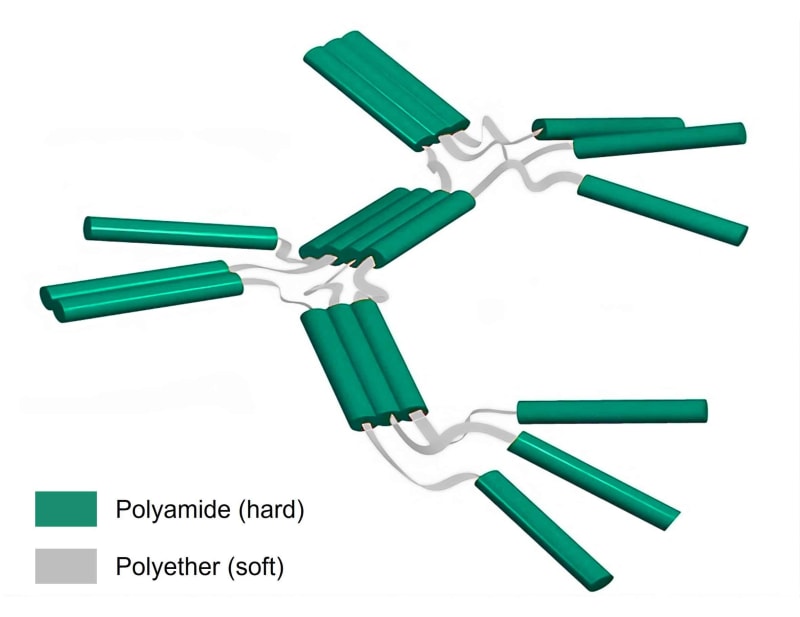 © Pebax® combines rigid polyamide blocks (green) and flexible polyether blocks (gray), a modular assembly at the root of its properties. © Arkema
On the recycling side, Pebax®’s thermoplastic advantage theoretically makes it possible to grind up and remelt a worn midsole to create new pellets, unlike EVA which, once crosslinked, can only be shredded and downcycled into lower-value uses such as mats. Arkema acquired an Italian specialist subsidiary, Agiplast, and is currently developing a recycled Pebax® that incorporates around 30% material from production scrap, now in the approval process with several brands. On also made an impression by presenting a near mono-material shoe, made entirely from castor-oil derivatives, designed to be fully reground at end of life.
On the very sensitive question of competition, Arkema is understandably cautious. The company protects its know-how through a large patent portfolio, valid for 20 years, covering chemical composition as well as manufacturing processes and thermal and UV stabilization additives. A less visible but just as strategic research track now focuses on digital modeling, with growing use of artificial intelligence to predict the optimal foam structure before even going into the lab, rather than multiplying time-consuming trial-and-error tests.
Democratization, from elite marathons to Sunday jogs
Pebax® is no longer reserved for podiums. Several major brands use it, and a growing number of mainstream training shoes now include measured doses of it. Arkema clearly embraces that democratization. Moving from artisanal production, on the scale of a marathon shoe made in small batches with lots of manual tweaking, to true mass industrial manufacturing requires a real change of scale. The material has to be more robust in processing to keep up with standard production lines, a project that’s almost as strategic as the pure performance race.
Still, the core engine remains the elite. On track, in football, in the marathon, Pebax®’s presence at the biggest international competitions is a huge image driver for Arkema, which readily claims its place in almost all spikes used at the Olympics or World Championships. Enough to keep fueling, season after season, this odd story: a plastic invented more than 40 years ago that, without ever appearing on a shoebox, has made itself indispensable to every record that falls.
More articles

Official: Kylian Mbappé leaves Nike to join running giant On
With Kylian Mbappé, On enters football and brings its running expertise to a whole new sporting arena.
Fri, September 18, 2026

Nike unveils the Alphafly 4, its new rocket built to break every marathon record
Nike launches the Alphafly 4, a lighter, more responsive carbon-plated racer built to help break marathon records.
Thu, September 17, 2026
On Cloudsurfer 3 brings softer miles with Surreal foam and redesigned CloudTec Phase
Meet the On Cloudsurfer 3, featuring the brand’s softest cushioning yet with Surreal foam and redesigned CloudTec Phase.
Tue, September 15, 2026