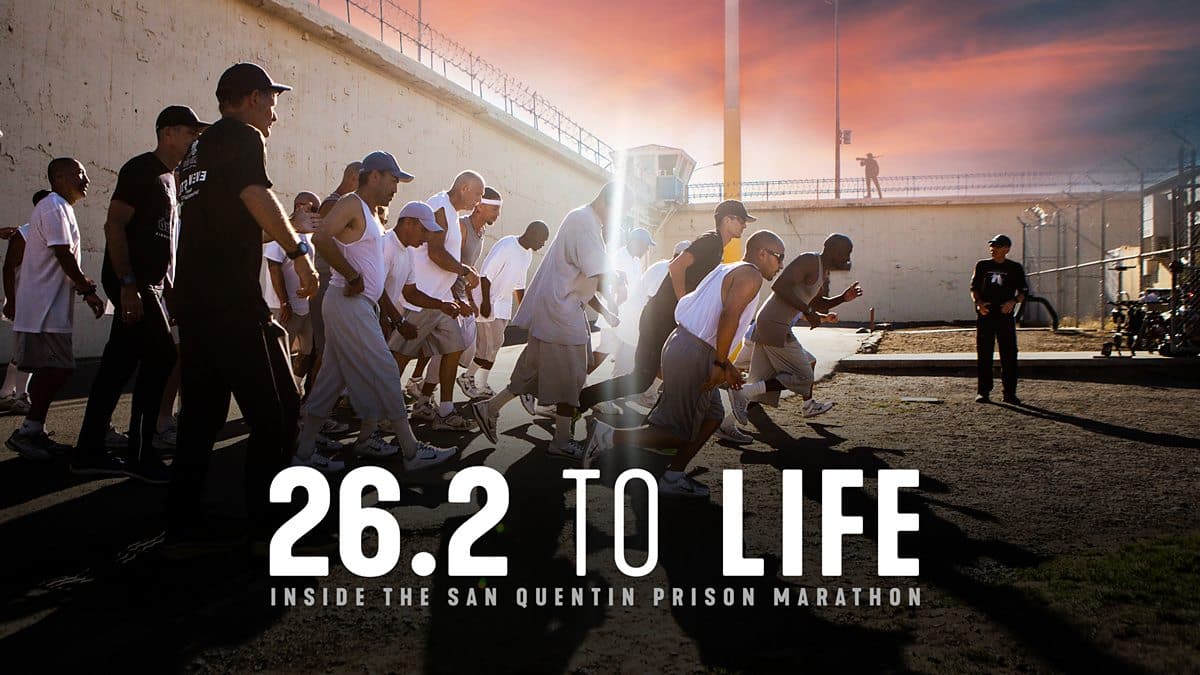
“26.2 to Life”: Running Toward Redemption
The documentary “26.2 to Life,” directed and produced by ESPN, focuses on the journey of three men convicted of murder who set out to run a marathon behind the walls of California’s San Quentin Prison. In search of redemption and a form of freedom, these inmates find hope for rebirth in running. Can running restore their zest for life? The answer lies in this film, in which coach Franklin Ruona plays a key role, acting as both mentor and pillar of support for these prisoners who are too often invisible to society.
“I consider them my family,” says Markelle Taylor, the top runner in the 1,000 Mile Club, founded by Franklin Ruona in 2005. This association, which brings together coaches and runners, is anything but insignificant. Its members are inmates incarcerated at San Quentin Prison in California, most of whom have been convicted of murder and are serving long sentences, which they hope to have reduced when they apply for parole.
At the beginning of the film, some of them have their requests denied, before they are re-examined in the final minutes of the documentary. Nothing is certain, but the film also raises the question of the usefulness of these “life” sentences, when some of the convicts now seem capable of rehabilitation. In fact, of the 45 club members who have already been released, none have reoffended. This figure speaks for itself and illustrates how belonging to a sports group can transform lives and have a major social impact.
The reason weekly training sessions are so important to inmates is because they are led by deeply committed coaches who see these men first and foremost as runners, and nothing else. Given how few visitors some of them receive, the Friday session (and the Monday session every other week) is a real ray of light in the darkness, an opportunity to feel fully integrated into a community.
Rahsaan Thomas, the last finisher of the marathon, now involved in journalism activities within the prison, emphasizes the importance of the volunteers from the 1,000 Mile Club: “There is an old Indian saying: those who think they are not part of the tribe act as if they have no relatives. With them, you feel like you belong to the tribe.” “ And he is far from alone in sharing this sentiment. Tommy Lee Wickerd also talks about this need to belong, emphasizing the collective nature of the group: not a gang, but a sphere where he is surrounded by ”good people.” “Here, I’m surrounded by coaches who are like my mother and father,” he confides in the documentary, aware of how lucky he is to be defined by something other than his crimes and his status as a prisoner.
| The marathon of redemption in 105 laps
No excessive waiting: the main subject of the film, the marathon, is shown right from the start. After about ten minutes, the runners set off on 105 dizzying laps on unsuitable terrain with treacherous ground. The winding course forces them to constantly zigzag between the other prisoners in the prison yard. The ordeal does not end there. After only two minutes of running, an alarm sounds, forcing all participants to sit down. The break lasts seven and a half minutes before the participants are allowed to start again. It is a brutal interruption, revealing the reality of prison life that imposes itself, even in the midst of an extraordinary event.
To go the distance, inmates have been training for a year, sometimes longer depending on when they joined the club. Gradually, they have learned to cope with the effort: completing a half marathon, running for two hours without walking, reaching 30 kilometers, before tackling the ultimate distance. On this cool, sunny November morning, the small team of coaches who accompany them throughout the year act as they would at any official race: they note lap times, offer encouragement, and hand out drinks. As the driving force behind this unprecedented initiative, these volunteers organize this unique marathon every year. Some runners repeat the experience to try to lower their record, while others are primarily committed to the collective project. Take Larry, for example, who became the first inmate to complete five marathons at San Quentin, in an event that only a dozen participants manage to finish each year.
Fiche technique du film
- Running time: 1h39
- Released on April 7, 2025
- Directed by Christine Yoo
- Produced by Film Hālau, Fifth Man Productions and Stoopball, LLC in partnership with ESPN Films, a leader in documentary filmmaking since its creation in 2008
| Three stories intertwined with those famous 26.2 miles
Three inmates are particularly highlighted in the documentary. First, Markelle Taylor, the best runner in the group, who is aiming for a time under three hours. “I started running to stay focused on my goal: getting out, regaining my freedom,” he says. When he crosses the finish line, most of the other participants are still only halfway through the race. He recounts the violent act that led to his imprisonment and recalls his childhood marked by violence. At the same time, we see him pass the 19.5 km mark in 2 hours and 20 minutes. Will he be able to break the three-hour barrier under these conditions? Or will he have to try again someday, in a different setting?
Another, very different profile is followed: Rahsaan Thomas, a journalist within the prison, involved in a restorative justice group and constantly mobilized by his many responsibilities. “I received a double life sentence. I will never go home. But instead of letting anger consume me, I’d rather turn it into energy,” he says. “I hope to survive the marathon on Friday. If you have seven hours ahead of you, you might see it with your own eyes.” Less passionate about running than his fellow inmates, Rahsaan trains only twice a week. Yet he is determined to complete the full 42.195 kilometers. Clocked at 3:35:16 at the 15-mile mark, will he have the energy and mental strength needed to finish the race?
Finally, Tommy Lee Wickerd appears to be the most supported, backed by a wife who is very present on screen. For him, the marathon is above all an escape from daily prison life. “I started running because I don’t like sitting around talking about prison. It’s always the same stories, just with different people.” Beyond the athletic challenge, he sees running as a way to channel his emotions. “I’m not angry about anything anymore. And if I am, I go for a run,” he admits. Comfortable on this improvised “track,” he passes the 23.4-mile mark in 3:25:21.
Through these three journeys, the film portrays lives transformed by marathon training. Here, sport becomes a tool for personal rebuilding, but also a means of inspiring broader reflection on the prison system. Born inside California’s San Quentin prison, the initiative has since influenced other correctional facilities across the United States. 26.2 to Life offers a rare glimpse into the lives of men serving life sentences who, behind prison walls, continue running toward redemption.

Sabine LOEB
Journaliste
 28/02/2026
 21/02/2026
 21/02/2026