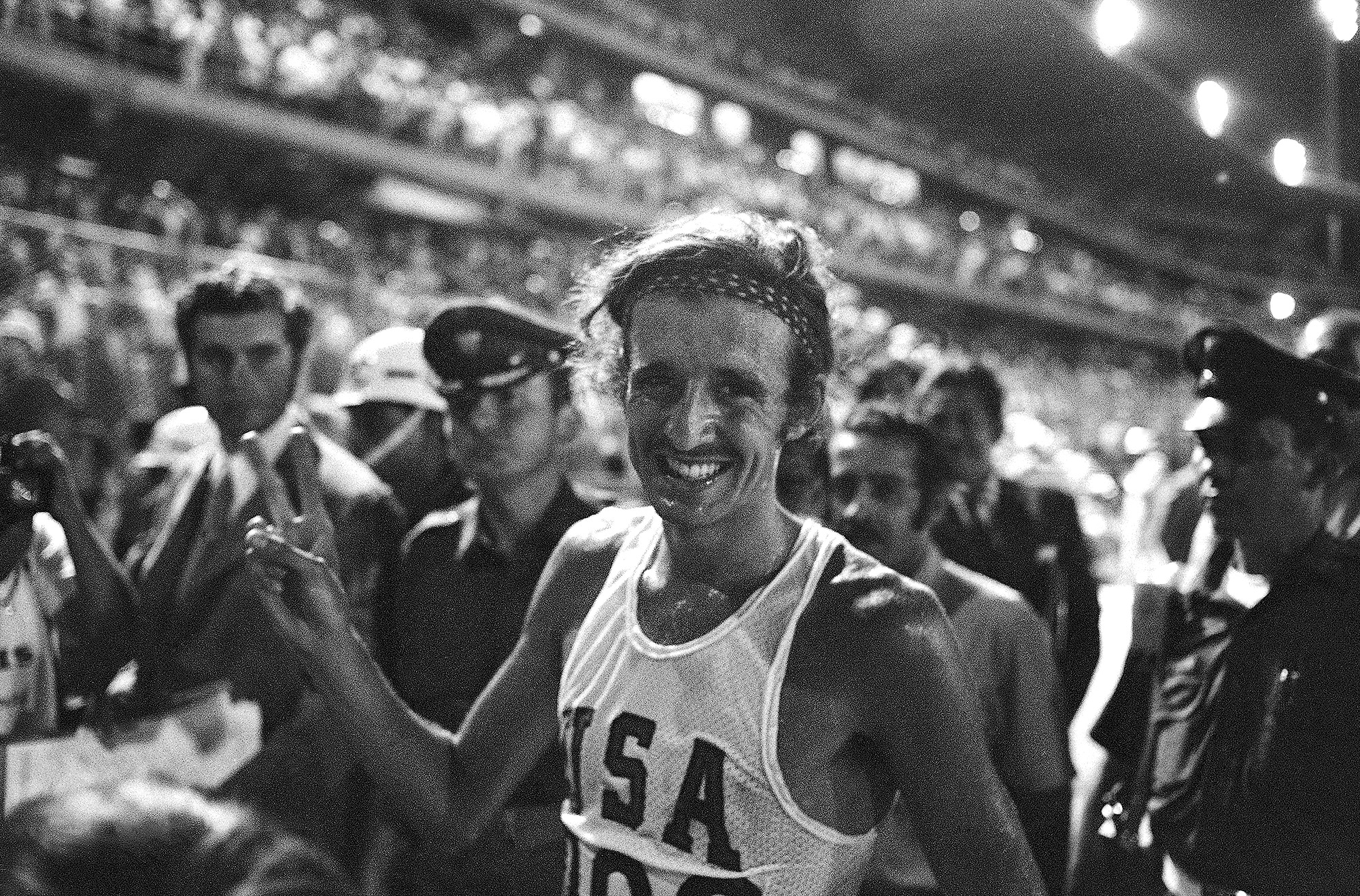
Frank Shorter, the First Running Pop Star
Olympic marathon champion in 1972 and silver medalist in 1976, Frank Shorter left an indelible mark on the history of distance running in the United States. The American runner is widely credited with helping ignite the jogging—and later running—boom of the 1970s, while also playing a major role in the fight against doping after his competitive career ended.
For running enthusiasts, the 1970s remain the decade when the sport truly went mainstream, fueled by iconic figures such as Kathrine Switzer—the first woman to officially finish the Boston Marathon in 1967—and Steve Prefontaine. Another athlete would profoundly shape the sport’s history and popular appeal: Frank Shorter. Born in Germany to an American military doctor, Shorter grew up in the United States, where he would establish himself as a dominant force. On the international stage, he won gold in the marathon at the 1972 Munich Olympic Games, becoming the first American to claim Olympic gold in the event since 1908. Four years later, he added a silver medal at the 1976 Montreal Games. These achievements turned Shorter into a national phenomenon and a symbol of American distance running.
| Frank Shorter, Born Twice in Munich
His most famous victory remains the 1972 Olympic marathon in Munich, where he won in 2:12:19, finishing more than two minutes ahead of Belgium’s Karel Lismont. A remarkable—and often overlooked—detail: Shorter received his Olympic gold “at home,” in the very city where he had been born 25 years earlier. An extraordinary twist of fate for the light-striding American runner. The performance was all the more significant as it ended a 64-year drought without an American Olympic gold medal in the marathon.
Four years later, at the Montreal Olympics, Shorter finished second, taking silver behind Germany’s Waldemar Cierpinski. Cierpinski would later be linked to East German state-sponsored doping scandals, though he retained his medal. That episode likely fueled Shorter’s later commitment to anti-doping efforts. With this second Olympic medal, Shorter joined an extremely exclusive club: marathon runners with two Olympic medals. At the time, only Ethiopia’s Abebe Bikila had achieved that feat, winning gold in 1960 and 1964. Shorter’s résumé also includes four consecutive victories at the prestigious Fukuoka Marathon (1971–1974), four U.S. national cross-country titles, and multiple national championships on the track.
Beyond his victories, Frank Shorter became a genuine ambassador for the sport. One anecdote among many that helped build his popular image: in 1975, Shorter and Bill Rodgers—future winner of both the Boston and New York City Marathons—crossed the finish line of the Virginia 10 Miler hand in hand, a striking display of sportsmanship between direct rivals. The moment helped boost the popularity of 10 km road races across the United States.
| Runner, Commentator, Brand Builder
Frank Shorter was born on October 31, 1947, in Munich, Germany, where his father was stationed. He grew up in Middletown, New York, and progressed quickly. At just 22, in 1969, he won the NCAA title in the six-mile race (roughly equivalent to 10 km). He went on to excel in track and cross-country running, collecting four national titles before turning his focus to the marathon. The first of his ten marathon victories came in 1970 in São Paulo. His career unfolded at a time when mass-participation races were growing rapidly and media attention was increasing. Shorter’s smooth running style and memorable quotes—many still circulating online—made him a media favorite. One of his most famous lines: “Running fast is more fun than running slow.”
After retiring from competition, Shorter remained deeply involved in the sport. He became a television commentator and later played a key role in founding the United States Anti-Doping Agency (USADA), serving as its president from 2000 to 2003. He also launched his own sportswear brand, now discontinued—though vintage Frank Shorter gear can still be found on second-hand platforms, including items branded with slogans like “Jogging: A Physical Fitness Program for All Ages.” In 1984, Shorter was inducted into the United States Olympic & Paralympic Hall of Fame in recognition of both his athletic achievements and his contribution to sport. He has also authored or co-authored several books.
| A Lasting Legacy
Frank Shorter’s impact on running extends far beyond medals and podiums. His Olympic victory and marathon success helped pave the way for a new generation of athletes and a new sporting culture. His 1972 triumph can be seen as one of the defining moments of the American marathon boom of the 1970s, which would later feature runners such as Bill Rodgers, Steve Prefontaine, Amby Burfoot, and Grete Waitz, alongside the growing popularity of mass races like the Boston and New York City Marathons.
American writer Cameron Stracher captured this pivotal era in his 2013 book Kings of the Road: How Frank Shorter, Bill Rodgers, and Alberto Salazar Made Running Boom. The book revisits the moment when jogging evolved into running—and when distance running became a cultural phenomenon.
Indeed, the rise of running as a mass-participation sport in the United States and beyond owes much to the aura surrounding Shorter’s Munich victory. Now in his late seventies, Frank Shorter has shaped history not only through the medals he won, but through his role in transforming running into a global lifestyle. As he once said, with characteristic simplicity: “I plan to run as long as I can—and I don’t plan on stopping.”

Charles-Emmanuel PEAN
Journaliste
 28/02/2026
 27/02/2026
 21/02/2026