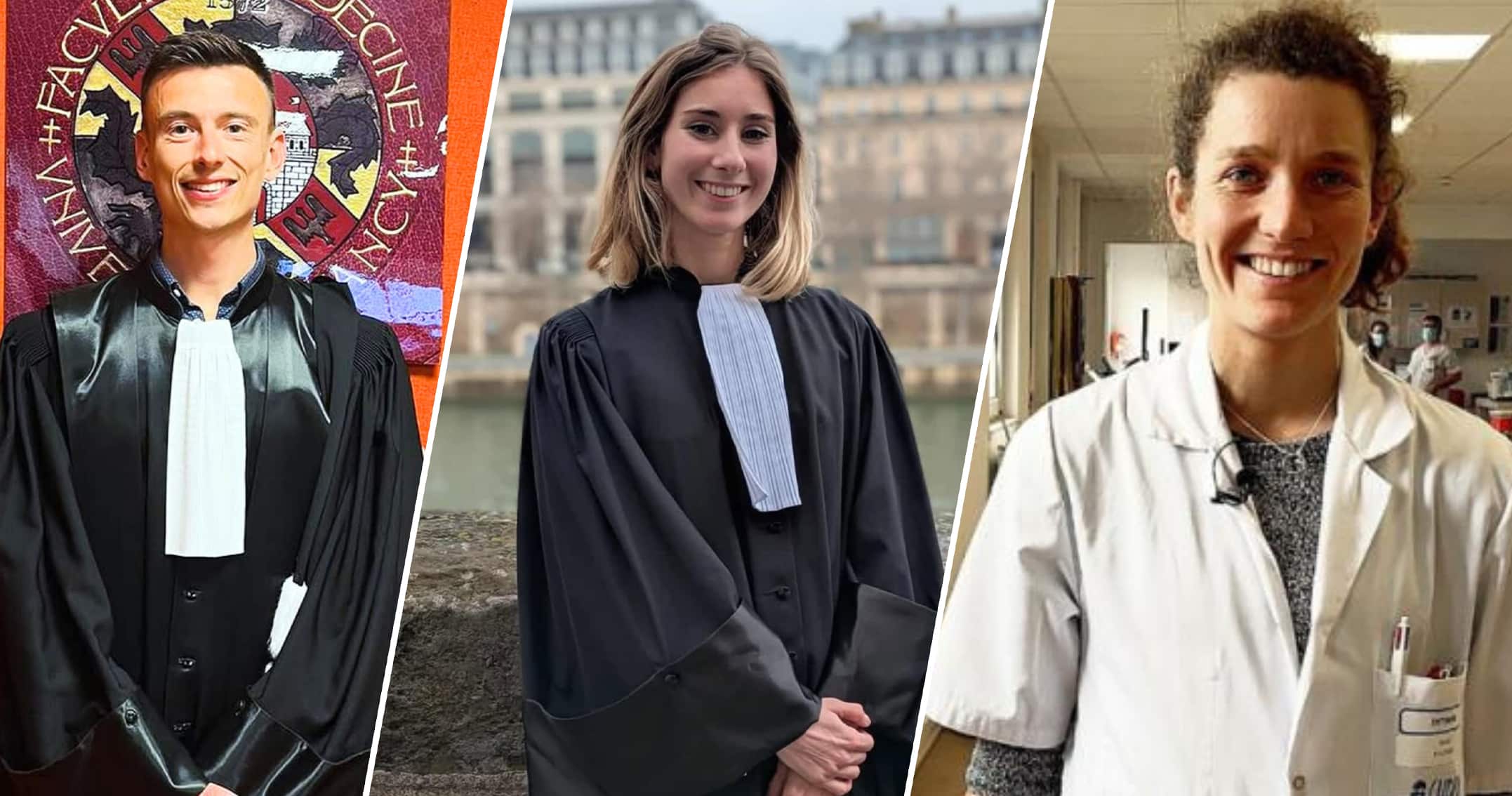
Marie Lohéac-Bouchard, Clara Liberman, Philippine de la Bigne, and Yann Schrub: The advantages and limitations of dual careers in athletics
In France, few people make a living from athletics, and often for a pittance. Faced with this unstable status, the majority of athletes have no choice but to pursue their studies and/or find a job.
✓ Decoding a double-edged reality through the testimonies of Marie Lohéac-Bouchard, Clara Liberman, Philippine de la Bigne, and Yann Schrub.
Walking a tightrope is often how athletes feel when faced with the precarious nature of their careers. Sometimes, they enjoy training half the time and working the other half. Keeping one foot outside the microcosm of athletics helps them stay grounded and feel like “everyone else.” But behind this balance, which often nourishes them, economic necessity is inevitable. Reality catches up with them sooner or later: in the first few years after high school, without financial support from their parents, athletes are forced to find a job. Even at the peak of their careers, when they have the backing of an equipment manufacturer, nothing is guaranteed: a sponsor may withdraw, a contract may not be renewed. It is therefore better to have an idea of what comes next before the end of their career. The dual project is therefore the only way to survive their high-level practice, during or aft
Ten years ago, no promising young French track and field athlete could have imagined being paid just to train for running. The idea of making a living from their passion didn’t exist. Pursuing academic studies, whether theoretical or practical, was the norm, especially for those competing at the regional level and on the cusp of national selection in the junior ranks. For them, running was just a hobby in which they sometimes performed well.
At 18, Philippine de la Bigne saw “athletics only as a hobby.” Competing at a high level had never even crossed her mind. “I didn’t do much. I went to the French Junior Championships, but without training very hard. Twice a week, three times at most.” Now 27 years old and holder of a record of 4’10″43 in the 1500m since May 2024, the Parisian sees her sport differently. The same is true for Marie Lohéac-Bouchard, who came into her own late in life: “In high school, I had a few national podium finishes, but I wasn’t selected for the French team. I wanted to study medicine, but I’ve always been athletic, so I couldn’t see myself giving up sports.”
Even among those who had already made a name for themselves at the national level, the idea of devoting oneself solely to running was not a given. Despite winning two medals at the French Junior Championships and competing in the U18 World Championships in Donetsk, Ukraine, Yann Schrub did not see a future for himself in athletics: “For me, when I started medical school, I knew I wouldn’t be able to devote myself to athletics anymore. I had had a good time running, and now it was time to focus on my studies.”
Since then, times have changed. Some young athletes are now able to attract equipment manufacturers and develop ambitious sporting projects. But the future remains uncertain. Hence the need to prepare for the future from the early years, building a professional career alongside athletics.
| L’envers du décor du haut niveau tricolore
From the outside, running enthusiasts envy these athletes with their spectacular performances, enjoying a “privileged” position in a sporting world that fascinates them. Who doesn’t dream of being invited to races, even local ones, so they don’t have to pay around €30 for a race number? Who hasn’t imagined themselves on the starting line of the 10,000m at the Olympic Games? France’s top runners are role models, often conveying a positive image of athletics where training is king. But when you pierce their bubble, the reality is less glamorous.
Very few, if any, talk about their years of wandering in search of an equipment manufacturer willing to support them. And sometimes, the energy required to secure a contract is not worth the investment when compared to studies that guarantee a future. “You beg for $500, but that just covers the cost of your suitcase for the plane. If you want to do an internship that costs $5,000, you have to beg 10 times. You might as well do nothing and stay at home,” admits Yann Schrub, very lucidly. The choice was easy at the time. I wasn’t going to tire myself out looking for partners, because that’s also a big source of fatigue. That’s why athletics has always been a hobby for me.”
Clara Liberman, the French 800m specialist with a record time of 1:58.82, also went through long periods of uncertainty despite her impressive national track record. “For almost two years, I sold shoes, did temp work, a bit of editing… really just odd jobs,” recalls the Haute Bretagne Athlétisme track athlete, talking about her arrival in Rennes. And even later, when her audiovisual BTS (higher technical certificate) enabled her to land a permanent contract at an agency, where she worked part-time as an editor, combined with a fixed-term contract in communications at her club, she did it “to survive” and, above all, to continue her athletics career, despite the modest sum of €1,100 she earned each month. “When you have to pay €550 in rent, there’s not much left. You don’t have much room for error,” she confides, now more relaxed since signing a three-year contract with New Balance. The Haute Bretagne Athlétisme athlete never shared these years of “struggle” with anyone. To her supporters, she presented a linear progression, as if her two laps around the track were the result of a life entirely devoted to athletics. To her supporters, she appeared to be progressing in a linear fashion, as if her two laps around the track were the result of a life entirely devoted to athletics.
Others are more “fortunate”: either because their parents support them financially, or because they have continued to train where they grew up, thereby limiting their expenses. Philippine de la Bigne emphasizes the importance of this supportive environment: “It allowed me to progress because I didn’t have the pressure of having to work alongside my studies.” “ Yann Schrub, whose parents supported him with accommodation during his studies, started out with few resources: ”We (his sponsor) have only been around for a year and a half. Before that, I had nothing. My volunteer coach, and that’s it. Otherwise, we don’t have that many expenses. It’s like amateur runners, they have their pair of sneakers. I got mine for free thanks to my equipment supplier. And then we stayed in Nancy or Metz to train. We went to competitions nearby, even though I didn’t do many because of my studies.”
| La course à pied, un levier pour décompresser
At 18, the idea of making athletics their profession did not exist. For many, continuing their studies while continuing to run was a given, even if medicine seemed, on paper, incompatible with running. Marie Lohéac-Bouchard therefore initially focused on her medical studies. She even thought she would have to give up running… until she met the Gras brothers. “Thanks to them, I realized that continuing to run and compete was feasible,” she says, without any ambition to shine at the highest level, but determined not to give up. For Philippine de la Bigne, the path was more traditional. As a law student, she saw her “beloved sport” gradually take up more and more of her time. The relative freedom of university allowed her to organize her time as she wished.
Running, a flexible activity, became the ideal leisure activity for unwinding. Yann Schrub, for example, would undoubtedly have given up team sports. But running gave him the freedom to follow his training plan as he wished. “When I got tired of studying, around 4 p.m., I would put on my sneakers and go to the forest. I would have a blast for 40 minutes and then come back.” Marie Lohéac-Bouchard had a similar experience. Far from imagining that she would one day reach such a high level, she began to improve while jogging to relax after stressful days. “It’s a good balance,” she says. “Medical students can quickly accumulate a lot of stress, being locked into a difficult routine with no outlet. Having running on the side allowed me to get some fresh air and take a step back from my classes.”
It’s also a way to learn how to manage pressure better. Philippine de la Bigne now sees this in her professional life: “Athletics helps me in my job, especially when it comes to stress management and perseverance. I see this in comparison to young lawyers who don’t do sports, who are sometimes much more unsettled in court.” Beyond simply being a way to let off steam, running requires meticulous organization and pushes you to become more efficient in order to fit it into your schedule. Marie realizes this: “On days when I don’t go running, I tell myself I have time. I don’t organize myself as well, and I end up running late.“ The 2024 French 5K champion agrees: ”Running gives me a discipline that I find in my job. Having a structured schedule means I’m not left to my own devices. The two feed off each other.”
This regular practice eventually paid off. By running more, Marie managed to earn her first selection for the French cross-country team, followed by several others. For her part, Philippine, who was busy preparing for the bar exam, never slowed down: “I was so used to doing both that sometimes, going for a run after hitting the books was incredibly liberating. I managed to get some good times,” she recalls, even lining up at the starting line of certain meets during this unusual period. For each of them, running became more than just a hobby: it provided an essential balance between their studies and sports, laying the foundation for a dual pursuit that went far beyond simply practicing.
| L’intérêt d’une activité en dehors de l’athlé
Having an activity outside of running allows athletes to take a break from a sport that can sometimes be demanding. Those who don’t have to choose between studies and athletics reap significant benefits: they feel better mentally, are more sociable, and feel closer to “normal” people. They feel more integrated into society, in a way.
For the past few months, Clara Liberman has been a professional athlete, a well-deserved reward after years of effort to reach the European elite. “I still hang out with people in normal courses of study, and I know that one day I’ll be part of that system. That’s why my studies are so important,” she insists, relieved to finally be recognized in the world of running, especially by her acquaintances, who understand her work better now that she is fairly compensated for doing it. Marie Lohéac-Bouchard adds: “When you only move in athletics circles, it’s a small world, so you quickly end up talking about nothing else.” Avoiding isolation allows you to stay in touch with the outside world. “If you don’t do anything else, you can quickly get bored and feel left out of society,” concludes Clara, who wants to be seen as a person first and foremost, rather than an athlete.
For Philippine de la Bigne, intellectual stimulation has always been paramount. “I prefer to find a job that I can adapt, that allows me to train a little more and recover, rather than not working and risking putting myself under a lot of pressure. “ Focusing on a single field can indeed be stressful, because you see life from a single perspective. Yann Schrub draws a parallel between the stress of medical exams and that of competition: ”In a lecture hall, you have to stay focused. In athletics, you have the stress of the result… but once you’ve prepared yourself, the hardest part is over, just like in training.” The only difference is in the physical effort required: “In medicine, you suffer less. In athletics, you know you’re going to suffer.”
Having another motivation also helps you get through periods of injury and poor performance. “It allows you to focus on something other than training,” confirms Marie, who manages her body better thanks to her medical training. Philippine de la Bigne agrees: “When a competition goes badly, it can be difficult to focus solely on athletics. Working on the side helps you move forward and not dwell on things.”
This openness also allows you to bounce back after what Clara Liberman calls her “little death” as an athlete. The Rennes native is truly passionate about her sport. The end of her career will hurt, and she knows it. “There were times when I wanted to quit, but something deep inside me told me it was impossible, that it would be like dying,” she confides, fortunately guided by other interests. Philippine, on the other hand, feels ready to give up high-level competition completely one day, convinced that her career as a lawyer will keep her excited for many years to come.
| Quand le double projet atteint ses limites
However, this model is not ideal. Juggling two projects is not easy and, especially in the early years, leads to chronic fatigue and the temptation to give up, as the mental strain can push you to the brink. Lately, Marie Lohéac-Bouchard has been prone to injuries. “Without realizing it, I’ve hurt myself a lot, probably because of the fatigue of doing both,” she realizes.
When she started out in the junior category, Clara Liberman embarked on audiovisual training alongside her coaching. “Those were the hardest years. I had 30 hours of classes a week, including the whole of Saturday, which I couldn’t miss,” she says. “Weekends were either for training or competing. I sometimes had a day off on Thursdays, when I was working from 8 a.m. to 9 p.m. … it wasn’t restful at all. It affected my athletic performance, which was the worst of my career.”
Philippine de la Bigne, who also faced this grueling pace, recalls: “I wanted to be everywhere at once: top of my class at university, a high-level athlete. I put a lot of energy into everything and spent all my years as a young athlete injured. It was very frustrating, but I also learned to slow down and understand that sometimes it’s necessary. “
With time and maturity, they found their balance. “Today, I work three days a week and sometimes find it tiring,” admits Philippine, a part-time lawyer. “I don’t understand how I did it before.” For Marie, who is from Brittany and has just defended her thesis, her approach has also changed: “I train once a day and prioritize sleep. The benefits outweigh a few extra kilometers.” Taking a step back and gaining experience transforms the relationship with training. Athletes learn to manage their workload, stay healthy, and continue their dual projects without exhausting themselves.
| Une façon de prévenir l’avenir
For those who have the opportunity and ability to study, isn’t it a way of equipping themselves for life after their career? “I have friends who studied a little less, and I’ve always wondered how they felt about it psychologically,” recalls Yann Schrub, the new European 10 km record holder, who was confident about becoming a medical student after graduating from high school. Brilliant from the outset, passing his PACES exam in just one year, the Moselle native secured his future, without knowing that it would also hold some wonderful surprises in store for him: a first bronze medal at the European Championships in Munich in 2022, which “fell into his lap,” another silver medal two years later in Rome, and then selection for the Paris Olympics. “That’s the beauty of the future. You never know what’s going to happen,” he smiles. Today, at 29, Yann, the new European record holder in the 10 km (26’43 in Castellón), is more of an athlete than a doctor, even though he works about ten hours a week in a practice, “an escape” that he enjoys, aware that he will be called upon to practice full-time in a few years.
For Philippine de la Bigne, going to college was also a no-brainer. “It was important not to be completely dependent on my parents,” explains the representative of Entente Paris Université, who was ‘predestined’ to become a lawyer. Her vocation had been clear since childhood, even though, like Yann, she never “put all her eggs in the athletics basket.” In her view, an athletic career can be long and impressive in terms of longevity. But you have to “be able to bounce back,” she insists, in agreement with her parents, for whom it was “out of the question” for her not to have a degree.
Clara Liberman’s story is slightly different. From high school onwards, she had her sights set on high-level sport thanks to a tailored curriculum, but her path was not as clear-cut as that of her fellow cross-country skiers. “I made a bit of a mistake at the beginning by going into sports science,” she recalls. “I got injured, which interrupted my athletic and academic plans.” A gap opened up, and the former member of the Pays de Fontainebleau club chose to pursue a technical degree focused on editing. It was a temporary sacrifice for her athletic career. “I knew I was putting my career on hold for something better later on. I wanted to secure my studies a little, with a diploma in my pocket. Two years isn’t that long.” She concludes lucidly: “Whatever your career, no matter how much money you can earn, at 30-35, it’s over.”
For all of them, juggling athletics with studies or a job was no easy feat. It required sacrifice, learning to organize themselves, and not overworking themselves. However, continuing to run gave them breathing space, social balance, and undeniable mental support. The two worlds shaped each other, although one might wonder: would not having to work to finance their daily lives or prepare for the future have allowed them, in some cases, to aim higher? Who knows? The answer is unique to each individual.
Sabine LOEB
Journaliste
 21/02/2026
 21/02/2026
 21/02/2026