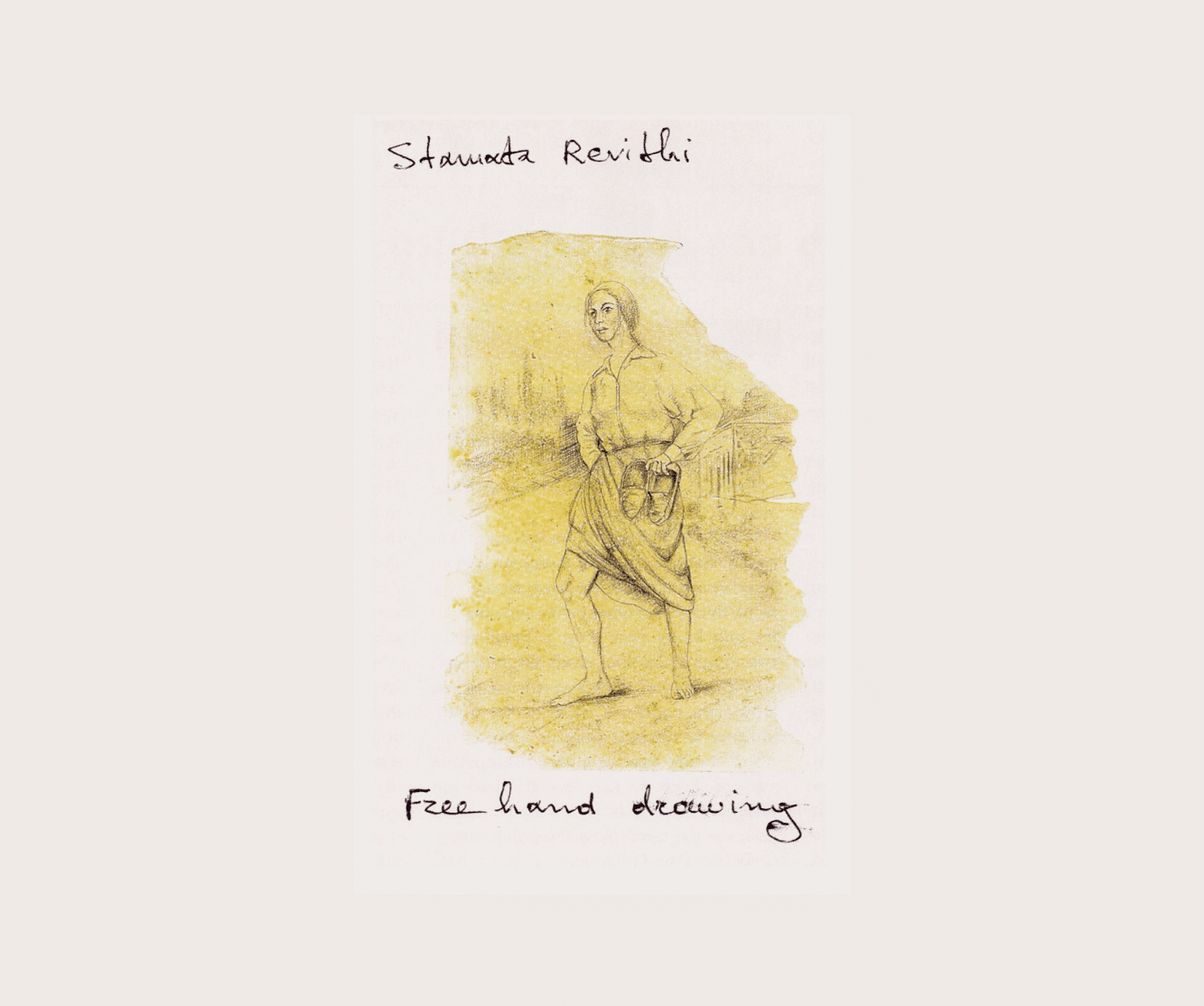
 Stamáta Revíthi, dessinée par l'historien Athanasios Tarasouleas
Stamáta Revíthi, the Unsung Pioneer
In April 1896, in Athens, as Greek water carrier Spyridon Louis celebrated victory in the first modern Olympic marathon, a woman set out the very next day to run the same 40-kilometer course—without a bib, without official recognition. Her name was Stamata Revithi, and she would become history’s first truly defiant female marathon runner.
In 1896, on the advice of French historian Michel Bréal, the Athens marathon became the centerpiece of the newly revived Olympic Games imagined by Pierre de Coubertin. On April 10, seventeen men lined up to run approximately 40 kilometers (the official marathon distance would only be standardized in 1908, at the London Olympics). No women were allowed to compete—simply because the rules forbade it. Among the justifications put forward at the time, one of the most controversial was the idea of protecting women from the supposedly inappropriate gaze of male spectators.
Yet one woman tried everything she could to take part in the official race, ultimately won by Spyridon Louis in 2:58:50. Revithi, a native of Syros, was determined to compete but was refused entry. The day after the race, on April 11, 1896, she set off alone from Marathon, east of the capital, heading toward the Panathenaic Stadium. Her stubborn and remarkable journey has since become a symbol.
| Running Against the Rules
The marathon at the 1896 Games was designed strictly as a men’s event. At the time, arguments ranged from references to the male-only ancient Olympic Games to claims that women’s bodies were unsuited to endurance efforts. Coubertin himself later made his position clear in 1928, arguing that women could take part in sports if they wished—so long as no spectators were present, implying that public competition was inappropriate for them. It would take nearly a century—until the 1984 Summer Olympics—for a women’s marathon to be included in the Olympic program.
Traditions die hard. Revithi formally requested permission to race, but officials turned her down. Even the priest assigned to bless the runners refused to acknowledge her. So she took matters into her own hands. On April 11 at 9:00 a.m., she set off alone. By 1:30 p.m., despite several stops along the way to recover, she had completed the distance. Even then, she was denied entry to the Panathenaic Stadium, where the official celebrations had taken place the day before. Still, her determination earned her a place in history. While details vary depending on sources, these discrepancies are partly explained by the coexistence of the Julian and Gregorian calendars—Greece was still using the former at the time.
| Une course pour sortir de la pauvreté ?
Newspapers of the era did report her feat. Greek historian Athanasios Tarasouleas, who has studied the story in depth, found traces of her run in contemporary press archives. The daily Estia referred to “Mrs. Revithi, the extraordinary woman who, having run the Marathon a few days ago as a trial, intends to compete again.” She was even quoted as saying: “If my shoes bother me, I will take them off along the way and continue barefoot.” The article suggests she may have completed a first trial run in about 4:30, which may explain the confusion surrounding her story.
Indeed, some accounts mention another female runner named “Melpomene,” borrowing the name of the Greek muse of tragedy. According to certain interpretations, this “Melpomene” may simply have been Revithi using a pseudonym. Historians remain divided on this point. What is certain, however, is that Revithi did run the marathon distance. Biographical details about her remain scarce. She is believed to have been born around 1866 on Syros, in the Cyclades. At the time of the Olympics, she was living in poverty, a mother of one child who had recently lost another. It is said that she walked to Athens in search of work, heard about the marathon, and decided to take part. Whether her effort helped her escape poverty is something history does not tell us.
| À quand une statue Stamáta Revíthi en Grèce ou ailleurs ?
Revithi’s bold act did not immediately transform Olympic rules. Women remained excluded from the marathon for decades. Yet her run set an important precedent: she was among the first women known to have publicly challenged the ban on female participation in endurance events. Whether driven by necessity, defiance, or both, her gesture has taken on strong symbolic meaning over time.
With the development of historical research into women’s struggles for equal rights in sport, her story has been rediscovered. Her run now fits into a broader timeline of isolated but significant acts—like that of American runner Kathrine Switzer in 1967—long before official recognition followed. In Greece, Revithi’s story has gradually been reintegrated into the national narrative of the marathon, where she is increasingly seen as a pioneering figure. The work of historians such as Athanasios Tarasouleas has played a key role in this recognition.
So when will there be a statue or even a museum dedicated to Stamata Revithi? Her story—marked by stubborn determination and quiet courage—surely deserves it, and continues to inspire dreamers around the world.

Charles-Emmanuel PEAN
Journaliste
 28/02/2026
 27/02/2026
 21/02/2026