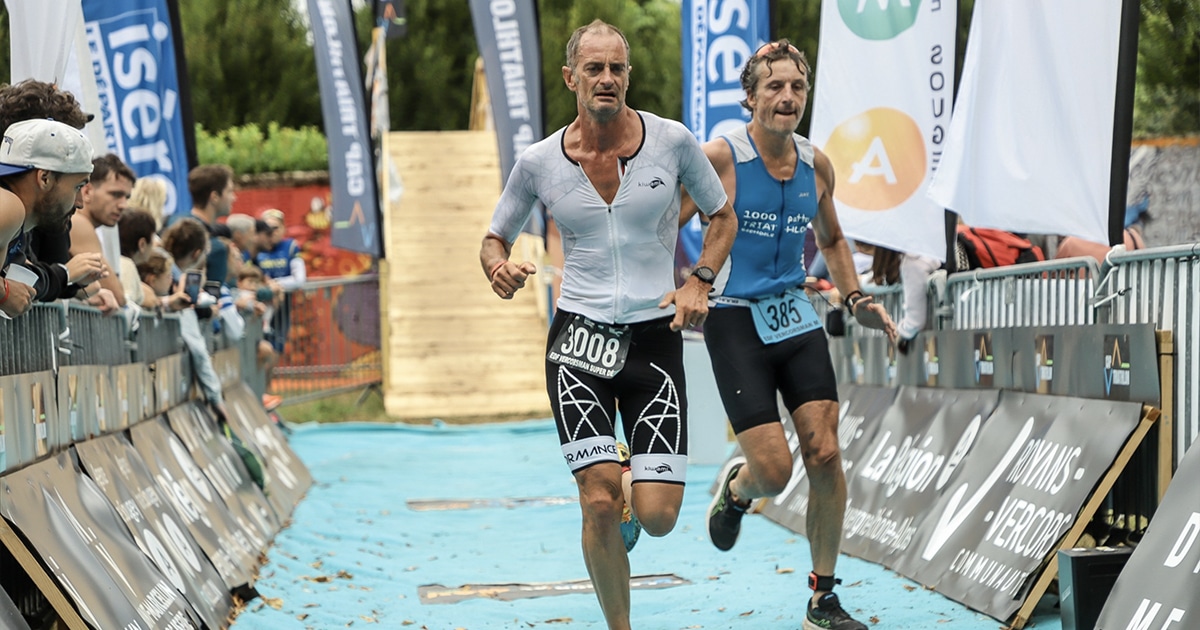
 © EDF Vercorsman
What’s the Point of Bicarbonate for Runners? Fabrice Kuhn Cuts Through Locker-Room Myths and Road-Reality
In the running world, everyone has their little “secret weapon”: a last-minute caffeine hit, beetroot juice during training, a pinch of salt tucked into a pocket just in case. And then there’s bicarbonate of soda. Yes—the same stuff sitting in your kitchen cupboard. In recent years, it’s been making the rounds like some mysterious potion that promises to erase the burn in your quads. But what does it actually do for a runner? To separate fact from folklore, Marathons.com spoke with French sports physician Fabrice Kuhn, who brings a refreshingly clear take on the topic.
Bicarbonate isn’t some hidden elixir—it’s first and foremost a physiological mechanism rather than a supplement. During intense efforts, muscles produce hydrogen ions (H+) that acidify the cellular environment and limit contraction. In real terms: that exact moment when your legs stiffen, your stride loses spring, and the burn climbs upward. So what does bicarbonate do? Fabrice Kuhn—well-known in France and author of several nutrition books, including La Science de l’Endurance (volumes 1 and 2)—breaks it down simply: “It buffers the acidity produced during hard efforts, neutralizes what accumulates in the muscle, and allows the fibers to function better.”
In other words, it pushes the boundary of “bearable” just a little further. But this isn’t universal—it’s strongly tied to intensity. “The harder the effort, the more acidity you produce,” explains Kuhn, who has been a triathlete for nearly 20 years and competed at the 2019 Ironman World Championship in his age group. “And the more buffering you need to keep it under control.” What bicarbonate offers is essentially a reprieve—not a transformation.
| Solid effectiveness… but in a very narrow window
Research is consistent: bicarbonate has a measurable effect on efforts lasting between one and twelve minutes. It’s a narrow range, but an important one—covering the classic “lactic” distances where the aerobic system can’t keep up. Kuhn doesn’t sugar-coat it: “For endurance, it’s not the thing that’s going to revolutionize your performance. Studies show an effect up to 12 minutes—we’re far from the marathon.”
The contrast is stark. What makes sense for an 800 m, 1500 m, or 3000 m becomes irrelevant beyond that. Could there still be some marginal benefit on the road? A marathoner with a personal best of 3:01, Kuhn weighs the idea: “Scientifically, we don’t have proof. But maybe in the final stretch, especially if the course forces you to change pace.” A surge on a hill, a tight corner, a last-kilometer sprint—tiny moments, but performance often hinges on tiny moments.
Practically speaking, bicarbonate is most useful before specific training sessions—not to boost marathon pace, but to help runners absorb hard lactic workouts: a set of 8×800 m at 5K pace, fast 400 m reps, relay work with a club. In that context, extra buffering can help squeeze out one or two more reps, lifting the overall quality of the training block. It’s a preparation tool, not a competition one.
| Not for everyone — and its digestive “efficiency” is far less magical
Then comes the downside: tolerance. Bicarbonate is notorious for upsetting the stomach, and Kuhn doesn’t dance around it. “Digestive issues with bicarbonate are very common,” he warns. The “classic” protocol—0.2 g per kg taken three hours before the effort—is science-approved but often accompanied by nausea, bloating, and emergency sprints of a very different kind.
Exactly the kind of thing runners want to avoid. Enter gastro-resistant capsules. They help—but they’re no guarantee. “If you want to reduce digestive problems, gastro-resistant capsules are ideal.” Still, even with them, the risk never fully disappears.
This supplement is not trivial. For some people, it’s even discouraged. At 52, Kuhn is unequivocal: “For someone with high blood pressure, I’d avoid it. The sodium can raise blood pressure.” A crucial reminder for a product many take lightly. Yet he avoids alarmism: “It’s not dangerous—aside from digestive issues. It’s simply not useful for endurance. But you can use it if you know exactly why you’re using it.” A perfect summary of bicarbonate’s real place: neither miracle nor threat, just a specialized tool.
| The illusion of a quick fix — and a drift toward doping?
There’s always the temptation to hunt for an external boost, a discreet trick to gain what training alone won’t give. Kuhn, once again, refocuses the hierarchy of priorities: “Before thinking about bicarbonate, optimize sleep, training, strength work, diet, and fueling strategy.” That’s the foundation. Everything else is just physiological window-dressing. And if he had to recommend only one supplement that truly improves performance? No hesitation: “Caffeine!” The message couldn’t be clearer—stick to what actually works.
Another recurring question: if a supplement improves performance slightly, does it lead toward doping? Kuhn—whose last marathon was Paris 2019—dismisses it calmly: “There’s no proof it’s a gateway to doping. I’ve taken bicarbonate myself and never felt the urge to go further.” The real risk, according to him, lies elsewhere: overconsumption, and the belief that every minor supplement is essential. “The danger is wasting money and piling on products that don’t do much for your health or performance.”
Bicarbonate isn’t a lie, nor a miraculous solution. It works—but only in a very specific context: lactic efforts where acidity rules the game. For an 800 m runner, it makes sense. For someone training for a 5K, it may help here and there. For a marathoner, it’s marginal. For an ultrarunner, it’s pointless. It’s useful for what it is—and only for what it is. And Kuhn sums it up better than anyone: “I don’t advise against it. I just don’t think it’s useful.”
➜ Discover the marathon calendar

Dorian VUILLET
Journalist
 28/02/2026
 27/02/2026
 21/02/2026