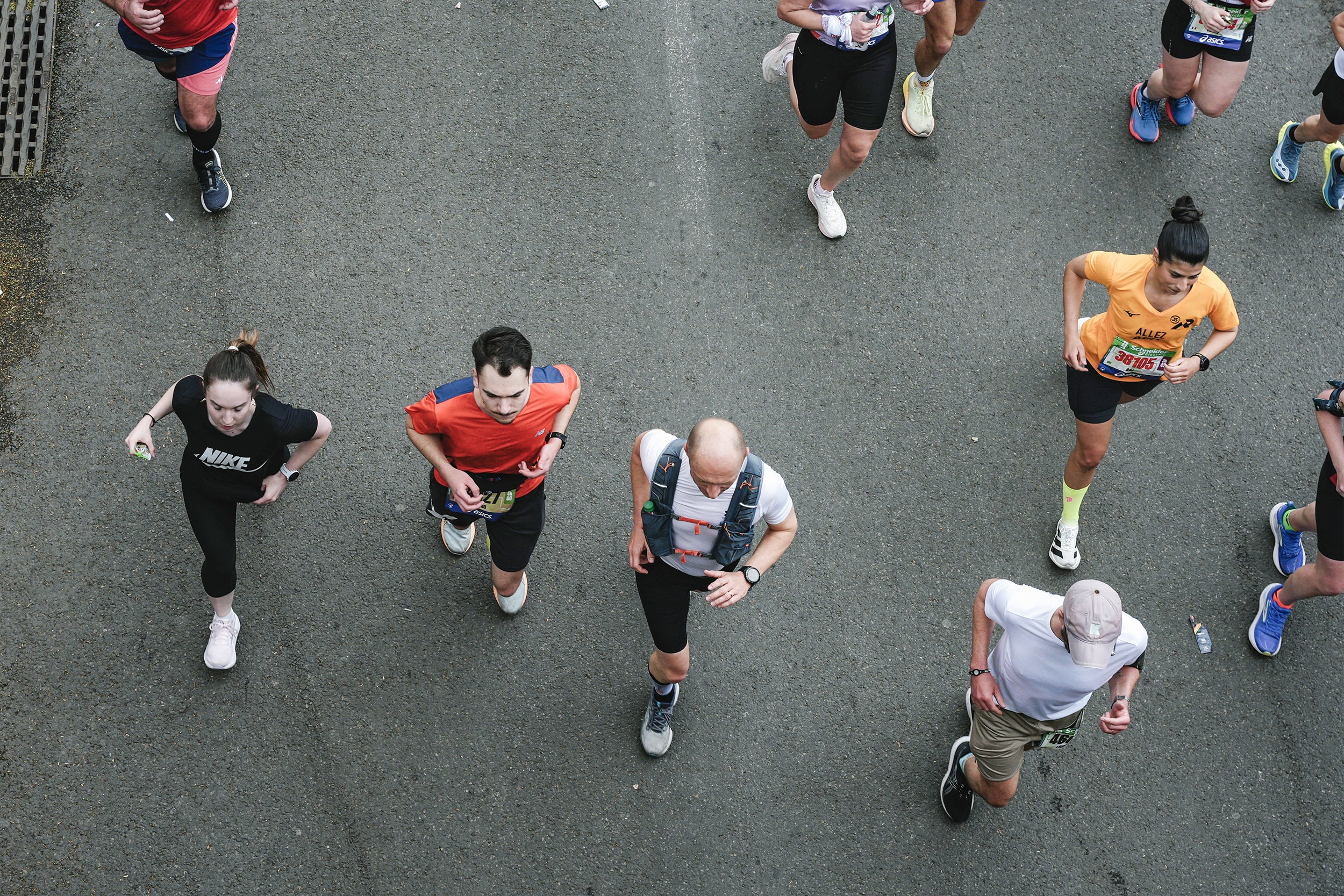
 © ASO
© ASO
When Running Becomes a Way of Life: Routine, Nutrition, Travel, Reading… Everything Revolves Around the Marathon
Some call it a passion, others a gentle obsession. Once the marathon enters a life, it doesn’t just pass through—it settles in, reshapes the days, disrupts habits, and eventually gives meaning to everything it touches. With meticulously planned routines, weighed meals, scheduled trips, and inspirational reading, running becomes more than a sport. It becomes a way of living, of existing, of moving forward… literally and figuratively.
Listening to Woodkid’s Run Boy Run 38 times in a row won’t magically bring your time under two hours, but the idea has its charm. Many runners embrace it anyway. When mind, heart, and sneakers are focused on a single obsession—the marathon—everything else starts to fall into place. Work, meals, weekends, playlists… life turns into a long mental jog, guided by one refrain: prepare, run, repeat. “We are limited only by what we believe we can be,” as the Kenyan GOAT Eliud Kipchoge once perfectly put it.
| Staying Focused on the Goal
It often starts with a spark—a New York Marathon video, a friend returning with a finisher medal, a desire to prove oneself capable. From that moment, nothing tastes quite the same. Every run becomes a step toward “the big race,” every interval session a silent battle against laziness. The marathon is more than a physical challenge; it’s a miniature life project.
“Running a marathon is mostly about learning to know yourself, respect yourself, and push your limits,” said Christelle Daunay, 2014 European marathon champion in Zurich. It’s a promise to oneself. And keeping it requires discipline—saying no to late-night parties, Sunday lie-ins, or midnight burgers. In short, building a world where everything revolves around the kilometers run.
| The Marathoner’s Routine
Among runners, some fit runs in when they can, others live to run. Alarms ring earlier than the local baker’s, outfits are laid out the night before like mission uniforms, and weeks stretch according to long, rainy Sunday runs. “On mornings when it’s raining, you think it’s impossible,” confides Thomas, 24, already a finisher of multiple marathons including La Rochelle. “Then you head out… and come back proud, even soaked.” Running becomes ritual: favorite socks, GPS watch fully charged, “boost” playlist for thirty kilometers of suffering. Often, it’s done alone, very early, in the rain—and it feels almost romantic.
| Sunday Nutritionist
Preparing for a marathon also happens on the plate. From porridge enthusiasts to cappuccino-flavored energy gel converts, everyone finds their fuel. Meals become strategy, Friday-night pasta a sacred ritual. Runners learn to love bananas that are almost too ripe, measure intake carefully, and avoid excess. The post-run pint is the only tolerated indulgence. With one goal in mind—crossing the start line light, sharp, ready to digest the miles—“we also run with what we put in our stomachs, it all counts there,” says Thomas.
| Planning Life Around the Race Calendar
Over time, marathons become temporal landmarks. Spring: Paris. Autumn: Berlin. Summer: a high-altitude race “for fun.” Vacations are chosen based on course layout or elevation. Hotels near the start are scouted, travel time to pick up the bib calculated, and a restaurant booked for the post-run feast. Traveling to race becomes second nature. The world splits into two categories: cities already run, and cities waiting their turn. Marie, a 27-year-old marathoner from Lille, sums it up simply: “I plan my trips around races. Even for a few days, I want to feel the city while running.”
| When a Bib Becomes a Passport
Some collect magnets, others marathons. “Race tourism” increasingly attracts enthusiasts who turn every race into a cultural adventure. Running in Tokyo, treading through Central Park, climbing Lisbon’s hilly streets… the bib becomes a passport, every medal a personal souvenir. Behind every finish time, a memory: the crowds of Boston, the heat of Rome, the fine rain of London. Effort merges with travel. A city is explored differently when running, through breath and pavement.
| Running Culture in the Blood
And when the sneakers are put away, the passion continues. Books on mindset, documentaries on Eliud Kipchoge, podcasts on mental preparation… “Only disciplined people are free,” a mantra long embraced by the Kenyan legend. Indeed, the modern runner educates as much as they sweat. Some reread Born to Run as a manifesto, others follow pro videos religiously on YouTube. Running becomes culture, language, a way of inhabiting the world. A marathoner doesn’t just run: they dream of running, talk about it, analyze it, dissect it. Training doesn’t stop at the finish line—and it will begin again, over and over.
After the medal is hung, a pause is promised—sleep, rest, think of other things. Then a notification pops up: “Valencia Marathon registrations are open.” And the heart starts again. Because the marathon isn’t just a race. It becomes a way of life, where every stride tells a different story.
➜ Discover the marathon calendar
Dorian VUILLET
Journalist
 28/02/2026
 27/02/2026
 21/02/2026