
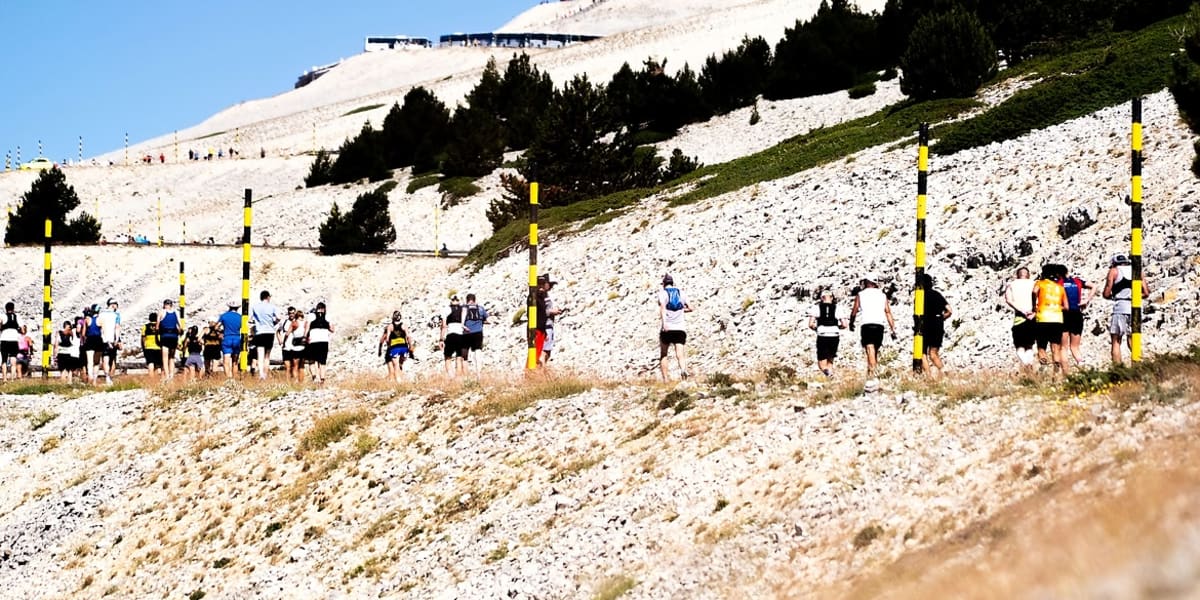
 © Semi-Marathon du Mont-Ventoux Kookabarra
The half marathon is closing in, but the marathon is still hard to catch
1,800 bibs at most for 8,000 to 9,000 hopefuls at the foot of Mont Ventoux, an inaugural half in Avignon sold out in two hours, a world record smashed in August in Buenos Aires. The 21.0975 km is no longer a bit part and is racing flat out behind its big brother. Catching it, though, looks a lot harder than a matter of times or entry caps. Organizers, coaches and numbers don't quite tell the same story.
At the foot of Mont Ventoux, Bertrand Delhomme is not short of requests. The native of Bédoin took over the Semi du Ventoux after Covid, a race its predecessors had kept very local for a long time, and watched it explode within two or three years, to the point of turning it into a classic whose reach far outstrips its number of starters. The lure of the “most difficult half marathon in Europe” helps, with its “1,600 meters of elevation gain over 21 kilometers” that makes even seasoned road runners wince. The result fits in one line of accounting. “We were at 1,700 bibs handed out, 1,800 at the very most, partners included, for a demand that I think was around 8,000 to 9,000 before registration opened,” he sums up.
In Avignon, where he co-founded a marathon with Christophe De Cecco, the script repeated itself on a rolling, touristy course looping through the city center. Half marathon registrations went in two hours, and the organizer is convinced that “we could have filled 5,000 to 6,000 people without any trouble,” had the desire to manage numbers for a first edition not held the machine back. Elsewhere, the phenomenon shows up on a large scale. The Semi de Boulogne-Billancourt drew 12,000 runners in November 2025, and Buenos Aires broke its participation record in August with over 31,000 entrants, including about 6,000 foreigners.
Is it a bubble? Delhomme brushes the idea aside. Every race with a bit of a name fills up in under a week, even the quieter ones sell out two months ahead, and entry caps rise every year without ever being enough. National statistics back him up. The Finisher barometer from the FFA and Union Sport & Cycle counts 4.12 million results in 2025 on road, trail and cross-country, 40% more than in 2024 (2.95 million), across 13,320 races, 4,905 of them on the road, where participation is highest with 2.52 million finishers. Union Sport & Cycle's general delegate, Virgile Caillet, calls them “reliable and unprecedented figures,” and the Observatoire du Running 2026 counts 13.2 million French people who ran in 2025. This data covers all running without singling out the half marathon, but it sketches a playing field that is ideal for it.
Under-35s now make up 41% of the pack, compared with 30% in 2015, and the share of women rose from 28% to 37% in ten years. At ASO, Antoine Courbon, Head of Digital, noted that this rejuvenation was even reaching the Marathon de Paris. “Before Covid, the average age was 40 to 41, then 39 in 2023, and now it's 37,” he details, roughly the average age you'd have crossed at a half in 2022-2023. Over at Strava, Gen Z says it is “75% more likely than Generation X to cite a race or event as its main motivation to run”. Bibs, stories and tales of self-surpassing fit a distance that doesn't demand giving up everything. The training app Runna, acquired by Strava, tells the same story: 34% of its female users are preparing a half against 29% of men, while 12% of women and 20% of men are aiming for the marathon.
The ideal distance, but not the top step
Why such enthusiasm? The coaches at “Campus” talk about a “good compromise between intensity of effort and endurance,” with a lower entry barrier than the marathon. Delhomme describes the same click among runners, whose reasoning fits in one sentence. “If I can run a 10K jog, I'll be able to finish a half marathon,” he imagines. Before, he notes, “the half marathon scared people, not as much as the marathon, but it still scared them quite a bit.” Today, even “runners who think of themselves as beginners project themselves fairly quickly onto a half marathon,” while ultras and marathons keep pushing limits and make the 20 kilometers feel a bit ordinary.
He himself, who strings together ultras without yet having dared the marathon, illustrates the psychological gap. Offer him a half tomorrow and he's in, even with less preparation, but for 42 kilometers, “if I don't prepare, I'm not going.” Julien Devanne, French half marathon champion in 2019 and marathon champion a few weeks later (2:14:55 personal best), now a coach, loves the distance too. He sees it as “the ideal distance from a physiological, mechanical and many other standpoints,” which allows “running a half marathon regularly, without too much fatigue, while keeping a steady form all year round.”
Even a slower amateur, who signs up for two to two and a half hours of effort, stays within acceptable variables, whereas the marathon doesn't lend itself to a weekly rotation. Another asset is predictability. A runner aiming for 4:30 in a marathon can't afford 30 kilometers in training without risking injury, whereas he can run two hours straight before a half and knows from the start that he can. According to him, “any elite athlete at the start of a marathon is scared or unsure of their preparation,” whereas the half leaves “far fewer biases” to interfere with performance, between stomach, hydration, weather, wind and pacers.
A half marathon hardly speaks to anyone
The same Julien Devanne nonetheless refuses to crown the half, and his verdict explains why the queen distance will be so hard to catch. In his view, “it's not on the top step of the podium. Basically, it comes in third,” behind the 10K in second and the marathon at the very top. The half is not a locomotive. It “follows the upward trend in marathon participation.” Runners start with a 10K, then slip a half into their marathon prep, as training literature recommends. His ground-level observation is just as blunt. “A half marathon hardly speaks to anyone,” he notes, while the water-cooler talk on Monday morning easily grasps what a marathon represents, even one walked.
The half is nonetheless a marathon cut in two, but the collective imagination doesn't do that math. The marathon keeps its mysteries too. Devanne calls it “the mirage,” those kilometers where everything seems easy, until three seconds too much per kilometer tips the race over. The half, for its part, demands “total commitment from the first kilometer to the finish,” whereas the marathon is “a race of patience.” The organizer of the Semi du Ventoux, though crowned king of distance enthusiasm, doesn't back down either. “The mythical distance is still the marathon,” he rules, convinced that “there's still an aura around the marathon that stands above the rest.” The numbers prove him right, with “80,000 runners at the London Marathon,” 60,000 entrants in Paris, and very few halves able to field such pelotons.
At the finish line, “the emotions are multiplied even more” for first-time marathoners. The economic argument also counts, since runners “aren't afraid to travel far” for 42.195 km, hotels and restaurants included. In Avignon, the original plan was actually the marathon. The half was added because it's simpler to organize and draws volume, but international visibility comes from the marathon. The organizer nonetheless warns against trivializing it, because first-timers think 42 kilometers will just about work out, and “we're taking risks.” His reading is also psychological. The more a distance scares, the more it feeds the myth, and the half loses a bit of that aura as it becomes more democratic.
Rocket-speed times and a throne that holds
On the spectacle front, the 21.0975 km has no complexes. Ugandan Jacob Kiplimo had run 57:20 in Lisbon in March, after an unratified 56:42 in Barcelona in 2025, before Ethiopian Yomif Kejelcha brought the mark down to 56:51 in Buenos Aires on August 23, becoming the first man under 57 minutes (record pending ratification). But the marathon hit back on its own turf. In April in London, Kenyan Sabastian Sawe ran 1:59:30, and that same Kejelcha, on his very first marathon, clocked 1:59:41, the second man in history under two hours. The greatest wall in running has fallen over 42.195 km, and no half record, however spectacular, makes the same noise.
On the French side, Kenyan Kennedy Kimutai won the Semi de Paris in 1:00:11, and the women's scene is no slouch either. In Lisbon, Frenchwoman Mekdes Woldu matched the French record at 1:08:20, which she now shares with Alessia Zarbo, in a race won by Ethiopian Tsigie Gebreselama in 1:04:48. This depth also comes from training, since “every young runner I come across who's into performance does at least 120 km, even 150 km a week,” insists Julien Devanne. A base that lets you stack distances without flinching, marathon included.
It's better to get into training for a half or full marathon than to stay home and not move.
So, dethroned or not? The marathon keeps its myth, its global visibility, its majors and its tourist economy, while the half has won its autonomy and its own dreams. Demand is there, records keep falling, pelotons are getting younger and more female, but the imagination gap won't close with bibs sold out in two hours. Running in 2026 remains “still very much about always wanting more,” which feeds the marathon as much as the half, and it even pushes its athletes to “go back down to the half marathon” to break the routine and work on other qualities.
Bertrand Delhomme preferred to widen the frame. “We're still lucky, in France, to have a half or full marathon calendar, which is pretty exceptional,” he points out, before concluding that “it's better to get into training for a half or full marathon than to stay home and not move.” The half marathon may not have toppled its big brother yet. It has mainly stopped asking for its permission, and the marathon has yet to stop proving it keeps the lead.

More articles
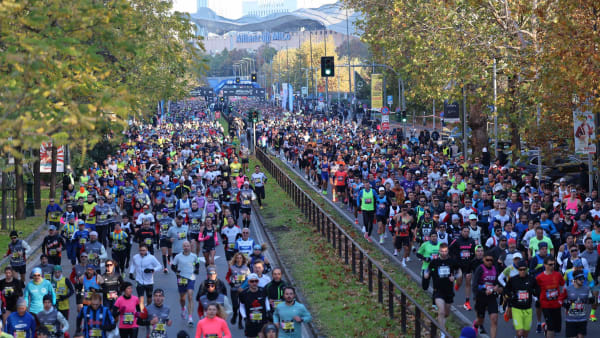
Four days out from the Powerade Milano Half Marathon, everything you need before the gun
Bib pickup, start times, course, weather, aid stations… Everything before the Powerade Milano Half Marathon on Sunday, November 22.
Thu, November 19, 2026

Monza Half Marathon 2026 set for Sunday, October 4: everything you need to know
Schedule, bib collection, access, timings and advice for getting ready for the 2026 Monza Half Marathon.
Thu, October 1, 2026
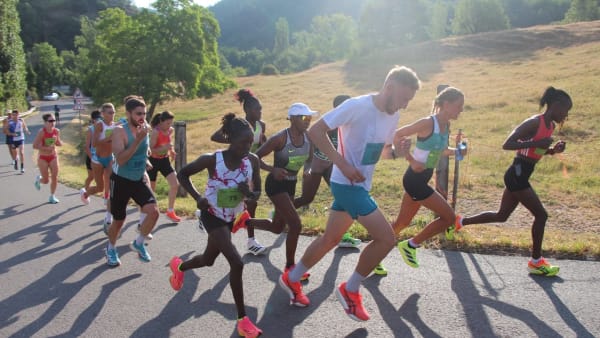
Marvejols-Mende delivers an exceptionally deep field for its 53rd edition
Nearly 2,200 runners took part in the 53rd Marvejols-Mende Half Marathon.
Thu, September 10, 2026
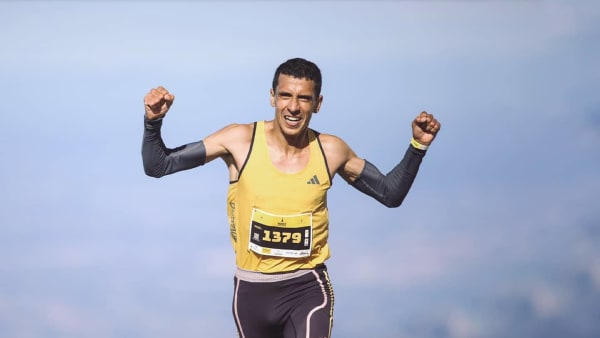
Mont Ventoux Half Marathon brings Chahdi, Roudolff-Levisse, Polin and 1,600 runners to the start line
Europe’s toughest half marathon features Chahdi, Roudolff-Levisse, Polin and 1,600 runners on the slopes of Mont Ventoux.
Wed, September 9, 2026