
Aude Clavier sets her sights on new horizons
 © STADION-ACTU
Aude Clavier claimed the French Elite 5,000m title in Talence on August 2. The victory could not have come at a better time, with the 26-year-old, ever-smiling athlete preparing to embark on a new adventure in northern France.
“One chapter is closing at INSEP, while another is already being written,” says Aude Clavier, the newly crowned French Elite 5,000m champion. With the new academic year just days away and the official results of her master’s degree yet to be announced, she has only two more races before a well-earned break. Crowned in Talence on August 2, the Aix-en-Provence native spent the year juggling her business law dissertation at the Sorbonne with life as an elite athlete. Now, a new chapter awaits. After five years at INSEP, having already swapped the sunshine of the south for the grey skies of Paris, she is heading north to focus fully on her goals: preparing for the 2026 European Championships in Birmingham, and above all, the 2028 Olympic Games in Los Angeles.
From late discovery to meteoric progress
Aude Clavier was not an instant revelation. At primary school, she took part in cross-country races and finished near the front, without exactly dominating. At middle school, though she was not part of the athletics section, she returned to the mud to make up the team. Once again, the young runner glimpsed the possibility of a medal. Yet she continued to keep her distance from running, even as the sport seemed to be calling her. Then came the moment that had been waiting to happen: enrolled in the alpine skiing programme at the high school in Barcelonnette, she put her 9mm spikes back on for yet another UNSS cross-country race. This time, it clicked. She produced an excellent result in her first year, then won the following year. The high-school student went one better, taking the regional title in the first-year cadet category. That was the breakthrough. The following year, she joined Gap’s club in an attempt to qualify individually for the French UNSS Championships. “At my school, they were good at skiing, but not so good at running, so qualifying as a team was impossible for me
A new era began for the teenager as she discovered a passion for middle-distance running. In an environment that allowed her to thrive, surrounded by a group of girls her age and guided by an encouraging, reassuring coach, young Aude progressed quickly. “I liked what we did in training.” Step by step, she climbed to the highest level of French athletics. At her first French Championships, she went largely unnoticed. Before long, she had become a leading figure, and even a threat to her rivals. In 2021, just short of her 23rd birthday, she reached the qualifying standard for the European U23 Championships, where she won bronze. She could hardly believe it: “Being part of the French team was my ultimate dream. I had really chased that first selection. I’d been knocking on the door for several years. I felt like, in one week, I had gone from one extreme to the other. It was crazy.”
Following in the footsteps of Jimmy Gressier, who was a 5,000m and 10,000m champion at the time and with whom she has shared her life for eight years, the southerner felt propelled “onto another planet. His planet”, not hers. “I never imagined that one day I could do this, wear the colours of the French team and do it in one of the best possible ways,” she recalls with a smile. Already captivated by that first bronze medal, she was desperate for more. “Whenever I achieve something, I always want to go further. So I wanted to make the senior French team.” Wings were already beginning to sprout, but they were not yet big enough: the next dream would take more time. “It took me from 2021 to 2024. And then, finally, it happened.” It was an achievement beyond her expectations, shaped by years of training and the support of her partner, the winner of the Diamond League 3,000m final on August 28, despite the obvious gap in their respective levels: “Coincidence or not, the year I met him, he won the European U23 cross-country title for the first time. Seeing elite sport through him inevitably inspired and pushed me. And even though our career goals are completely different, I measure my career on my own scale, considering where I started, and that’s fine. In fact, it still motivates me.”
 © STADION-ACTU
Ten years of hard work to become a senior national champion
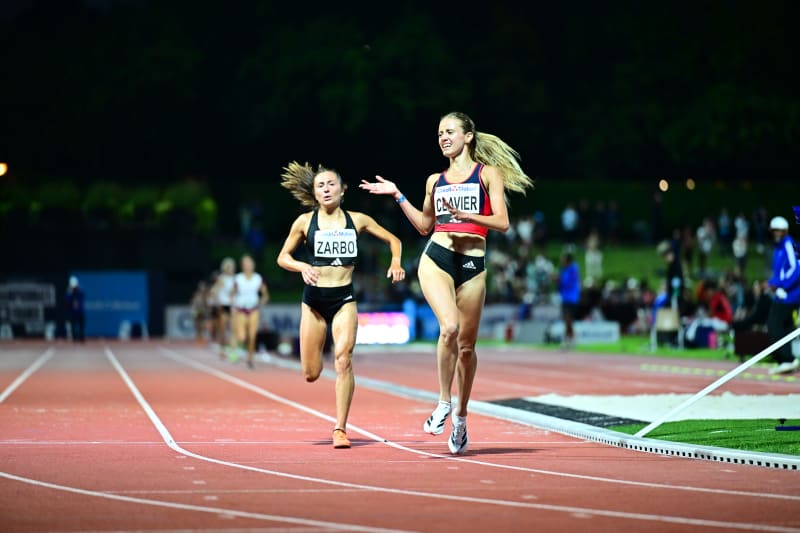
It was not until today, almost a month after reaching the ultimate prize, that the Amiens UC athlete truly began to take it in: “At the time, I was simply relieved. I had put a lot of pressure on myself because it was the first time I was capable of fighting for the title, rather than just being an outsider for a podium place. I knew it was possible, but the hardest part was still to come.” The route to victory was complicated, with her biggest theoretical rival being none other than Alessia Zarbo, a close friend. “I knew some of my strengths, and that I might have to play to them. I had worked well on the 1,500m and 3,000m, whereas she is more focused on the longer distances.” The victory was a real challenge, especially when Aude Clavier remembers crossing the finish line: “It didn’t really sink in straight away, because we know each other so well. I didn’t realise. But now it’s incredibly satisfying to think that the only title I’ve won is the most beautiful one.”
To reach the top of her game, the track specialist, who occasionally races on the road when the mood takes her, endured difficult periods before finding balance during this unusual “transitional” year. “I had quite a few physical problems last year, including two stress fractures. With less pressure, this became my best year. I hadn’t been able to string weeks of training together for a very long time. By pushing my body less, things worked better.” She never viewed the World Championships in Tokyo as an end in themselves: her “big goals for the season were the French Elite Championships and running good times in meets.” By easing off compared with previous years, which had demanded greater risks and an intense training schedule, particularly last year when she had to push her body to its limits in an attempt to qualify for the Olympic Games, the French champion found the key. It took her ten years to get there: “It really is hard work and resilience that pay off. Even if someone isn’t naturally the most talented, hard work will make the difference.”
The idea of hard work is no small matter for Aude Clavier, who is anything but afraid of it. She trains every day, completing between 10 and 12 sessions a week. Her weekly schedule is packed. On Monday, she starts with an easy run and strength work, then follows up on Tuesday with a session and another run. A long run is enough in the middle of the week, before Thursday brings a day similar to Monday, sometimes topped up with a few strides. Friday is more of the same, and the weekend offers little respite, with a run on Saturday and a long run on Sunday including a threshold section, or at least some faster running. Under those conditions, it is fair to ask what she means by “balance.” Her explanation is clear and direct: “I studied during my afternoons off, in the evening or in the morning before training. But at training camps, all I did was eat, sleep and run. That was my life, except I couldn’t afford to lose the rhythm.” Balancing athletic life and study is not easy day to day: “I’m lucky to find some things easy, but I have to admit it’s good that the master’s is over, because I did the bare minimum to pass. When I had to revise for all my exams in May, I was completely wiped out for two weeks afterwards. I couldn’t put one foot in front of the other in training.”
 © STADION-ACTU
Between passion, friendship and the pursuit of performance
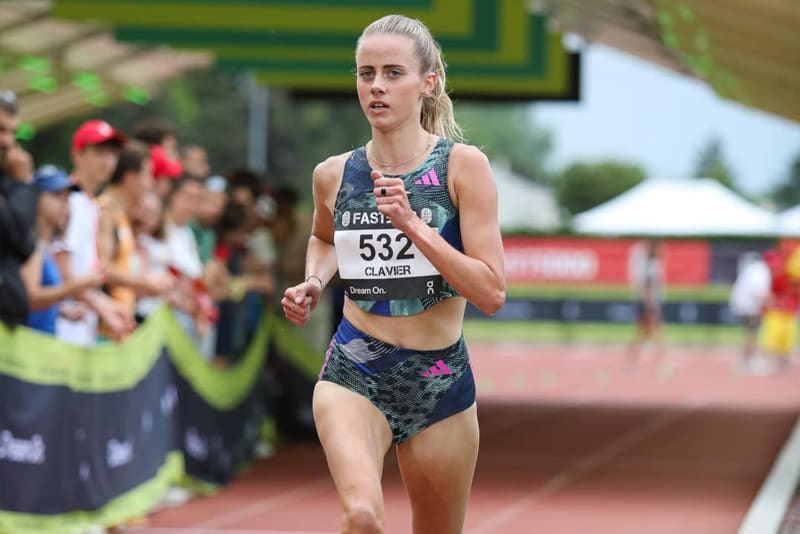
Finishing near the front from an early age awakened young Aude’s love of running. “When you’re good at something, you generally enjoy it. I got encouraging results quickly, better than the average person, which motivated me to carry on.” But her real source of motivation runs deeper, rooted in her personality: “What I’ve always loved most is pushing myself. I love going all the way into the effort and surpassing myself. Athletics really is the sport that allows you to do that.” It is this outlook, this deep attachment to performance, that she draws on in moments of doubt or waning motivation. “I really want to succeed. So even if I felt a bit lazy this morning about going out for 16km at 8:30, I went without thinking because I want to be strong in my race next week.”
Where does this constant desire to improve come from? It could be her father, a former rugby player, or her mother, who was not very sporty when she was young but has become more active recently. “At 55, she’s in pretty good shape, so perhaps genetically she’s the one who gave me the genes. I think she could have been quite good at it.” The desire to keep going further is not the only thing that has made Aude a true athlete, with a lifestyle adapted to her sport. “It’s a slightly unusual life because we’re constantly travelling… There are definitely lots of personal events we miss. Unfortunately, we don’t have the same rhythm as everyone else. But that doesn’t stop me from being incredibly happy with what I do. Besides, I love travelling and discovering new places.”
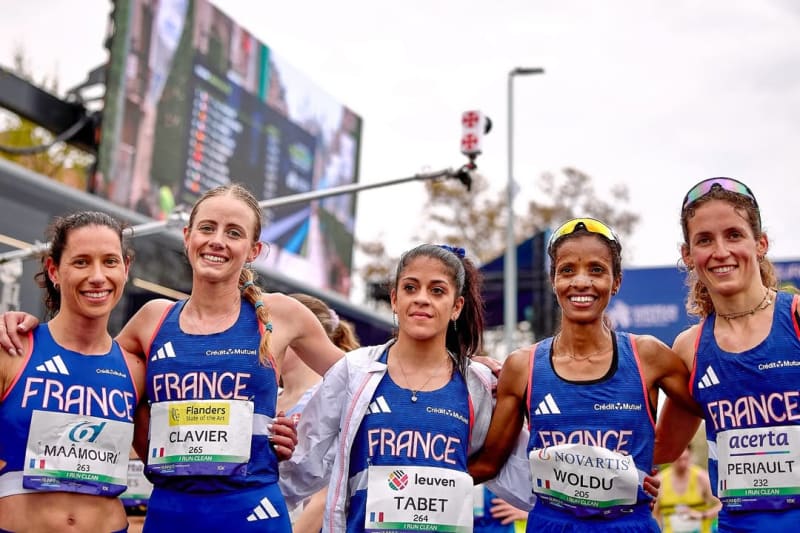
Her commitment to athletics did not come from nowhere, of course, but it is anchored in something strong: her friends. The relationships she has built through club changes, competitions, French team selections and gatherings organised by her equipment sponsor, adidas, are unique. Spending every day from morning to night with Anaïs Bourgoin and Bérénice Cleyet-Merle at INSEP naturally brought them closer. The core became tight-knit. But what happens when you have to face one of your best friends to win the ultimate title? The individual nature of the sport takes over for twelve and a half laps, then fades beneath the affection they share. “We compete in a fair sport. In the call room, we’re still really close friends. When I walked onto the track, I just wanted to hug Alessia (Zarbo), because racing against her was emotionally difficult. But you have to put that aside during the race. We train hard for ourselves first, so I gave everything, even though she was the one racing against me. At the same time, all I hoped was that she would cross the line just after me. I wanted the best for her, but I wanted just a little bit more for myself first.” At other major championships, competing against training partners or friends is less painful. One athlete’s success does not prevent another’s. Quite the opposite: it encourages them to train harder and believe it is possible. “Sarah Madeleine pulls us towards times that seem impossible to us.”
 © STADION-ACTU
New ambitions on the horizon
The title marked the end of one chapter and a turning point in her still-young career. Two weeks after her victory, she finally lowered her 5,000m personal best in Belgium. From 15:46, she moved significantly closer to the symbolic 15-minute barrier, running 15:05.19 in Oordegem on August 9. “It’s a huge leap. Even though we knew that in previous years I was worth better than 15:46, I hadn’t done it yet. Now it’s done.” This is only the beginning of the international adventure that awaits Aude, already “focused on other goals”, both in Europe and beyond. When she began the 2025 season, the idea was to think further ahead: not just about the season to come or the following year, but about a series of milestones leading to the 2028 Olympic Games in Los Angeles. “I want to improve and reach a very good European level next year, because the European Championships will truly be the goal, one of the first steps before reaching world level in 2027 and 2028.” None of this would be possible without the valuable support of the three-stripe brand, Crédit Mutuel and an Amiens-based investment fund, which allow her to devote all her energy to her ambitions.
Free from the demands of her studies, she now has three rewarding years ahead devoted entirely to athletics. “I want to take the gamble of really committing myself for three years. My boyfriend and I are moving to Boulogne-sur-Mer, where he is from. I’ll train mainly there, and also a lot in Font-Romeu.” Aude Clavier has not yet settled on her future coach, but she remains confident: “I’ll definitely have coaches working remotely, and I could get help from Jimmy’s childhood coach, even though we want to keep our sporting projects somewhat separate and therefore not have the same coaches.” Goodbye to INSEP and the sessions where she trained alone behind her coach Adrien Taouji, on a bike. “Normally, I’ll be able to train with the men from the club. I think that will be a plus compared with INSEP.”
Before leaving the track for a few weeks of recovery, Aude Clavier is not quite ready to put her feet up. She still has two meets left in which to lower her personal bests. Next week, she will race the 1,500m at the Meeting de Trier in Germany, then finish her season with one final 3,000m, and a major one at that, at the Gold Meeting in Beijing on September 7. What should we wish her? Continued success, including a place in an Olympic final earned through the front door and without injury, and more new barriers broken, just as she has done so impressively this year.
Aude Clavier claimed the French Elite 5,000m title in Talence on August 2. The victory could not have come at a better time, with the 26-year-old, ever-smiling athlete preparing to embark on a new adventure in northern France.
“One chapter is closing at INSEP, while another is already being written,” says Aude Clavier, the newly crowned French Elite 5,000m champion. With the new academic year just days away and the official results of her master’s degree yet to be announced, she has only two more races before a well-earned break. Crowned in Talence on August 2, the Aix-en-Provence native spent the year juggling her business law dissertation at the Sorbonne with life as an elite athlete. Now, a new chapter awaits. After five years at INSEP, having already swapped the sunshine of the south for the grey skies of Paris, she is heading north to focus fully on her goals: preparing for the 2026 European Championships in Birmingham, and above all, the 2028 Olympic Games in Los Angeles.
From late discovery to meteoric progress
Aude Clavier was not an instant revelation. At primary school, she took part in cross-country races and finished near the front, without exactly dominating. At middle school, though she was not part of the athletics section, she returned to the mud to make up the team. Once again, the young runner glimpsed the possibility of a medal. Yet she continued to keep her distance from running, even as the sport seemed to be calling her. Then came the moment that had been waiting to happen: enrolled in the alpine skiing programme at the high school in Barcelonnette, she put her 9mm spikes back on for yet another UNSS cross-country race. This time, it clicked. She produced an excellent result in her first year, then won the following year. The high-school student went one better, taking the regional title in the first-year cadet category. That was the breakthrough. The following year, she joined Gap’s club in an attempt to qualify individually for the French UNSS Championships. “At my school, they were good at skiing, but not so good at running, so qualifying as a team was impossible for me”, she recalls.
A new era began for the teenager as she discovered a passion for middle-distance running. In an environment that allowed her to thrive, surrounded by a group of girls her age and guided by an encouraging, reassuring coach, young Aude progressed quickly. “I liked what we did in training.” Step by step, she climbed to the highest level of French athletics. At her first French Championships, she went largely unnoticed. Before long, she had become a leading figure, and even a threat to her rivals. In 2021, just short of her 23rd birthday, she reached the qualifying standard for the European U23 Championships, where she won bronze. She could hardly believe it: “Being part of the French team was my ultimate dream. I had really chased that first selection. I’d been knocking on the door for several years. I felt like, in one week, I had gone from one extreme to the other. It was crazy.”
Following in the footsteps of Jimmy Gressier, who was a 5,000m and 10,000m champion at the time and with whom she has shared her life for eight years, the southerner felt propelled “onto another planet. His planet”, not hers. “I never imagined that one day I could do this, wear the colours of the French team and do it in one of the best possible ways,” she recalls with a smile. Already captivated by that first bronze medal, she was desperate for more. “Whenever I achieve something, I always want to go further. So I wanted to make the senior French team.” Wings were already beginning to sprout, but they were not yet big enough: the next dream would take more time. “It took me from 2021 to 2024. And then, finally, it happened.” It was an achievement beyond her expectations, shaped by years of training and the support of her partner, the winner of the Diamond League 3,000m final on August 28, despite the obvious gap in their respective levels: “Coincidence or not, the year I met him, he won the European U23 cross-country title for the first time. Seeing elite sport through him inevitably inspired and pushed me. And even though our career goals are completely different, I measure my career on my own scale, considering where I started, and that’s fine. In fact, it still motivates me.”
© STADION-ACTUTen years of hard work to become a senior national champion
It was not until today, almost a month after reaching the ultimate prize, that the Amiens UC athlete truly began to take it in: “At the time, I was simply relieved. I had put a lot of pressure on myself because it was the first time I was capable of fighting for the title, rather than just being an outsider for a podium place. I knew it was possible, but the hardest part was still to come.” The route to victory was complicated, with her biggest theoretical rival being none other than Alessia Zarbo, a close friend. “I knew some of my strengths, and that I might have to play to them. I had worked well on the 1,500m and 3,000m, whereas she is more focused on the longer distances.” The victory was a real challenge, especially when Aude Clavier remembers crossing the finish line: “It didn’t really sink in straight away, because we know each other so well. I didn’t realise. But now it’s incredibly satisfying to think that the only title I’ve won is the most beautiful one.”
To reach the top of her game, the track specialist, who occasionally races on the road when the mood takes her, endured difficult periods before finding balance during this unusual “transitional” year. “I had quite a few physical problems last year, including two stress fractures. With less pressure, this became my best year. I hadn’t been able to string weeks of training together for a very long time. By pushing my body less, things worked better.” She never viewed the World Championships in Tokyo as an end in themselves: her “big goals for the season were the French Elite Championships and running good times in meets.” By easing off compared with previous years, which had demanded greater risks and an intense training schedule, particularly last year when she had to push her body to its limits in an attempt to qualify for the Olympic Games, the French champion found the key. It took her ten years to get there: “It really is hard work and resilience that pay off. Even if someone isn’t naturally the most talented, hard work will make the difference.”
The idea of hard work is no small matter for Aude Clavier, who is anything but afraid of it. She trains every day, completing between 10 and 12 sessions a week. Her weekly schedule is packed. On Monday, she starts with an easy run and strength work, then follows up on Tuesday with a session and another run. A long run is enough in the middle of the week, before Thursday brings a day similar to Monday, sometimes topped up with a few strides. Friday is more of the same, and the weekend offers little respite, with a run on Saturday and a long run on Sunday including a threshold section, or at least some faster running. Under those conditions, it is fair to ask what she means by “balance.” Her explanation is clear and direct: “I studied during my afternoons off, in the evening or in the morning before training. But at training camps, all I did was eat, sleep and run. That was my life, except I couldn’t afford to lose the rhythm.” Balancing athletic life and study is not easy day to day: “I’m lucky to find some things easy, but I have to admit it’s good that the master’s is over, because I did the bare minimum to pass. When I had to revise for all my exams in May, I was completely wiped out for two weeks afterwards. I couldn’t put one foot in front of the other in training.”
© STADION-ACTUBetween passion, friendship and the pursuit of performance
Finishing near the front from an early age awakened young Aude’s love of running. “When you’re good at something, you generally enjoy it. I got encouraging results quickly, better than the average person, which motivated me to carry on.” But her real source of motivation runs deeper, rooted in her personality: “What I’ve always loved most is pushing myself. I love going all the way into the effort and surpassing myself. Athletics really is the sport that allows you to do that.” It is this outlook, this deep attachment to performance, that she draws on in moments of doubt or waning motivation. “I really want to succeed. So even if I felt a bit lazy this morning about going out for 16km at 8:30, I went without thinking because I want to be strong in my race next week.”
Where does this constant desire to improve come from? It could be her father, a former rugby player, or her mother, who was not very sporty when she was young but has become more active recently. “At 55, she’s in pretty good shape, so perhaps genetically she’s the one who gave me the genes. I think she could have been quite good at it.” The desire to keep going further is not the only thing that has made Aude a true athlete, with a lifestyle adapted to her sport. “It’s a slightly unusual life because we’re constantly travelling… There are definitely lots of personal events we miss. Unfortunately, we don’t have the same rhythm as everyone else. But that doesn’t stop me from being incredibly happy with what I do. Besides, I love travelling and discovering new places.”
Her commitment to athletics did not come from nowhere, of course, but it is anchored in something strong: her friends. The relationships she has built through club changes, competitions, French team selections and gatherings organised by her equipment sponsor, adidas, are unique. Spending every day from morning to night with Anaïs Bourgoin and Bérénice Cleyet-Merle at INSEP naturally brought them closer. The core became tight-knit. But what happens when you have to face one of your best friends to win the ultimate title? The individual nature of the sport takes over for twelve and a half laps, then fades beneath the affection they share. “We compete in a fair sport. In the call room, we’re still really close friends. When I walked onto the track, I just wanted to hug Alessia (Zarbo), because racing against her was emotionally difficult. But you have to put that aside during the race. We train hard for ourselves first, so I gave everything, even though she was the one racing against me. At the same time, all I hoped was that she would cross the line just after me. I wanted the best for her, but I wanted just a little bit more for myself first.” At other major championships, competing against training partners or friends is less painful. One athlete’s success does not prevent another’s. Quite the opposite: it encourages them to train harder and believe it is possible. “Sarah Madeleine pulls us towards times that seem impossible to us.”
© STADION-ACTUNew ambitions on the horizon
The title marked the end of one chapter and a turning point in her still-young career. Two weeks after her victory, she finally lowered her 5,000m personal best in Belgium. From 15:46, she moved significantly closer to the symbolic 15-minute barrier, running 15:05.19 in Oordegem on August 9. “It’s a huge leap. Even though we knew that in previous years I was worth better than 15:46, I hadn’t done it yet. Now it’s done.” This is only the beginning of the international adventure that awaits Aude, already “focused on other goals”, both in Europe and beyond. When she began the 2025 season, the idea was to think further ahead: not just about the season to come or the following year, but about a series of milestones leading to the 2028 Olympic Games in Los Angeles. “I want to improve and reach a very good European level next year, because the European Championships will truly be the goal, one of the first steps before reaching world level in 2027 and 2028.” None of this would be possible without the valuable support of the three-stripe brand, Crédit Mutuel and an Amiens-based investment fund, which allow her to devote all her energy to her ambitions.
Free from the demands of her studies, she now has three rewarding years ahead devoted entirely to athletics. “I want to take the gamble of really committing myself for three years. My boyfriend and I are moving to Boulogne-sur-Mer, where he is from. I’ll train mainly there, and also a lot in Font-Romeu.” Aude Clavier has not yet settled on her future coach, but she remains confident: “I’ll definitely have coaches working remotely, and I could get help from Jimmy’s childhood coach, even though we want to keep our sporting projects somewhat separate and therefore not have the same coaches.” Goodbye to INSEP and the sessions where she trained alone behind her coach Adrien Taouji, on a bike. “Normally, I’ll be able to train with the men from the club. I think that will be a plus compared with INSEP.”
Before leaving the track for a few weeks of recovery, Aude Clavier is not quite ready to put her feet up. She still has two meets left in which to lower her personal bests. Next week, she will race the 1,500m at the Meeting de Trier in Germany, then finish her season with one final 3,000m, and a major one at that, at the Gold Meeting in Beijing on September 7. What should we wish her? Continued success, including a place in an Olympic final earned through the front door and without injury, and more new barriers broken, just as she has done so impressively this year.
Aude Clavier claimed the French Elite 5,000m title in Talence on August 2. The victory could not have come at a better time, with the 26-year-old, ever-smiling athlete preparing to embark on a new adventure in northern France.