
Pierre Destailleur ran 20 marathons in 23 days to champion healthy soil
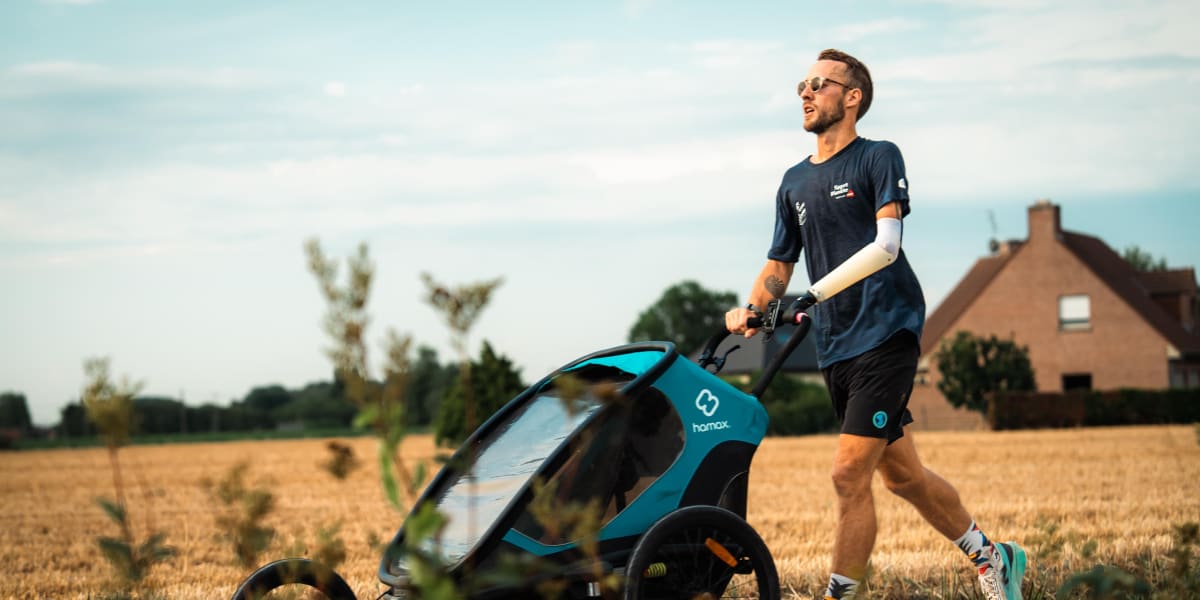 © Jérôme Habasque
From September 16 to October 9, agronomist Pierre Destailleur ran a marathon every day to raise awareness of soil preservation and biodiversity. We spoke to a man who describes himself as “rooted”. His generous project was dedicated to his older brother Thomas, who died in 2019.
✓ Last April, we spoke with Pierre as his idea was only just beginning to take root.
Pierre, how far back can you trace the origins of the “Enraciné” project?
Back to 2019, after my brother died. At the time, after completing a business degree, I was working in retail. I had very materialistic dreams: a powerful car, a quad bike, a beautiful house. When I lost my older brother, I went through a painful period. I began to question certain aspects of our way of life. For years, we had travelled, flown, visited the United States, Asia, the islands and France’s overseas territories without considering the impact. I had flown to quite a few races abroad. We were far from being role models. Thanks to my brother Thomas Destailleur, I realised that my job at the time was meaningless. I didn’t want to be part of a system that was destroying life. Then Covid arrived. I started taking online courses and became very interested in the issues highlighted by Jean-Marc Jancovici (an engineer and lecturer), as well as in our societal myths. The realisation was painful. Eventually, I suffered an episode of eco-anxiety.
That’s where sport comes in…
Sport has always been part of my life. At first, it helped me get back on my feet and reconnect with the world. Running, and sport in general, puts me in a state where I feel good. Almost meditative. After all those difficult moments, and because I love studying and learning, I eventually enrolled in an agricultural engineering school to get closer to environmental issues. I didn’t come from that world and had a lot to learn.
Was it when you went back to school that you found your calling?
Not straight away. The broad approach of the course, focused on technical solutions such as solar power and waste management, or on legislation, didn’t speak to me. I realised how difficult it was to change things in a deeply polarised world, between organisations such as the Confédération paysanne and the FNSEA, for example. It was ultimately through studying agronomy that I found my cause. I became passionate about soil. We rarely talk about it. You can’t see it, and we mostly just walk on it. Yet it feeds us, regulates our water and carbon, and sustains our forests. It’s a central ecosystem: when we emerged from the water, we began to develop alongside the bacteria and microbes in the soil. All life, and the entire web of life, rests on the soil, its biodiversity and its evolution. Alongside my studies, I started getting involved with an organisation called Uni-Vert Sport. The organisation is lucky to have the support of runner Nicolas Vandenelsken, who ran 110 marathons in 110 days to raise awareness of health and the planet through sport. The books by Pierre Weill, who among other things founded the Bleu-Blanc-Cœur association, also had a major influence on me. Nicolas Vandenelsken encouraged me a great deal. I had always been afraid to embark on a project like this. At some point I thought, “let’s go”. I wanted to talk about soil, tell a story and bring these issues to the forefront. I applied for MAIF’s Sport Planète programme and was selected. The adventure was under way…
I’m proud to be a disabled person and to raise awareness of disability.
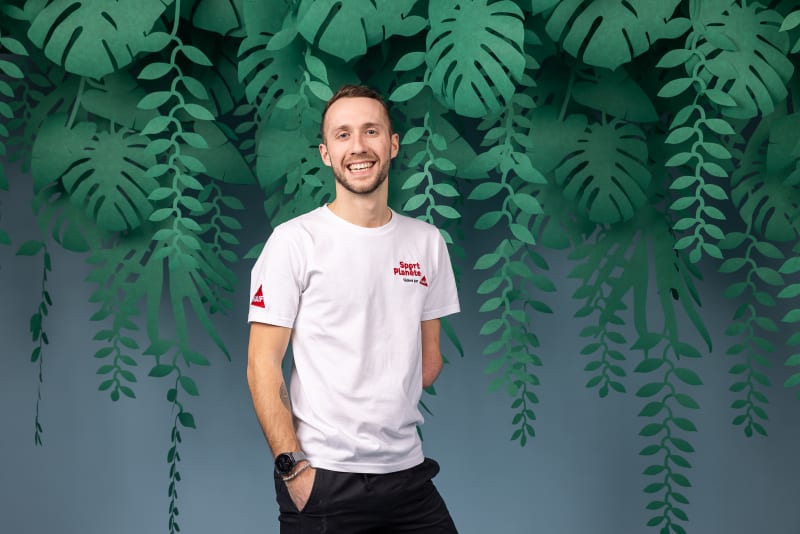 © MAIF – Pierre Destailleur with Sport Planète colours
We saw on social media that you met a lot of people during your tour…
We did, and it was quite incredible. I spoke to all kinds of people and everyone opened their doors to me. Above all, I met people who were engaged. Some studied soil, while others worked as environmental educators. I also met a large number of farmers from very different backgrounds and with very different perspectives: large-scale operators and more modest farmers. It was fascinating because I even got to “challenge” people who weren’t necessarily convinced by my cause. In the space of 30 years, we have destroyed a huge amount of fertile soil, even though it was something we inherited. Some accounts suggest that Rome collapsed because the Mediterranean basin had been “exhausted” by the empire’s agricultural demands. They supposedly depleted their soil and brought down their society in 1,000 years. We’re going to do it in 50.
Do you remain optimistic despite everything?
We’ll get through this collectively, I’m convinced of it. The point of this adventure was to make soil a more popular topic for everyone. I want people to take an interest in soil for all the richness it provides. It regulates the water cycle and gives us clean drinking water. It protects biodiversity, stores carbon, and helps fight floods and drought. I’m trying to share this message with everyone through Instagram, and through platforms aimed at the general public, so people understand that healthy soil is the foundation of a viable society and that it must be protected. I really want to help create a wider public debate around soil. That might sound a little pretentious or presumptuous, but I want to do it.
Can you tell us about your disability?
I was born with it and it has never stopped me doing anything. I played football and tennis. That said, I hid my disability until I was 18. I had a prosthesis and wanted to be like everyone else. Travelling in Australia and Canada changed the way I saw things. I wanted to embrace it more openly. From the age of 18, I became proud to be disabled. It doesn’t factor into how I view my performances. For the tour, I did have a running stroller, which made things more complicated. Having two arms is better when you’re pushing a stroller. During the “Enraciné” tour, I also raised awareness of disability. Paradoxically, children were perhaps the hardest part. They have no filter: “Sir, you scare me”, “How do you eat?”, “Do you have a girlfriend?” There were even tears sometimes. It was enriching for everyone. I’m proud to be a disabled person and to raise awareness of disability. It’s like racism. People need to be educated. We need to show diversity and difference.
We need to include others in everything. The aim of the adventure was to raise awareness of sport, disability and soil. I highlighted that three-way connection everywhere I went, especially in middle schools, primary schools and high schools, where we talked about disability much more openly than with adults. There is still a certain discomfort around the subject, and the Paralympic Games can still make some people uncomfortable. It’s discomfort in the face of diversity.
Is there one particular memory that stands out?
The journey was full of great moments. In Nançois-le-Grand, in the Meuse, I visited the Ferme bio des Terres Froides, an extraordinary place. For a village of 45 people, 20 of them came out to welcome me, with a saxophone and signs. I arrived at the home of a family of committed farmers, on a small farm with only a few cows. They milk the cows the traditional way, make cheese and sell their produce. They made me feel at home and were so welcoming and open in conversation. They have so much to pass on, so much worth highlighting. We need to celebrate people like them, even though I’m aware that there are different types of agriculture and different ways of doing things. In Châlons-en-Champagne, I was welcomed by Jean-Loup Coquillard, an incredibly welcoming physics and chemistry teacher who organises festivals every year. In our society, we build ourselves too much around fear of others. We have politicians who make us afraid of one another. This tour was a wonderful lesson in openness for me. People opened their doors to me, creating an exchange of lives, conversations and perspectives. I hadn’t anticipated that when I was developing the project. Always reach out to others.
In our society, we build ourselves too much around fear of others. This tour was a wonderful lesson in openness for me. People opened their doors to me, creating an exchange of lives, conversations and perspectives. I hadn’t anticipated that when I was developing the project.
On October 25, you experienced another intense moment…
Yes, I’m finally releasing a film, Open your Wild, about my older brother Thomas’s adventure. The project is dedicated to him. I worked very hard on this 35-minute film, which tells the story of his journey. I’m proud of it. At the time, my brother was asking questions about the impact humans have on nature. In 2019, he naturally decided to travel to Canada to investigate the highly polluting tar sands. He took his bike, met people and visited towns affected by the industry. He also travelled by kayak through the wilderness to understand its impact on rivers and different ecosystems. He did it in a very educational way and brought quite a few people into his reflections. In a way, he wanted to reconcile us with nature. And he died during that adventure… It’s bound to be an emotional moment. I’m the only one in my family to have seen the footage and to have faced that pain… My whole family will be at the cinema on October 25. Perhaps it will help us come to terms with his death. When I finished my 20 marathons in Orléans, I was psychologically devastated because Thomas never got to cross the finish line of his dream. With this film, I want to pay tribute to his work and commitment. We’re holding two screenings in France, then I’m cycling to Aarhus in Denmark as part of “Enraciné”.
You’re already setting off again? Tell us about it…
I haven’t announced it yet, but on October 30 I’m cycling towards Aarhus. It’s 1,100 kilometres. I’m setting off by bike for a mini-adventure to attend a conference on soil preservation, alongside European business and scientific stakeholders. I’ll tell them about my journey. To reach Aarhus, I’ll be covering between 150 and 200 kilometres a day, so it will be a serious challenge. Cycling with one arm is more complicated too, and physically demanding. After Aarhus, I’ll travel to Montpellier and Toulouse to take part in festivals and conferences. The tour is far from over. Things will stay intense until the end of the year. I’ll try to make as much noise as possible about soil.