
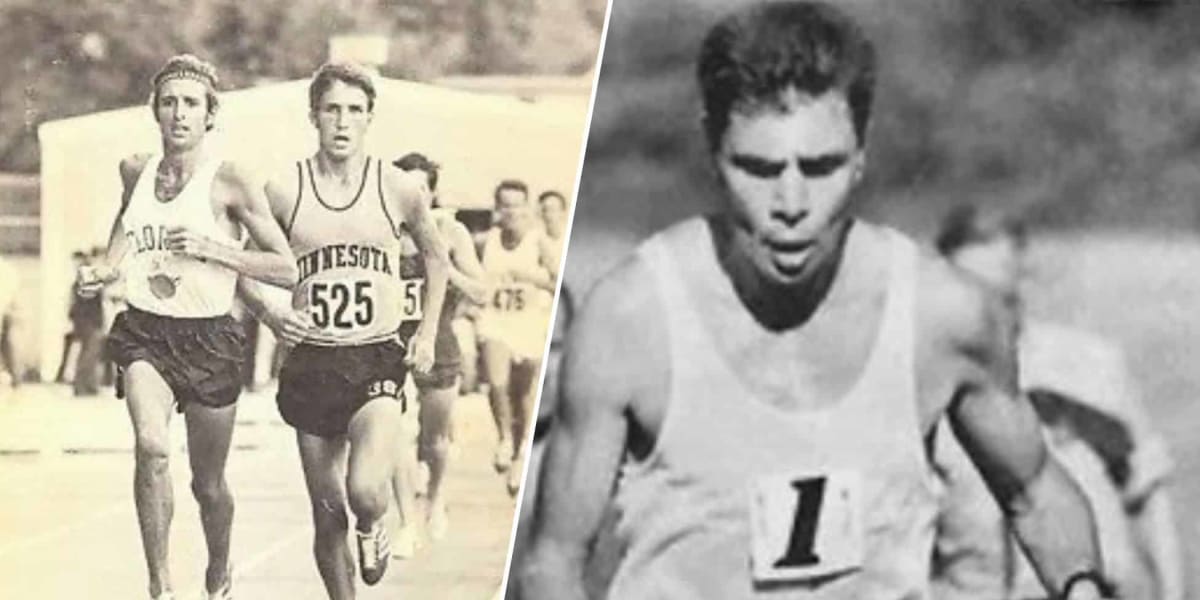
Banned for years from competing in British athletics, John Tarrant (born 1932) went down in history as the “Ghost Runner”. Behind the nickname was a world-class athlete who never let go of his passion, despite the era’s overzealous sporting bureaucracy.
For much of the 20th century, sporting federations were determined to protect “amateur” status, strictly banning amateurs from receiving money for performances. In reality, that often punished those who might have been able to make a living from running. Plenty of athletes paid the price. John Tarrant is part of that long list, but the Stretford native never backed down, racing in countless events under the radar before finally finding his place in ultra-distance. A short spell in boxing and a few modest appearance fees set the Ghost Runner on this strange path. He remains one of Britain’s best ultramarathoners of the 1960s.
Barred from international selection
When he applied for membership in 1952 with the AAA (Amateur Athletic Association), England’s athletics federation, young John Tarrant had no idea what was coming. At the time, he candidly admitted he’d once received the paltry sum of £17 for a few boxing bouts when he was younger. Coming from working-class Manchester, he’d soon regret that honesty. He was banned from competition and from Great Britain selection, a decision that dragged on and cost him a far bigger career, especially internationally. Because John Tarrant was one of the best runners of his generation, and he spent years proving it, earning the respect of the British public along the way. He kept racing despite the ban, building a real life as a distance runner. He showed up to races without a bib and kept demanding justice from the AAA, which clung stubbornly to its outdated rules. In 1958, his persistence finally brought some relief: certain sanctions were lifted and he was allowed back into domestic competitions, even if he still couldn’t represent his country. In 1960, he won the Liverpool Marathon in 2:22:35, making it clear he belonged with the very best in Britain. It was the start of the Ghost Writer’s payback…
From ghost to ultra star
Born on November 16, 1932 in Stretford near Manchester, John Tarrant grew up in a working-class family. Naturally gifted in a country where sport doubles as a social marker, Tarrant gravitated to distance running and applied for an AAA licence after a handful of paid boxing bouts. Suspended, he refused to give in and hunted for any way to race. That relentless urge pushed him toward the long road races where his endurance and toughness really shone, and where he could actually toe the line with a bib. In the mid-1960s, he went on to dominate some of Britain’s biggest road ultras: winner of Liverpool–Blackpool (77 km) in 1965 and 1967, setting a new course record; victorious at Exeter–Plymouth (71 km) in 1965, 1966 and 1967, again lowering the event record; and at the Isle of Man Road Race (63 km) in 1965, 1966 and 1967, where he also set the fastest mark in the race’s history. In 1967 and 1968, he won the prestigious London to Brighton (87 km), one of the benchmarks of British ultra-distance. Internationally, he took an outstanding 4th place at the Comrades Marathon in South Africa in 1968, covering roughly 90 km in 6:18:47, and won the Gold Top Marathon (80 km) in 5:43 in 1970. Those results leave no doubt that John Tarrant was among the most formidable ultramarathoners of his generation.
A name worth remembering
There’s something universal in the story of John Tarrant: an ordinary man up against the violence of institutions once they forget their first purpose, which is to protect people. When rules lose their meaning, you end up with situations like the one the Englishman lived through. Other athletes have faced similar ordeals. In France, John Tarrant’s fate echoes that of Jules Ladoumègue, a French runner also caught by the rigid amateurism rules that dominated sport in the early 20th century. The difference is that Ladoumègue could continue his career on the professional meet circuit, while Tarrant spent years in limbo, shut out of Britain’s most prestigious races yet determined to run anywhere he was allowed. Over the following decades, that model gradually disappeared in most sports, allowing athletes to compete regardless of any earlier professional background. Even today, the ghost runner remains a singular figure in British sporting history. His passion and extraordinary will to fight the life laid out for him left its mark on the crowds, who still remember him more than 50 years after his death in 1975, at just 43. John Tarrant was seriously ill with stomach disease. But to the very end, his friends could testify to his courage in the face of cancer.
More articles

Jean Bouin, the trailblazing face of French running
Olympic medalist and pre-war French athletics icon, Marseille’s Jean Bouin set the bar sky-high before being killed at 25 in World War I.
Sun, August 2, 2026

What if starting running later in life was the best way to keep going?
Sat, May 16, 2026
Charity Bibs: The Alternative Way Into Sold-Out Races
Wed, May 13, 2026