

Am I Really a Marathoner? When Impostor Syndrome Creeps Across the Finish Line
Crossing the finish line after 42.195 km should be proof enough. Yet for many amateur runners, the medal around their neck does little to silence that nagging inner voice: “Am I really entitled to call myself a marathoner?” ✓ Between comparisons, self-doubt and the search for recognition, impostor syndrome can find its way into every corner of the running world.
We always picture the marathoner in a state of euphoria, arms raised and beaming beneath the finish-line arch. In reality, another emotion often takes hold, one that is far more insidious: doubt. Some runners tell themselves they did not really “run” a marathon because they walked from mile 22, while others feel they have not earned the title because they took more than five hours. Julien, 32, describes a particularly strong first experience of feeling like an impostor. “ I had just finished my first marathon in Paris. I was exhausted but incredibly proud… and yet the first thing I said to my friends was, ‘I ran 4:52, so it doesn’t really count’.” It is a revealing statement, as if the effort itself had no value unless it fitted into a “performance” bracket.
This feeling often takes root in constant comparison. Social media has amplified the phenomenon: every weekend, Strava, Instagram and Facebook fill up with eye-catching times and heroic race reports. When Kipchoge tears through Berlin in 2:01 or your colleague finishes a marathon in 3:20, it is hard not to put your own time into perspective. The problem is that this comparison erases one obvious truth: whether it takes two hours or six, a marathon is still the same course, the same distance and the same battle. Forgetting that, many amateurs reduce their achievement to a single number, as if 42.195 km somehow became shorter because someone else covered it faster.
Legitimacy is in the eye of the beholder
Impostor syndrome, well known in the professional world, translates perfectly to amateur sport. Many marathoners do not feel legitimate until the people around them acknowledge what they have achieved. “When I told my colleagues I had run a marathon, their first reaction was: ‘Oh, how long did it take?’ I said 4:40, and I could see their smiles freeze a little, explains Sarah, who has been a keen long-distance runner for nearly three years. Since then, I have found it hard to say I am a marathoner, as though I had to justify myself.” This need for external approval often shapes how runners perceive their own performance. Yet the title of marathoner should not depend on a time or on other people’s judgment, but on the personal journey that led to crossing the finish line.
When the mind gives out before the legs
What is most striking is that the difficulty is not limited to the race itself. The body recovers within a few days, but the mind can remain stuck on the feeling of not being “good enough”. Some runners enter one marathon after another to reassure themselves, as if they had to collect medals to prove they belonged to the club. Others, like Thomas, an experienced 41-year-old runner from Grenoble, avoid even mentioning their achievement for fear of being asked about their time. “I have been running for ten years and have run three marathons, but I do not really dare talk about them. I always tell myself: real marathoners are the ones chasing three hours. I just survived the distance.” Here, impostor syndrome acts like a persistent shadow: it is not enough to have suffered and crossed the finish line; you also have to feel entitled to call yourself a “marathoner”.
Rediscovering pride in the effort
The key may lie in changing the way we look at the experience. Sports psychologists often stress that a marathon is not just about the final result, but about the process. Every long run in the cold, every weekend sacrifice and every bout of pain managed in training all become part of a marathoner’s identity. As Haile Gebrselassie told the Guardian: “When you run a marathon, you are competing against the distance, not the other runners or the clock. In long-distance running, you have to learn to be patient. You do not need to start very fast. But training is what really matters .” Placing the effort in this broader context helps restore value to the experience. Being a marathoner does not mean breaking records. It means accepting the challenge of an adventure that goes far beyond the finish line itself.
The final sprint
The word “marathoner” carries weight, which is probably why it triggers so much doubt in those who claim it for themselves. It suggests endurance, courage and resilience. Yet it comes with no hidden conditions: no minimum time, no prescribed pace. Legitimacy does not rhyme with performance, but with commitment. So yes, the runner who walked from mile 19, the one who took five hours, even the person who swore they would never run again… they are all marathoners. And the next time that inner voice asks, “Am I really entitled to call myself one?”, perhaps all it takes is an obvious answer: there are no impostors at the finish of a 42K.
More articles
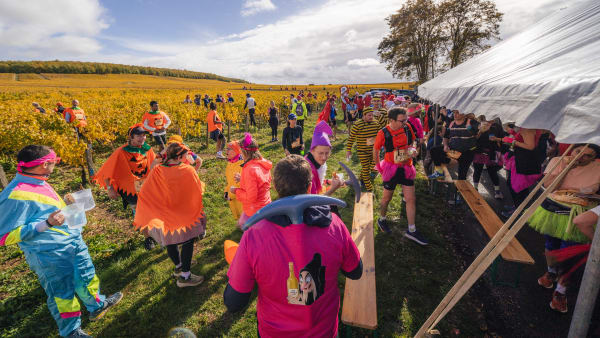
Marathon de Chablis set to welcome 4,400 runners among the vines
The Marathon de Chablis returns on Saturday, October 24, with races, hikes and a festive atmosphere among the vineyards.
Wed, October 21, 2026

Avignon Marathon makes a winning debut with more than 3,450 runners
More than 3,450 finishers turned out for the successful first edition of the Avignon Marathon on Sunday, September 27, 2026.
Wed, September 30, 2026

Night races: why does everyone want to run while everyone else is asleep?
From Glow Runs to low-key trail races, night running is taking off, offering a more festive experience and a different relationship with the clock.
Thu, September 10, 2026