
Emil Zátopek, built to suffer
Czech runner Emil Zátopek is still regarded as one of the greatest athletes of the 20th century. The story of the runner born in Kopřivnice, in what was then Czechoslovakia, is as complex as that of his country. A look back at the life of the “Czech locomotive”, as he was known. A nickname that suited him perfectly.
Table of contents
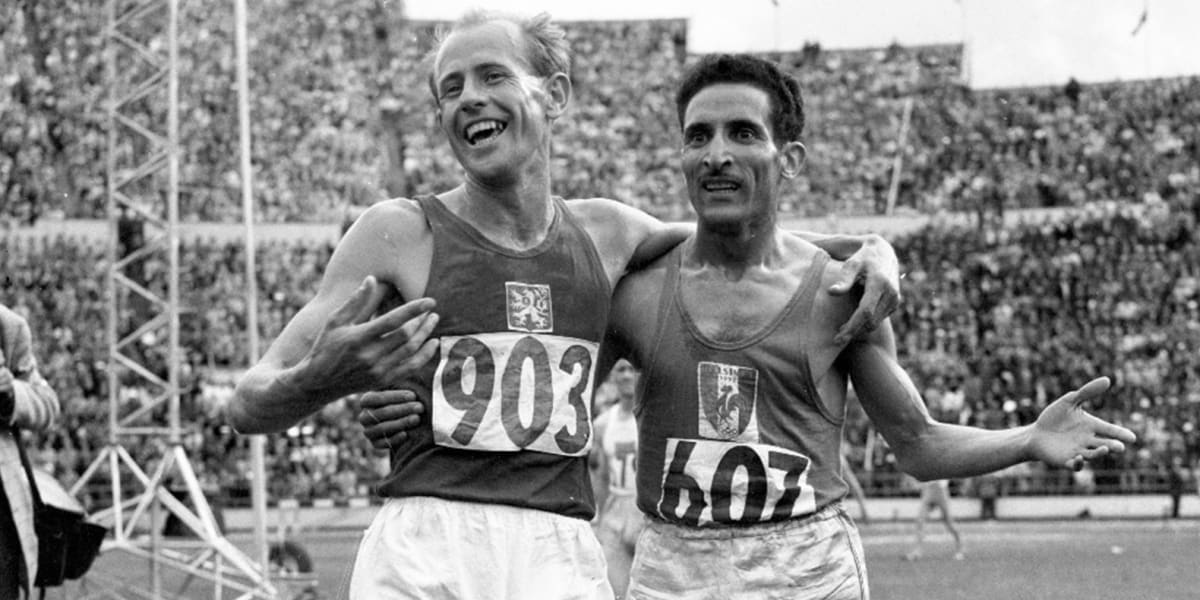
On 27 July 1952, Helsinki’s Olympic Stadium welcomed a hero. For the third time in just a few days, Emil Zátopek had left all his rivals trailing. This time, the Czech raised his arms to the sky after winning the greatest race of them all. He made it look almost easy. It was Zátopek’s third gold medal at these Games, completing one of the greatest feats in modern sporting history. Just days earlier, he had steamrolled the opposition in the 5,000 and 10,000 metres, his specialist events. Because yes: Emil Zátopek had never run a marathon in an official race before the Helsinki Olympics. Hard to believe. And that day, he set an Olympic record to boot… A giant. Three gold medals, three Olympic records smashed. No athlete had ever dominated the Games while giving such an impression of indestructibility, despite a running style that was often mocked. His workmanlike form was hardly elegant on the track. Nothing suggested that this son of a Moravian carpenter would enter the history books. Here is the story, and the memories left behind, by a big-hearted athlete whose willpower and resilience seemed limitless.
A simple childhood…
… Simple, but tough. That environment undoubtedly helped Zátopek forge his iron will. On 19 September 1922, in Kopřivnice, Moravia, František Zátopek welcomed his sixth child, Emil. No one could have imagined that this frail little boy would become the most enduring man on the planet. The Zátopek family lived near the Tatra factory, where his father worked hard. Legend has it that Emil was already running 4 km every day at the age of five to collect milk from a nearby farm. In 1931, the economic crisis hit both the country and Emil’s family. Nine-year-old Emil had to work before going to school. At 16, he joined the Bata shoe factory. His daily routine: 12 hours of work and a strange habit that puzzled his colleagues: running barefoot around the yard during breaks. The Second World War began, and Czechoslovakia was annexed by Nazi Germany. Emil Zátopek was lucky amid the misfortunes of the age. He narrowly escaped forced labour in 1944. The Czechoslovak army in exile needed athletes for its propaganda efforts. At 22, Emil joined the physical training battalion in Prague. His life changed when an officer gave him a proper pair of running shoes. “For the first time, I felt that my feet could fly.” In 1945, the war was over and Prague had been liberated. Zátopek was transferred to Stará Boleslav. It was there, in the woods surrounding the barracks, that he refined his methods. It was also where he met a javelin thrower named Dana, who would become his wife, his coach and the guardian of his legend.
A record-breaking machine
The numbers are dizzying: 18 world records, 38 consecutive wins over 10,000 m, his signature event. But behind the statistics lies a harsher truth: a capacity for suffering that defied belief. He arrived at the 1952 Helsinki Olympics with a lung condition. And he wrote in his notebooks: “Pain on the right side. Bloody sputum. Doctor says pneumonia. Solution: run faster to finish sooner…” The Czech locomotive was built from solid steel. On 27 July 1952, during his legendary marathon, the temperature reached 32°C. British favourite Jim Peters collapsed 5 km from the finish. Zátopek, meanwhile, accelerated. “I saw runners stop to vomit. So I thought: if they stop, I have to run faster”. He finished in 2:23:03, a new Olympic record.
The official list of his records is dizzying:
30,000 m : 1:35:23.8 (1952), world record for seven years
10,000 m : 28:54.2 (1954), record unbroken for six years
20,000 m : 59:51.8 (1951), first man under the mythical one-hour mark
One hour : 20,052 m (1951), a performance that stood for 13 years
A training-method pioneer
Performances like these come from somewhere. From his history as a man built to suffer, certainly, but also from his methodology and inventiveness. His methods? Sessions of 100 x 400 m in the snow, running underwater for 200 metres to increase lung capacity, weighted runs, whole nights spent skipping rope in his room. Beyond the methods themselves, he was above all a relentless worker, perhaps a forerunner of all the modern athletes capable of handling huge training loads. A true Stakhanovite. His widow Dana later revealed some of Emil’s training notes. He was remarkably methodical for his time. Here is one striking example:
“Monday: 100 x 400 m (75”) with 100 m walking
Tuesday: 20 km through the forest with a sandbag (5 kg)
Wednesday: breath-hold running (200 m x 10)
Thursday: hill repeats in army boots”
Mimoun-Zátopek: a brotherly rivalry
History might have made them enemies. The Frenchman Alain Mimoun facing Zátopek, the Czechoslovak workhorse. They had plenty separating them. Except for what mattered most: a love of running and deep respect for the person behind the athlete. They first met at the 1948 London Olympics. Mimoun, a lieutenant in the French army, would say of him: “Zátopek? He looks like a guy fleeing hell. I like running. He runs as if he’s trying to save his life.” Beaten in 1952, as seen in the 5,000-metre footage above, Mimoun got his revenge at the 1956 Melbourne Olympics. This time, it was Zátopek, weakened by a hernia, who advised Mimoun: “Attack at 30 km, the wind will turn”. The Frenchman followed the plan to the letter and won gold. At the finish, sixth-placed Zátopek was the first to embrace him. “This medal is yours too,” Mimoun told him. Their correspondence, preserved at the Olympic Museum in Lausanne after being brought to light by the Czech Olympic Committee in 2018, spans nearly 40 years, from 1948 to 1982, and bears witness to a profound friendship. Beyond nations and flags. Beyond the differences between a Frenchman born in Algeria and a Czechoslovak. The friendship of two men beneath the same sky, both caught up in their countries’ histories. These moving letters capture an era: “Dear Alain, everything is grey here. I still run, but now in my cellar.” (one week after the Soviet invasion, in August 1968). We will end with this one, written in March 1975, simple and deeply humane: “You are right, politics passes, friendship remains. Your brother Emil”
A hero broken by history
1968. Prague Spring. Zátopek, then a colonel, handed out leaflets opposing the Soviet occupation. The repression was brutal. Demoted to the rank of an ordinary worker, he spent his days drilling wells in Slovakia. “They gave me a pickaxe and a bucket. I dug until my hands bled”. Worse still, barred from stadiums after turning to journalism, he had to sign his sports columns under a pseudonym. In 1975, the regime offered to rehabilitate him… if he signed a retraction. Proud, he refused. It was not until 1989, after the Velvet Revolution, that he regained his rank. But an aggressive cancer was eating away at his lungs. When he died on 22 November 2000, thousands of Czechs marched with trainers hung around their necks. A final tribute to the man who ran against tyrants. Today, a statue in Prague shows him grimacing with effort.
Zátopek belongs to no political regime. He is our brother in the struggle.
More articles
From cycling pelotons to running packs: Mathieu van der Poel, Tony Martin, Nacer Bouhanni and the cyclists turning to running
Each winter, cyclists and triathletes take to the roads, testing their endurance and chasing new goals after life in the peloton.
Wed, September 9, 2026

Inside the Kiprun Pacer community: what a study of 224,000 runners reveals
Kiprun Pacer studied 224,000 runners: 37 million kilometres, trail’s rise, 10K and half-marathon dominance, and a more connected sport.
Wed, September 9, 2026

Marathon veterans: the passion that never fades
Over 80, sometimes over 90, these marathon veterans are still running, inspiring us with their passion and resilience.
Wed, September 9, 2026