
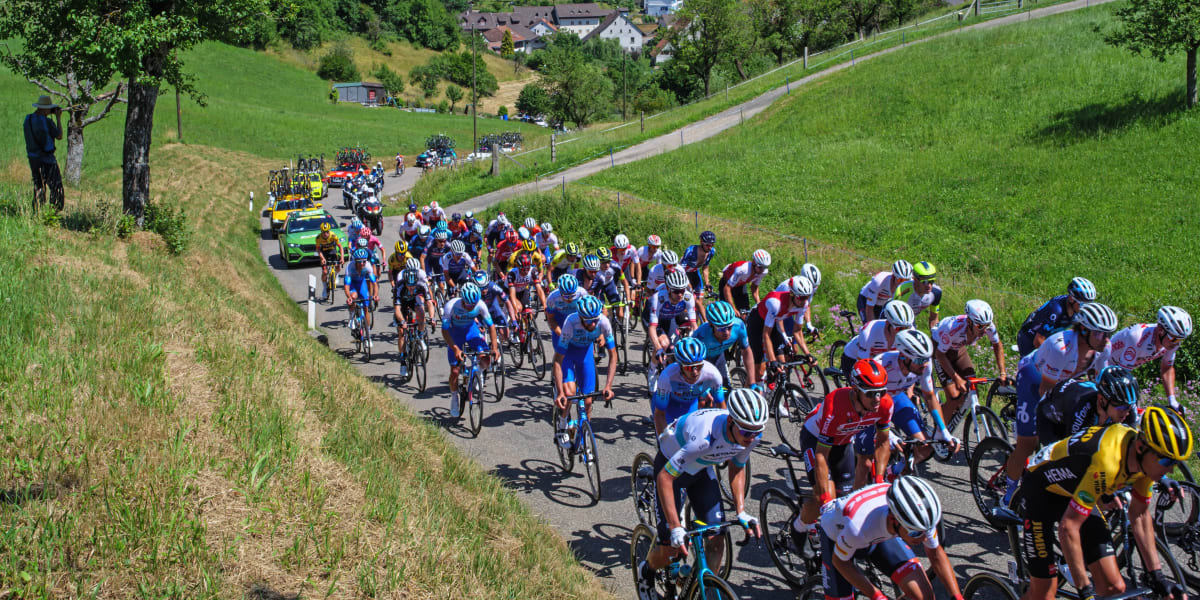
From cycling pelotons to running packs: Mathieu van der Poel, Tony Martin, Nacer Bouhanni and the cyclists turning to running
Every winter, runners’ fields welcome triathletes and cyclists, some still competing, others reinventing themselves after retirement. The running boom is drawing athletes from every background, including elite sportspeople looking for a new challenge. For those used to life on two wheels, testing themselves on the road has become a genuine winter goal, or even a post-career project.
In recent months, one cyclist after another has been pulling on a pair of running shoes and turning heads. The latest to set Strava alight was superstar Mathieu van der Poel. The three-time European cyclo-cross champion logged 10 km at 3:22/km under the title “Is this my Strava comeback?”. The activity sent the numbers soaring, with more than 1,200 comments and almost 70,000 kudos. “MVDP” could also have made an impact at October’s Valencia Half Marathon, where he had entered. Although the Dutchman did not start, his name on the entry list did not go unnoticed.
The prodigy is not the only one to make the leap. German Tony Martin, a four-time world time trial champion, made his first appearance on the tarmac over 21 km in 1:24, calling it “not bad for me, but so far from the top” while marvelling at the specialists’ performances. Nacer Bouhanni, a former French champion and professional rider, ran 2:34:36 at the Frankfurt Marathon, just one year after hanging up his bike. A few weeks ago, the French sprinter completed the Semi de Boulogne-Billancourt in 1:11:37 and is now targeting sub-2:28 in Valencia on 7 December.
Jimmy Whelan: from Australian cycling prodigy to a 1:01:37 half marathon
One of the most spectacular cases is Australian Jimmy Whelan. A former professional cyclist who switched to running in 2024, the 29-year-old clocked an impressive 1:01:37 at the Valencia Half Marathon, the 13th-fastest Australian performance of all time. After seven years at the highest level of cycling, including on the World Tour, the middle-distance runner also had a background in running until the age of 20. The promising athlete has an exceptional aerobic base. He admits he has a “cheat code”, the result of an enormous training volume accumulated on the bike.
His 200 km running weeks, made possible by years of intensive training, prove that the phenomenon has no fear of piling on the miles. The 2018 Tour of Flanders U23 winner realised he had built a bigger base than “anyone in running”. His original post-career goal was to become a professional triathlete, targeting Ironman 70.3 races and the 2028 Los Angeles Olympics. Since then, the plan has changed. Jimmy Whelan is now focused exclusively on one sport and dreams of qualifying for the Olympic marathon.
A solid base for running
That ease is common among many cycling specialists. Racking up hours of training on foot is no problem for those accustomed to spending around 30 hours in the saddle. Running is far less time-consuming than cycling, making it possible to reach a good, even excellent, level without training as much as on the bike. For almost any runner, ultradistance specialists aside, running four to eight hours a day is unthinkable. For cyclists, it is routine.
Damien Monier, a former professional who became an amateur runner, is a striking example. “I was riding 30,000 km a year, so 25 hours a week, with no days off. Then we’d follow that with three weeks of racing and two days off. It was hard to absorb,” says the man who won the 17th stage of the Giro in 2010.
Now running alongside his work as an assistant and masseur at Cofidis, he quickly made a name for himself in his new discipline. “They’re two different sports in terms of time and distance, but I found a lot of similarities in the way you train and in pushing yourself.” After five months of running three to four times a week, the former rider finished second in the 25 km Trail des Volcans in Auvergne. “As any self-respecting cyclist would, I wanted to go hard, so I chose the 25 km. I really enjoyed it that day, and the result wasn’t too bad,” he says.
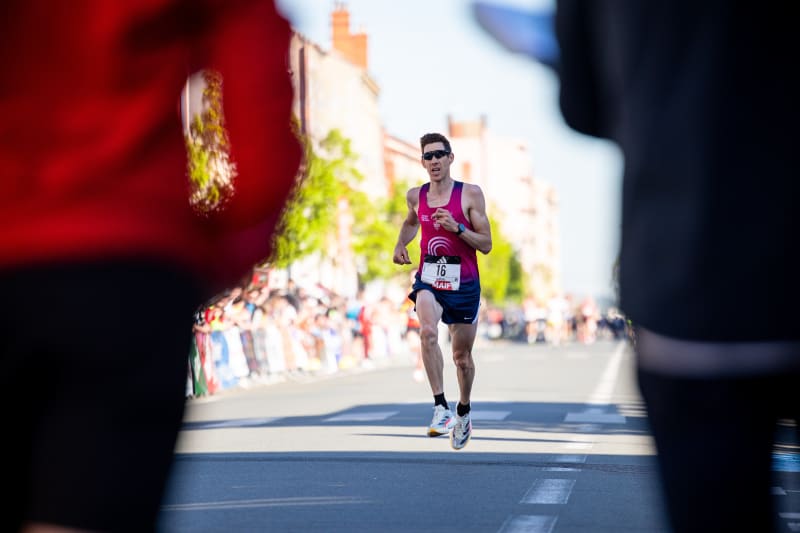 © Alanis Duc / Marathons.com
The mindset forged in the peloton
The Clermont native was quickly spotted by coach Cyrille Merle, a former national-level runner. The specialist was struck by Damien Monier’s “huge engine” and his “great potential”. Years at the highest level have given him a formidable engine, but also an iron mindset forged by an ascetic career in the peloton. “A pro runner is 50% legs and 50% mindset,” says the long-distance enthusiast. One day, the Clermont native hopes to line up for a marathon, with the unofficial record of the former road warriors in his sights: that of an “little-known Italian professional who ran 2:26:26 in 2007”.
His coach describes Damien Monier as “professional and meticulous” after 19 years in the sport. Monier himself jokes about his appetite for hard work, his enjoyment of “making himself suffer” and his determination to take on the best. It is a cyclist’s trait: always ready to “hurt himself”.
Cyclists and their extraordinary strengths
The multiple French pursuit champion has also discovered the near-absence of strategy in his new discipline. With mass starts where settling into a steady pace is the best way to manage the effort, explosive attacks like those seen on the bike are rare. It is an aspect he has enjoyed as a former climber. “It’s satisfying to see the group string out behind you, to watch people start getting dropped at the back while you hold on. I find a bit of that same pattern when running.”
At his first cross-country race, his coach had pointed out two or three rivals he should not follow because they were out of reach. That was all it took to push him into the lead group. “I approached it like a cyclist, sitting in the leader’s slipstream and attacking near the finish after staying sheltered the whole way. It wasn’t very sporting of me. It was my first cross-country race, so I hope he forgave me.” His top-20 finishes at the French Masters Cross-Country Championships then began to pile up: 18th in 2023 in Carhaix, 8th at Cap’Découverte in 2024 and 15th in 2025 in Challans. Highly impressive results that highlight the immense talent of athletes coming across from cycling.
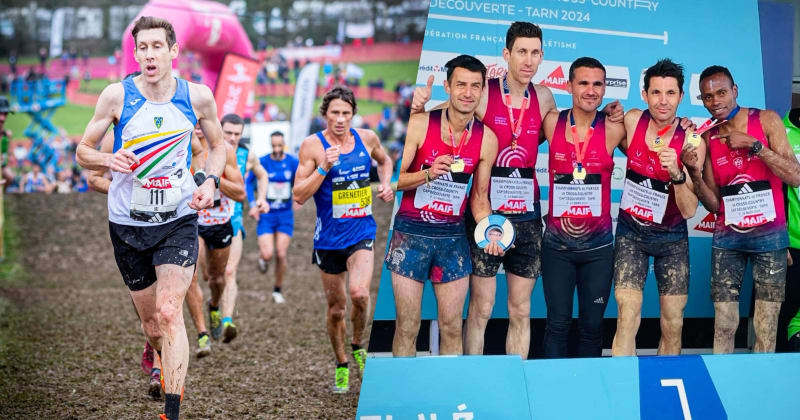 © Larry shooting 63
The difficult transition from cycling to running
The transition is not always straightforward, however. Moving from a non-weight-bearing sport to an impact discipline often leads to injury. Running complements cycling well, but the reverse can be difficult. “Momonne” experienced it soon after the Trail des Volcans and the Marvejols-Mende classic, which the newcomer completed in 1:22. “I could run for two months, then I’d have to stop for three. I was trapped in an endless cycle of forced layoffs for two years,” recalls the hard-working 43-year-old, who was limited to around 50 km a week during that period.
“At first, I suffered from muscle pain I had never experienced before. I was still doing a lot of cross-training because of the injuries.” Through sheer perseverance, the Cofidis runner put together some fine performances: 1:07:19 for the half marathon, 30:53 for 10 km and even the 2024 French Masters 10 km runner-up title.
His body changed, his thighs slimmed down and his build adapted. The man who has already ridden all three Grand Tours swapped his “cyclist’s musculature”, an advantage on trails and climbs, for a lighter frame. “I can feel that I no longer have the power I had in my early years in this sport,” says Monier, who can now run more than 100 km a week. Vigilance is still essential. Beyond a certain threshold, the pain returns. But Damien Monier also knows his body extremely well, thanks to his professional background.
More and more cyclists are making the move from the peloton to the running pack. Their endurance is impressive, as is the mindset forged through thousands of hours of pedalling. Those undeniable strengths offer a significant advantage, even if they still have to adapt to a new impact sport.
More articles
Marathon de Chablis set to welcome 4,400 runners among the vines
The Marathon de Chablis returns on Saturday, October 24, with races, hikes and a festive atmosphere among the vineyards.
Wed, October 21, 2026

Avignon Marathon makes a winning debut with more than 3,450 runners
More than 3,450 finishers turned out for the successful first edition of the Avignon Marathon on Sunday, September 27, 2026.
Wed, September 30, 2026

Night races: why does everyone want to run while everyone else is asleep?
From Glow Runs to low-key trail races, night running is taking off, offering a more festive experience and a different relationship with the clock.
Thu, September 10, 2026