
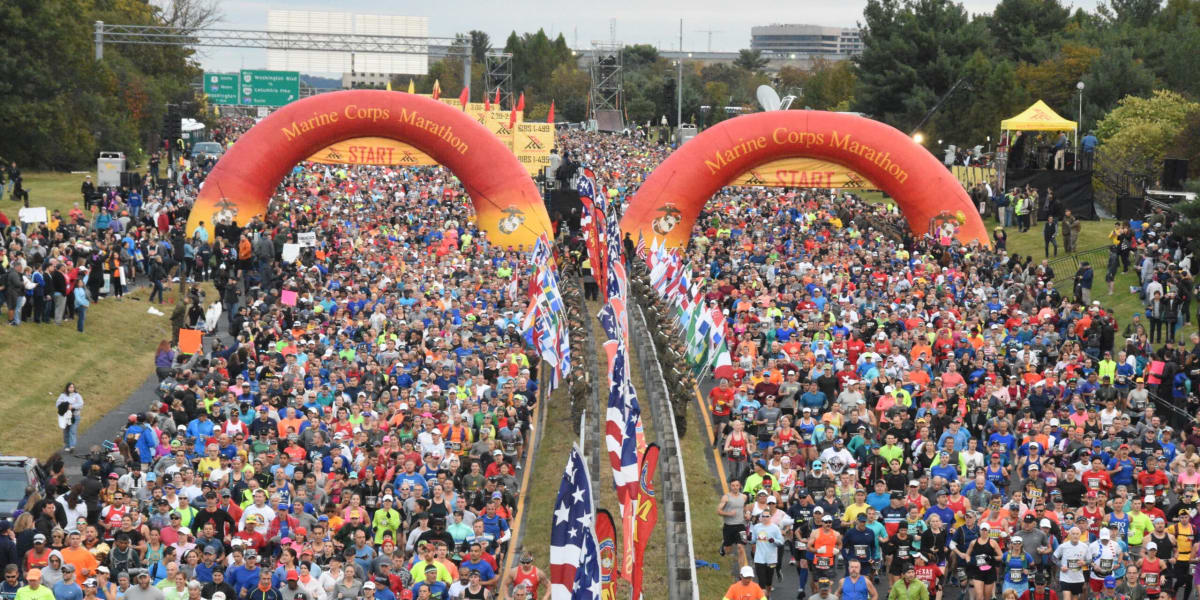
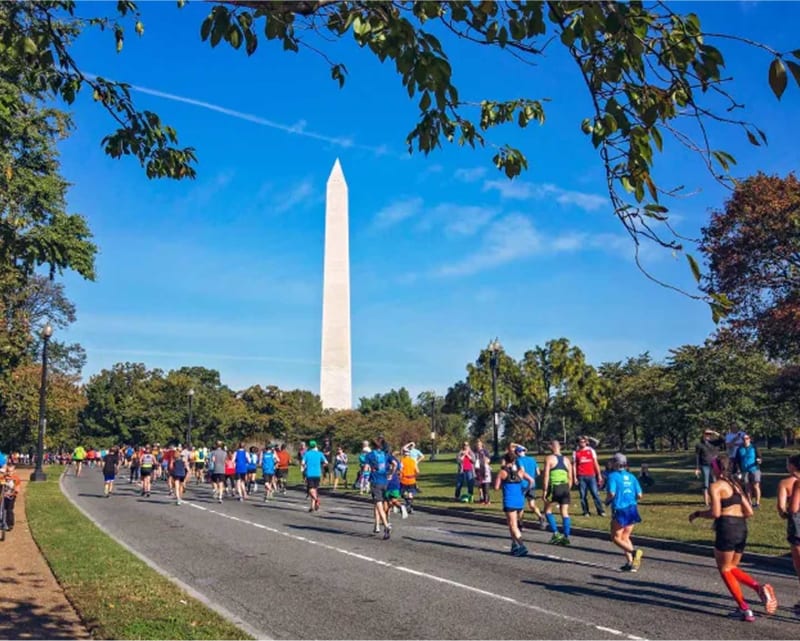
Every last Sunday in October, Washington, D.C. welcomes more than 30,000 runners for an event unlike any other. Organized by the Marines since 1976, the Marine Corps Marathon winds past the Lincoln Memorial, the Capitol and the Pentagon, bringing together service, tradition and public enthusiasm. As the race approaches its 50th anniversary this fall, Alex Hetherington, the event director and a former Marine helicopter pilot, takes us behind the scenes. He talks about his deep connection to the course, his own life as a runner, and the way the event is adapting to today’s challenges, from inclusion and environmental impact to preserving its military heritage. The Marine Corps Marathon is more than a race: it is a living tribute to those who serve and a celebration of the bond between civilians and the military.
➜ With the 2025 Marine Corps Marathon set to celebrate its 50th anniversary, we were given a privileged look behind the scenes at how the event is organized.
 © Marine Corps Marathon
 © Marine Corps Marathon
 © Marine Corps Marathon

Behind the scenes of a marathon steeped in military heritage: an interview with Alex Hetherington, a former Marine and the current director of the Marine Corps Marathon.
| Could you walk us through the overall organization of the marathon, describe your role at the event, and tell us how long you have been involved?
Alex Hetherington: The Marine Corps Marathon organization directly represents the United States Marine Corps. It is responsible for sharing the Marines’ traditions, values, culture and spirit of service with the public. The Marine Corps also promotes physical fitness, organizational excellence and public outreach. We organize five event weekends a year, mainly in Northern Virginia. Most recently, on May 18, 2025, we held our historic half marathon in Fredericksburg, the city’s largest public event, which is something we are very proud of.
This year marks the 50th Marine Corps Marathon. My role is to organize these events and represent the Marines properly. I am a former Marine and now retired. Apart from my family, my life revolves around the Marines, whom I served on active duty and now support as a civilian.
I am also a passionate runner. I was known for it. I was not an elite athlete, but I was heavily involved. I ran in high school and college. I have always been inspired by the Marine Corps Marathon, and I love the marathon distance. I ran on Marine teams against athletes from the other branches of the armed forces. The marathon’s unique tradition is the Challenge Cup, which dates back to 1978. It is a competition between the U.S. Marines, the Royal Navy and the British Royal Marines. That is how I ended up in my current position.
✓ The Marine Corps Marathon is a one-of-a-kind race. Its exceptional course, the spirit of the Marine Corps, its accessibility, inclusivity and focus on the runner experience set it apart on the international stage.
| What makes the Marine Corps Marathon so unique around the world?
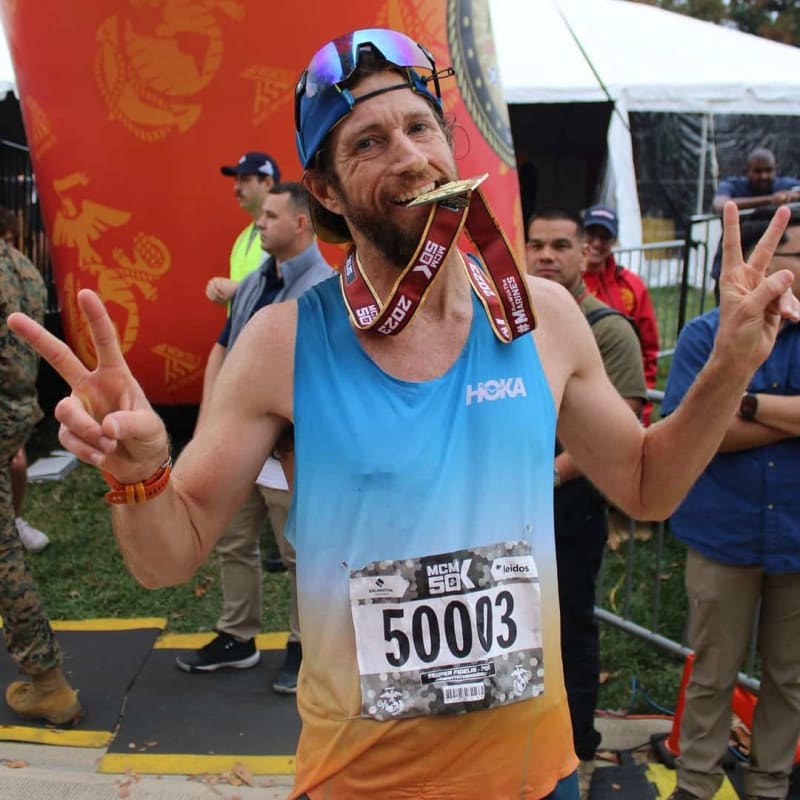
Alex Hetherington: The Marine Corps Marathon stands out in three essential ways. First, it is a major race, professionally organized in an iconic setting and carried by the spirit of the Marine Corps. Our mission is simple: to give every runner, whatever their level, the best possible experience. Whether you are chasing a time or simply trying to finish within the time limit, we want you to have the tools to reach your goal. We also make a point of celebrating every athlete’s performance, particularly those competing with disabilities, who play an important role in our event. Finally, it is one of the world’s largest endurance events without prize money. That is why it is known as the “People’s Marathon”: all our efforts go into the quality of the experience our participants have. That means respecting your goals, wanting to see you perform and giving you the recognition you deserve. The iconic Marine Corps Marathon medal is presented at the finish by an active-duty Marine.
 © Marine Corps Marathon
 © Marine Corps Marathon
 © Marine Corps Marathon
 © Marine Corps Marathon
✓ The Marine Corps Marathon is known as the “People’s Marathon” because the winners receive no prize money. Winning the race is first and foremost the honor of taking a prestigious victory and standing on the top step of the podium, where a former Marine presents the medals.
| Could you explain more about the philosophy behind this unique position as the “People’s Marathon”?
Alex Hetherington: It reflects the culture and values of the Marine Corps on a deep level. To become a Marine, you have to meet high standards that can be mental, moral and physical. Running a marathon is a demanding challenge, an ambitious goal that requires discipline and rigor in training. In the Marines, there is no hierarchy among members: everyone is celebrated in the same way. Awards are presented publicly, in a solemn and respectful setting, but they are never financial. They are symbolic and honorary.
Winning the Marine Corps Marathon is an achievement that stays with you for life, even without a cash prize. It is not a race designed to attract elite athletes with appearance fees, but it is an important stage for strong runners who want to make their mark. Some former winners, despite being used to paid podiums, have told me that the victory that truly stayed with them was the Marine Corps Marathon. To me, that is the greatest compliment possible.
✓ The history of the Marine Corps Marathon is as fascinating as it is little known to the general public. The race was created to strengthen ties between the military and the public, and particularly to restore the Marine Corps’ image. It has continued to bring together active-duty personnel, veterans and their families, many of whom have a direct connection to the event.
| Let’s go back to the beginning, to its creation in 1975. Why did the Marines decide to create such an event at that time?
Alex Hetherington: The idea came from Colonel Jim Fowler, a decorated and wounded veteran of the Vietnam War. He was actually a Marine reservist serving at the Pentagon. In 1975, he wrote a memo to the Secretary of the Navy and the Commandant, arguing for the creation of the Marine Corps Reserve Marathon. He felt that the American public was losing confidence in the armed forces and the Department of Defense because of events during the Vietnam War. He wanted to organize a celebration of service that civilians could take part in, one that would create a positive feeling toward the Marine Corps and help people reconnect with it as civilians. The timing was right because Frank Shorter had won the Olympic marathon in Munich in 1972. Running was hugely popular, and marathons were beginning to take off. This was also when the New York City Marathon began its remarkable growth.
Of course, the Boston Marathon had existed for a long time, but its popularity was exploding at that point. The idea of creating a Marine Corps marathon was genuinely innovative, almost revolutionary. At first, the institution itself was not entirely convinced. But one of its strongest supporters was the Secretary of the Navy, Ambassador Mittendorf, who was a keen runner. He was immediately taken with the project and passionately argued for its implementation. The result was that, just one year after the first memo was written in 1975, the inaugural Marine Corps Marathon took place in 1976. Given how quickly it came together, it was a remarkable demonstration of vision, ingenuity and determination.
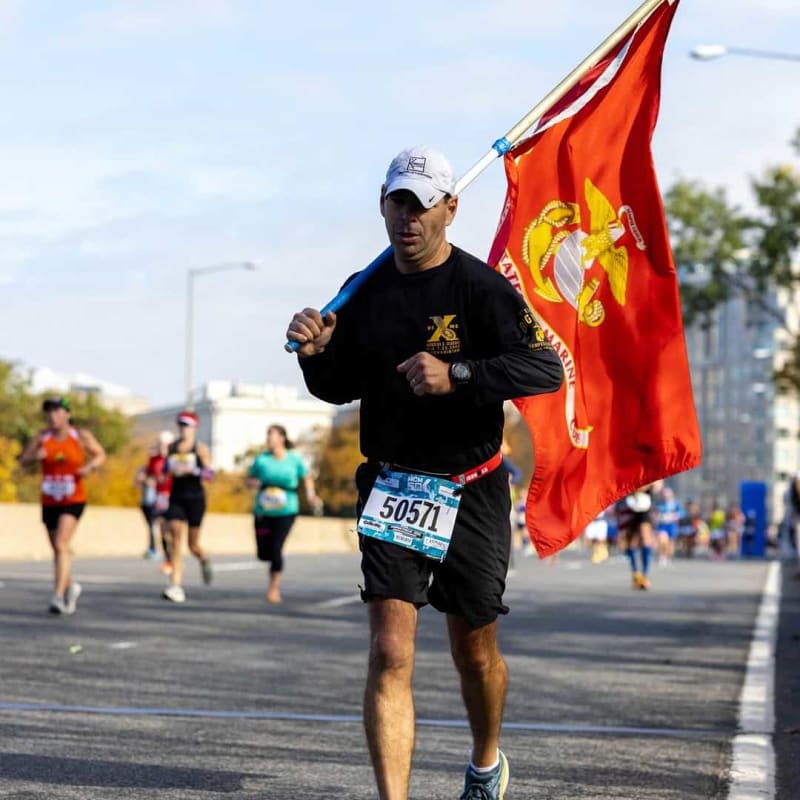 © Marine Corps Marathon
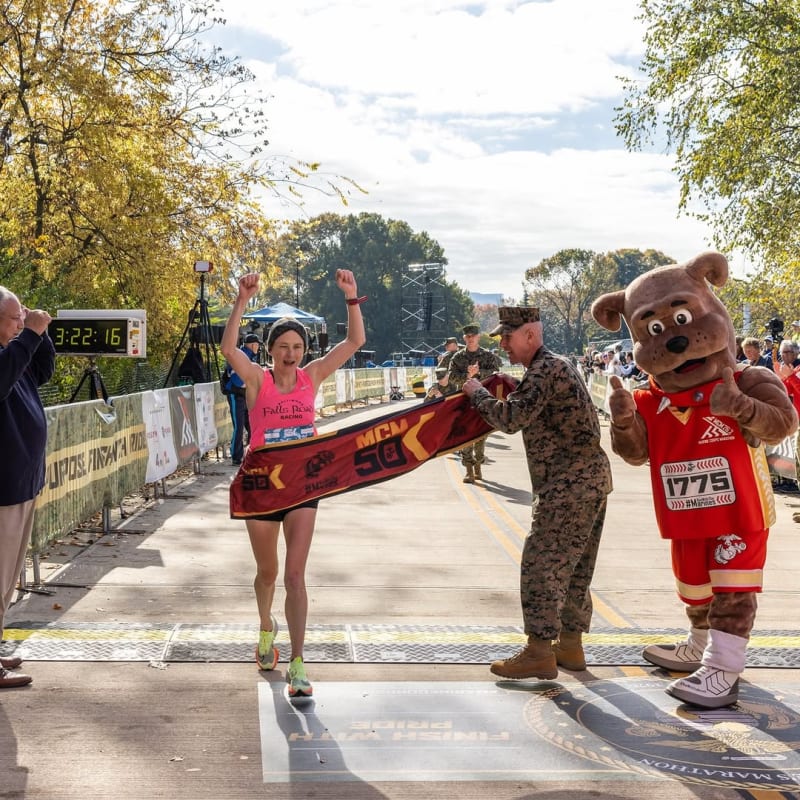 © Marine Corps Marathon
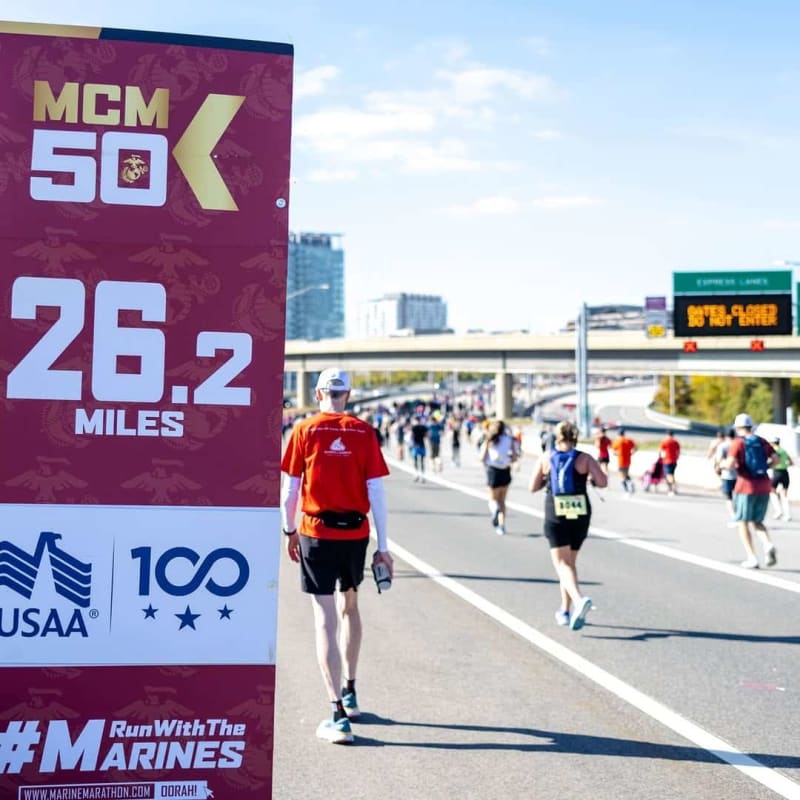 © Marine Corps Marathon
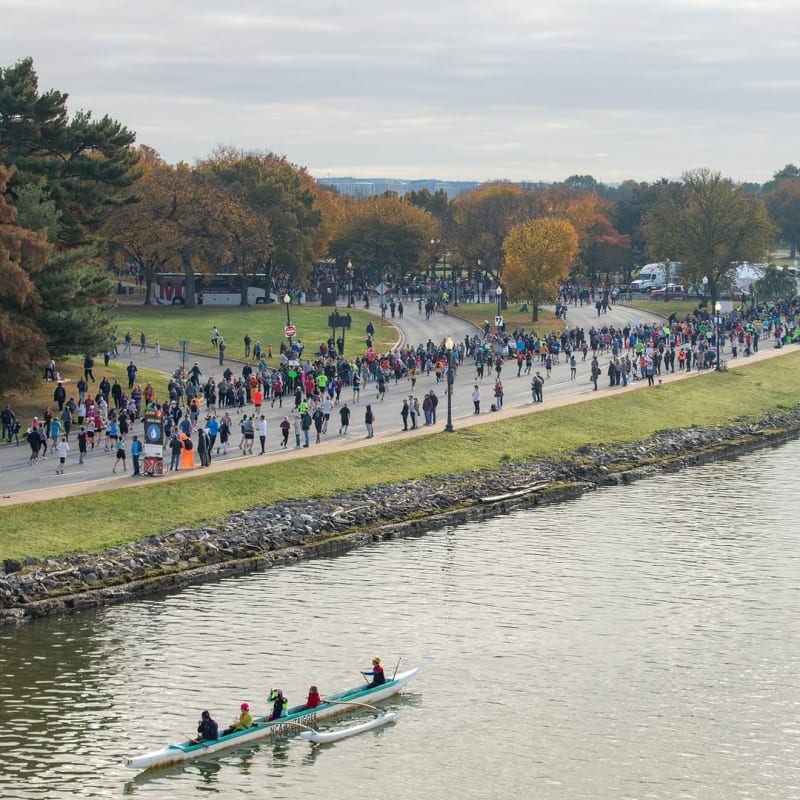 © Marine Corps Marathon
| The marathon passes iconic sites such as the Pentagon, the National Mall, the Lincoln Memorial, the Jefferson Memorial and the Capitol. Has the course remained the same, or has it evolved in recent years? And what is it like organizing a marathon in such symbolic locations? Is it straightforward or particularly complex?
Alex Hetherington: The main challenge is that the course runs through both Arlington, Virginia, and Washington, D.C., and around 70 to 75 percent of it is on land managed by the National Park Service. We also cross Pentagon and Department of Defense property. That means coordinating a large number of different authorities, including Capitol Police, since the course passes near the Capitol. The biggest difficulty is coordinating all those law-enforcement agencies and emergency services across multiple jurisdictions. A lot of players have to be brought together to make the race work.
Washington, D.C., particularly this iconic part of the nation’s capital, is also constantly dealing with public works and development projects. Those projects affect us. For example, in West Potomac Park, right next to the Lincoln Memorial, a huge construction project forced us to change the course last year, and that will probably remain the case for another five or six years.
The first Marine Corps Marathon took place entirely in Northern Virginia. At the end of the 1970s, it expanded into Washington, D.C. The course had remained stable for more than a decade. The latest change, made last year, allowed us to add two new monuments: the Martin Luther King Jr. Memorial and the Franklin Delano Roosevelt Memorial. It added a few turns, which is not ideal, but it allows us to showcase two important sites. As always, there are trade-offs between the advantages and disadvantages. We are very attached to our course and consider it one of the best possible.
✓ It is rare for a marathon of this scale to rely solely on participant entries and the support of a handful of partners. This unusual model is made possible by the event’s unique status.
| You occupy a unique position as an organizer. This race is different, largely because of its runners, but you also depend on the U.S. government. That means decisions, funding and organization work differently. How does the model operate?
Alex Hetherington: The Marine Corps Marathon is a government activity funded through non-appropriated funds, or NAF. Put simply, we operate similarly to a nonprofit organization, but we are officially part of the U.S. government. As a non-appropriated fund activity, we receive no taxpayer funding and no money approved by Congress supports our operations. We are entirely self-funded. All our activities, staff and events are supported by the revenue we generate through entry fees and partnerships. That is how we are able to plan and organize our races.
Our team is made up entirely of employees paid through non-appropriated funds. That means we are federal employees whose salaries and benefits follow government pay scales, but are funded exclusively by the revenue generated by our events.
Other branches of the military organize similar events under the same principles, with their own races funded through non-appropriated funds. We are very proud to have partnered with them to create a race series called the Armed Forces Series Challenge, now in its second year. It includes the Marine Corps Marathon, the Army 10-Miler in Washington and Arlington in October, the Air Force Marathon in Ohio in September, the Coast Guard Marathon in North Carolina in March, and the new Space Force T-10-Miler at Cape Canaveral in December. This collaboration allows us to share best practices and offer a common experience to all runners, military and civilian alike.
Even with such a wide range of races available today, I think the Marine Corps Marathon will continue to attract people. What matters is offering an experience that means something and makes people want to come back.
| In 2025, running has exploded. Fifty years ago, you launched this race, and today running has become a phenomenon. With so many marathons on the U.S. scene, do you see other races as competitors? Or do you collaborate with other organizers?
Alex Hetherington: Running is experiencing an incredible boom, which is fantastic. It allows athletes to run throughout their lives, and that is exactly what we want. To me, running is the best form of preventive medicine: it benefits physical health, mental well-being, mood and overall balance.
I am still an active runner, even as I get older, and I love the variety of races. I have my regulars every year, but I also like trying one or two new events. That is what I recommend to everyone.
The marathon is there, accessible, and I hope it will one day become part of your plans. Competition is healthy; it pushes you to remain authentic. My responsibility is to offer a race experience that fully satisfies you. That is what matters most to me.
Even with such a wide range of races available today, I think our event will continue to attract people. What matters is offering an experience that means something and makes people want to come back. We show people all the opportunities available to them and explain how they can make the most of them, so they can make the best decisions with the time and money they have.
 © Marine Corps Marathon
| Why do so many runners in the United States choose your marathon as their first marathon? What do you do to welcome this particular group of runners?
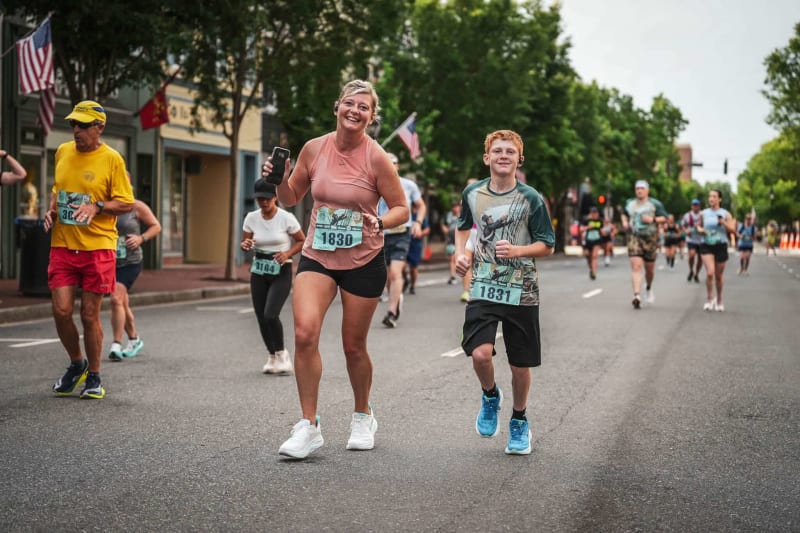
Alex Hetherington: Much of our reputation comes from being the “People’s Marathon” and especially welcoming to first-timers. Every year, around one-third of our participants are running their very first marathon, and we are incredibly proud of that. We do not focus on an elite field, which allows us to put all our energy into making the race straightforward, easy to understand and accessible. We provide all the information and resources beginners need to feel comfortable and motivated.
Our job is to make the experience as smooth and intuitive as possible. Our communications include advice and educational resources to help first-time marathoners prepare, so they arrive ready on race day. The real race begins well before that, with a thoughtful, progressive training plan that allows runners to prepare calmly for covering those 42 kilometers, or 26.2 miles.
| Last year there were more than 30,000 participants. What percentage were Marines? Do you think Marines enjoy running more than most people? They face high standards, train every day, take part in several sports and have abilities many others do not.
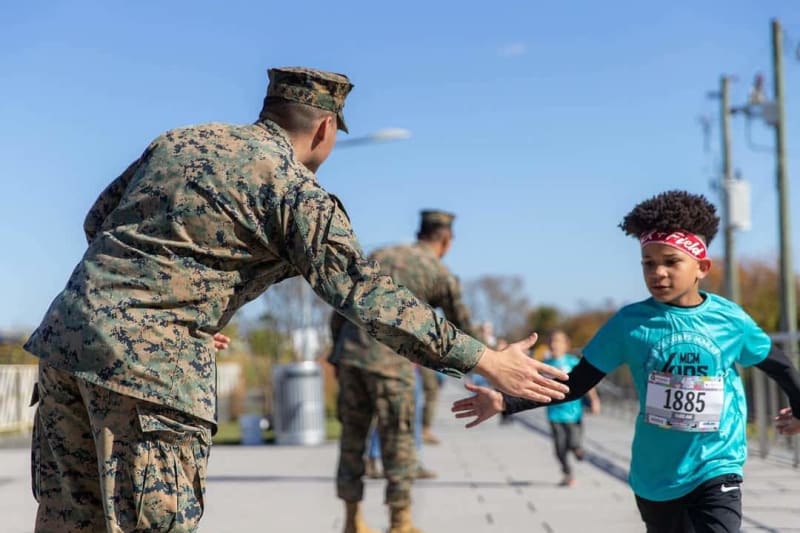
Alex Hetherington: Yes, there is a real tradition of Marines taking part in the Marine Corps Marathon. First, many Marines come to support the race in uniform. You find them at the aid stations, handing out drinks, encouraging runners along the course and celebrating their efforts. That is an essential quality of the U.S. Marines: leading through support and enthusiasm. Training is hard, but what helps people keep going is that spirit of mutual aid and encouragement.
Around 35 to 40 percent of participants are active-duty service members, veterans or members of their families who are present on race day. For many, the marathon is a rite of passage, an important challenge to check off their personal list. It is especially meaningful for veterans because the race celebrates their commitment and service.
But it is not only Marines who take part. Civilian participation is an essential part of the event. It symbolizes unity, a shared purpose and the cohesion that defines our nation. We also welcome many foreign military athletes, which strengthens that sense of international solidarity.
| Do you consider your event international in scope? Do you welcome runners from around the world? What do you do to attract participants, particularly from Europe, given the distance they have to travel?
Alex Hetherington: We do some international marketing through a few of our partners, but word of mouth works best. We attract many participants from embassy staff in Washington, D.C., as well as foreign military personnel posted at those embassies, who then encourage other military athletes from their countries to come and take part.
These runners often travel from their home countries specifically to run the Marine Corps Marathon. The military team competition is very active and brings together foreign service members, embassy staff and their families. Many discover the race for the first time and want to return the following year.
So our international participation grows mainly through word of mouth. That is an integral part of the race’s spirit, which celebrates friendship and solidarity among allies, a fundamental principle in the United States.
 © Marine Corps Marathon
| Participation has grown significantly, and you expect that to continue in the years ahead. Have you reached capacity? Could you welcome more runners, perhaps by changing the courses? And with the 50th edition approaching, do you have any special plans, such as adding or removing distances or changing other aspects of the race?
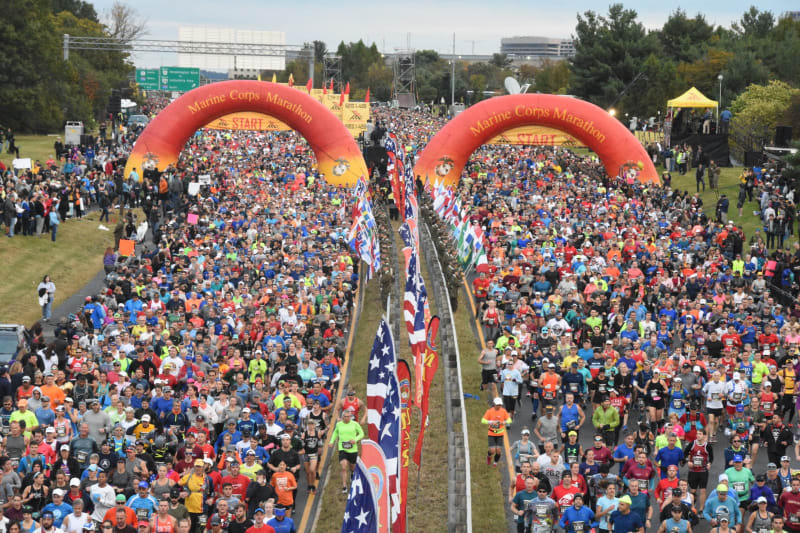
Alex Hetherington: For the 50th Marine Corps Marathon, we are focusing all our resources on the marathon itself so that as many runners as possible can take part. We are aiming for 40,000 entrants, which would be a record. Until now, the maximum number of entrants across the three distances was around 30,000. The 10K will be held virtually this year, and the 50K is temporarily suspended. More than 33,000 runners have already registered, at a rate of around 1,000 entries per week, so we should reach our target very soon.
To mark our 50th anniversary, we have planned a whole series of events: a dinner honoring marathon legends, a children’s race on Saturday, a major celebration alongside the expo before the race, a fun run with our key partners and sponsors, and an opening ceremony for the Armed Forces Marathon Championships.
Every year since 1998, teams from the different branches of the armed forces have competed at the Marine Corps Marathon for the title of best military team. Last year, the men’s winner was Major Kyle King of the Marines, who has already won the race twice. We hope he can make it three and become the first three-time winner in race history. He is an exceptionally talented runner and will be back this year, which has us very excited.
| Do you have responsibilities around social inclusion and the environment? What concrete steps are you taking on these issues? In 2025, we can see that your events inspire smaller races. How do you support that movement?
Alex Hetherington: We see running as a voluntary activity, but that does not stop us from taking concrete action on sustainability. We work with many partners and have introduced several initiatives to reduce our impact. On race day, for example, we recycle and compost almost all the materials used. Clothing left behind by runners is collected through our partners, cleaned and redistributed. Our apparel sponsor, Recover Brands, operates a closed-loop system using recycled materials. Even our finisher shirts are recycled if they are not claimed after the race.
We have also made significant progress in forecasting our needs, which reduces waste. I do not have the exact figures in front of me, but every year we improve our processes to make the event more sustainable, including saving and using resources such as water responsibly. We are constantly looking for more efficient ways to limit waste and optimize travel. In that respect, we work with the city to have the Metro open two hours earlier on marathon day, because it is clearly the most convenient way to get to and from the race. We strongly encourage the use of public transportation wherever possible.
| Can the half marathon be considered the marathon’s “little brother,” or is it a completely different event with its own distinct spirit?
Alex Hetherington: Yes, the two are connected. The event is important to our team because it serves as a kind of dress rehearsal, especially for testing new initiatives we want to bring into the marathon. We are planning to welcome 40,000 runners for the marathon, while our most recent half marathon in Fredericksburg, Virginia, had 8,000 participants. It gives us a chance to put new methods into practice, experiment and work with new partners.
Fredericksburg is a small but growing city in Virginia. It is something of a hometown for the Marine Corps because Quantico is nearby, an essential place in a Marine’s career, whether for training or headquarters assignments. Many retired Marines live there, which gives the city a very welcoming atmosphere. It is also steeped in history, with a colonial past, and George Washington spent his childhood there. That is why we call the race the “Historic Half.” It is Fredericksburg’s largest annual mass event. The atmosphere is a little different, but the race helps us prepare more effectively for the marathon later in the year.
One initiative that works particularly well is the Distinguished Participant Challenge, which invites runners to take part in all five of our event weekends. It grows every year. This year, more than 1,000 people could complete all five events, including the Marine Corps Marathon. That is how we build a community of highly committed athletes who know us, appreciate what we do and help our organization grow and evolve in the right direction.
| As a runner, is there a particular section of the course you especially enjoy? If so, which one?
Alex Hetherington: I love the Marine Corps Marathon course because of its variety. It is not a slow course, but it is not an ultra-fast one either. There are a few climbs, including one as early as the second mile, with around 60 to 90 meters of elevation gain, which is more than many other marathons offer. There are also quite a few turns, but the course is mostly flat. What runners often remember is that the race finishes with a climb. At the end of a race, the last thing you want to do is run uphill. Yet that is what makes this marathon unforgettable. I like that it is not too difficult: it is accessible while still demanding enough because it is not completely flat.
The marathon is actually a series of out-and-backs, nearly five in all. The Lincoln Memorial is the central anchor of the course. That is also why the race is perfect for beginners: friends and family can see and encourage them several times without having to travel far. Of all the national monuments on the route, the Lincoln Memorial is the strongest symbol for me. Abraham Lincoln was, in many ways, our greatest president, and his memorial is iconic. When you come back toward it late in the race, the fatigue is setting in, but you know the finish line is getting closer.
| As an organizer, have you officially run the race?
Alex Hetherington: I have run it many times, close to 29. I discovered the race as a Marine and loved taking part. For 15 years, I was part of the Marine Corps running teams, racing almost every year, whether on active duty or after retiring. For a Marine, it is a bit like a mini annual reunion.
Every year, as an organizer, I run into people I have not seen in decades. They matter because they are brothers in arms. Many families also take part, often in memory of a loved one, Marine or service member, who has died. They come back to honor those they served with, or simply to reunite and run together. That is what gives the Marine Corps Marathon its depth and meaning, and it is why I love it so much.
The COVID period was extremely difficult. We had to cancel the race two years in a row, which made restarting and bringing runners back challenging. But now, in 2025, the race is nearly full and enthusiasm is stronger than ever. For this 50th edition, I am especially happy to celebrate that comeback while keeping the lessons we learned in mind.
| What is your marathon personal best?
Alex Hetherington: My personal best is 2:29, which I ran three times in the 1990s. As a committed runner, I trained hard, but I never managed to go faster. You could say I reached a plateau. Two of my three sub-2:30 times came at the Marine Corps Marathon.
| When you build your race calendar, which three races do you most want to run, or return to, for their organization, atmosphere or setting?
Alex Hetherington: I like trying new things, but I also have my regular favorites. What I really appreciate are events with real depth, a strong culture and clear values. Every race tells a story, the story of the organization and the runners who take part.
The race that inspires me most is the Boston Marathon, because it is one of the oldest organized running events in the world. It is incredible to be part of it, especially since it is highly competitive and you have to qualify. The start is arranged in waves based on qualifying times, which makes the experience even more exciting. Every year, the challenge is to beat your own bib number, in other words, to run faster than your qualifying time.
I also love the Annapolis 10 Miler in Maryland. It takes place in August, always in hot and humid conditions. It starts and finishes at Navy-Marine Corps Memorial Stadium, part of the U.S. Naval Academy, on a hilly course. Annapolis is an iconic colonial city with a rich maritime tradition. It is probably the biggest competition I have ever won, even if my winning time is probably one of the slowest in the event’s history. The race celebrates its 50th anniversary this year, which is a nice coincidence.
Finally, I really like the Army 10-Miler, the race most closely connected to Marine service. It is fast and highly competitive, with teams from army bases everywhere, including ROTC cadets. It also welcomes many adaptive athletes, particularly veterans who use wheelchairs. It is another superbly organized race that I love. So those are my three favorite races, the ones I look forward to returning to every year.
 © Marine Corps Marathon
 © Marine Corps Marathon© Marine Corps Marathon
For nearly 50 years, the Marine Corps Marathon has been carried by the same rigor and commitment that honor the Marine Corps. At its helm, a passionate leader watches over every detail with a sharp sense of mission: creating a deeply human experience. Behind every Marine handing out a cup and every runner climbing toward the Iwo Jima Memorial, the spirit of the “People’s Marathon” rings out. No one runs here for prize money or glory. They run to belong to something bigger than themselves. As its 50th edition approaches, this iconic race continues to evolve without ever betraying what makes it strong: unity, remembrance and shared experience.
➜ The next Marine Corps Marathon will take place on Sunday, October 26, 2025. Find all the details!
More articles

Marathon de Chablis set to welcome 4,400 runners among the vines
The Marathon de Chablis returns on Saturday, October 24, with races, hikes and a festive atmosphere among the vineyards.
Wed, October 21, 2026

Avignon Marathon makes a winning debut with more than 3,450 runners
More than 3,450 finishers turned out for the successful first edition of the Avignon Marathon on Sunday, September 27, 2026.
Wed, September 30, 2026

Night races: why does everyone want to run while everyone else is asleep?
From Glow Runs to low-key trail races, night running is taking off, offering a more festive experience and a different relationship with the clock.
Thu, September 10, 2026