
 © Marathon International de Marrakech
Morocco is becoming the world’s new playground for distance running
Published on Wed, August 5, 2026
The Maghreb, and Morocco in particular, is no longer just a land of champions. Slowly, methodically, it’s turning into a full-fledged ecosystem, from altitude tracks to big-city boulevards, from Diamond League meets to international marathons. For federations, pro squads and managers worldwide, the model is starting to make real sense.
Table of contents
- The Rabat Meeting, a global showcase
- Ifrane, distance running’s worst-kept secret
- Sensible altitude, not extreme
- El Bakkali, product of the system and a template for what’s next
- Moroccan marathoning, an identity taking shape
- What El Guerrouj saw before everyone else
- There’s still everything to build… and that’s where it gets exciting
Something is shifting in Tunisia, Algeria, and above all Morocco. Not a sudden revolution, more like a steady rise in pressure. A region long overshadowed by East Africa, the land of the Rift Valley, Iten and Bekoji, is beginning to take shape as a genuine global hub for distance running. The numbers speak for themselves. The Casablanca Marathon drew more than 10,000 runners last year, with a friendly vibe in the heart of Morocco’s biggest city and elite times that keep lifting the race’s profile. In Marrakech, the 36th edition of the international marathon was announced with close to 16,000 athletes expected across the different events, in a clear push toward modernization and openness. Numbers that would’ve sounded unrealistic barely ten years ago.
And while the mass races are growing, the elite level is keeping pace. El Mahjoub Dazza won the Casablanca Marathon in 2:09:43, ahead of Omar Ait Chitachen in 2:10:31, times that reflect real competitiveness. On the women’s side, Keltoum Bouasriya and Hasna Zahi, two Moroccans, are regularly up front alongside Kenyans and Ethiopians. The East African hierarchy isn’t crushing anymore. It’s being challenged.
The Rabat Meeting, a global showcase
If one symbol could sum up the region’s ambition, it would be the Meeting International Mohammed VI d’Athlétisme. Staged at Rabat’s Olympic Stadium, it’s been a full Diamond League stop for several years now, on the sport’s toughest circuit. Almost exactly a year ago, Soufiane El Bakkali won the 3,000m steeplechase in front of a world-class field, clocking 8:00.70 on his home track in Rabat. In that same race, Tunisia’s Mohamed Amin Jhinaoui finished sixth in 8:10.59. Two North African nations in a Diamond League top six. That’s not a fluke, it’s a trend.
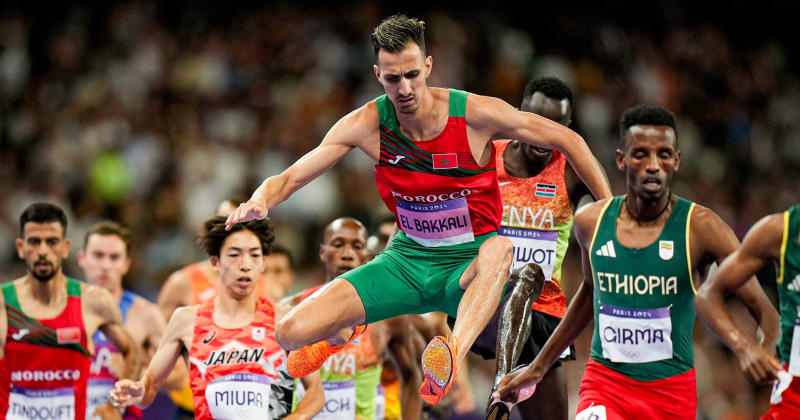 © Soufiane El Bakkali embodies this fresh Moroccan momentum. © World Athletics
In 2023, El Bakkali ran 7:56.68 in the steeple, the world’s best mark in 11 years, set at home in front of his own crowd. The kind of image that sticks with the managers and agents who build their athletes’ calendars. Having a Diamond League meet on home soil sends a strong signal, not just to runners, but to broadcasters, sponsors, and the whole global distance-running ecosystem.
Ifrane, distance running’s worst-kept secret
Sitting at 1,650 meters in Morocco’s Middle Atlas, Ifrane has a humid continental climate, with high annual rainfall and an average temperature of 12.5°C. Translation for distance runners: ideal training conditions. Not too hot, not too cold, and just enough altitude to boost red blood cell production without trashing the legs.
Ifrane is popular with athletes thanks to its 1,750-meter elevation, which pushes the body to produce extra red blood cells to carry oxygen in thinner air. Hicham El Guerrouj himself used it as a base, training there several times a year, with blocks of at least three weeks per stay, in the cedar forest that surrounds the town. Athletes like Gabriela Szabo and Qatar’s national team have also set up camp in Ifrane. In global endurance circles, the town’s reputation is well established.
As for El Bakkali, he’s never wanted to go anywhere else. “ I got a lot of feedback from former athletes, including Hicham El Guerrouj, who advised me never to look for training anywhere other than Morocco. I saw it brought me luck, so I don’t change,” he said. And in January 2025, when snow covered the Middle Atlas peaks, the double Olympic champion was still there, training in Ifrane’s bitter cold, treating those harsh conditions as an opportunity, not an obstacle. “ Right now I’m training at altitude in Ifrane. It’s snowing, it’s cold, and I ask myself: why am I spending all this time in the mountains, putting in all this work? To achieve something. To win,” he said in a recent interview with The National. The mountains as a driving force, not a constraint.
Sensible altitude, not extreme
It’s one of the region’s least talked-about, yet most convincing strengths. Unlike extreme-altitude venues like Mexico City at 2,240 meters, Morocco leans into mid-altitude sites around 1,650 to 1,800 meters, a range that maximizes physiological adaptations without the long acclimatization penalty that can blunt the first few weeks. For a European athlete coming from Paris or Madrid, a few days is usually enough to find their feet and get quality sessions done. Coaches like it. Managers running groups with tight prep windows like it even more.
Add to that logistical perks the sport is only now fully pricing in: under three hours by plane from most major European capitals, nearly identical time zones, and a cost of living noticeably lower than Font-Romeu or St. Moritz. A three-week block in Ifrane between a half marathon and a major marathon? Affordable, repeatable, effective. Almost a no-brainer.
El Bakkali, product of the system and a template for what’s next
Behind the times and bibs, one man embodies North African athletics’ trajectory better than anyone. Soufiane El Bakkali, born in Fez to a modest family, was spotted during a major school-based talent ID drive in the working-class neighborhood of El Merja, screening 3,600 pupils. A wide net, that pulled in an Olympic champion. Double Olympic champion in the 3,000m steeplechase, in Tokyo 2021 and then Paris 2024, El Bakkali became the first Moroccan to defend an Olympic title across two consecutive Games, and only the second steeplechaser to do it since Finland’s Iso Hollo in 1932.
Early in 2026, from the heights of Ifrane, El Bakkali is building toward a very specific target: the 3,000m steeplechase world record, currently held by Ethiopia’s Lamecha Girma at 7:52.11. “ Hicham is a legend for me, he said. He kept teaching me: ‘I train, I work hard, why? To win.’ And I say the same. There’s a difference between an athlete who only chases times, and an athlete who thinks about times but also hunts medals. That’s the most important lesson he passed on to me.”
That model, from school talent ID to the Olympic podium, with the baton passed between generations, is starting to shape a way of thinking. El Guerrouj himself was identified at 14 by Aziz Daouda, then the national technical director, before joining Rabat’s National Institute of Athletics. The value chain exists. It’s just still missing a few links.
Moroccan marathoning, an identity taking shape
Before taking on 42.195 km, Fatima Ezzahra Gardadi already ruled the domestic track scene. Morocco’s 5,000m champion in 2019, she made her marathon debut in Marrakech in 2022, running 2:25:07. A successful first test. The following year, she confirmed in Rabat and punched her ticket to the biggest international stages.
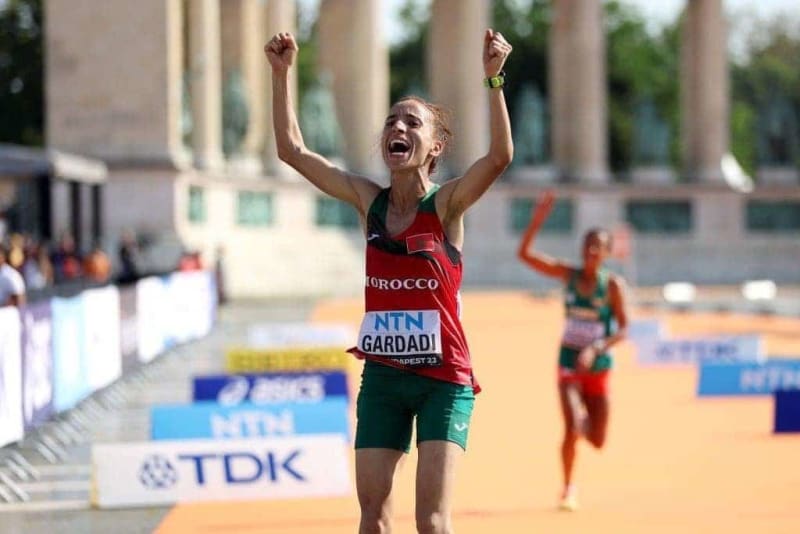
She used that ticket with a bang. On August 26, 2023, Gardadi won bronze in the marathon at the World Championships in Budapest in 2:25:17, becoming the first Moroccan athlete to medal in the marathon at a World Championships. “ It’s an incredible feeling to win this medal, she said. I’m very proud to bring this medal to the entire Arab world and especially to the Moroccan people.” Ranked 159th in the world before Budapest. A world medalist as she walked away. The Maghreb still has surprises up its sleeve. Today, at 32, Gardadi trains in Marrakech under the guidance of her husband, athlete Mustapha El Houdadi, with goals that are simple and razor-sharp: “ Win a medal at the Olympic Games and represent Morocco extremely well.” An ambition forged on Morocco’s roads. That’s new too.
What El Guerrouj saw before everyone else
Since Paris 2024, Hicham El Guerrouj has spoken publicly about the state of Moroccan athletics, with no sugar-coating. He reminded everyone you don’t become an Olympic champion overnight, that reaching that level takes years of preparation and support from the Ministry of Sport, the federation, the Olympic committee, the club, the regional league, and the family. And he put a name on what needs to be built: an “ecosystem,” which he sees as essential to produce champions capable of winning Olympic medals, urging authorities to shift mindsets.
Ecosystem. The word is out there. And it’s exactly what North Africa is building, brick by brick, with Diamond League meetings, marathons stepping up a level, altitude sites known worldwide, and one or two generations of athletes proving the talent is there, just waiting to be better supported.
There’s still everything to build… and that’s where it gets exciting
North Africa isn’t Ethiopia or Kenya. It doesn’t claim to be. El Bakkali was the only Moroccan athlete to win an Olympic medal in athletics at the Paris 2024 Games, a result that reflects both gaps in preparation and the overall standard of global competition. Depth is still lacking, talent ID can be improved, and support structures are only just starting to professionalize across the region, with nutrition, medical monitoring, and high-level management.
But that’s the point. The room for growth is what makes this story compelling. When a region goes from a generation of isolated icons like El Guerrouj, Hissou and Gharib, to a structured ecosystem with certified events, internationally recognized training camps, and locally developed athletes delivering on the world stage, something shifts.
That shift is underway. For the global distance scene, North Africa is becoming an address you can’t ignore. And for runners looking for their next training camp destination, the answer might already be waiting somewhere in the Middle Atlas cedars at 1,650 meters, where a double Olympic champion is still putting in the work in the snow, because he learned that’s where it all starts.
➜ Check out the marathon calendar
More articles
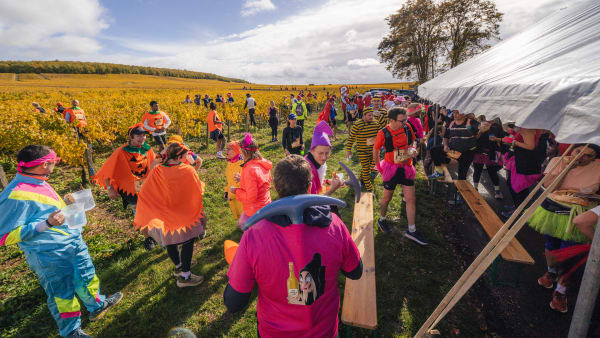
Marathon de Chablis set to welcome 4,400 runners among the vines
The Marathon de Chablis returns on Saturday, October 24, with races, hikes and a festive atmosphere among the vineyards.
Wed, October 21, 2026

Avignon Marathon makes a winning debut with more than 3,450 runners
More than 3,450 finishers turned out for the successful first edition of the Avignon Marathon on Sunday, September 27, 2026.
Wed, September 30, 2026

Night races: why does everyone want to run while everyone else is asleep?
From Glow Runs to low-key trail races, night running is taking off, offering a more festive experience and a different relationship with the clock.
Thu, September 10, 2026