
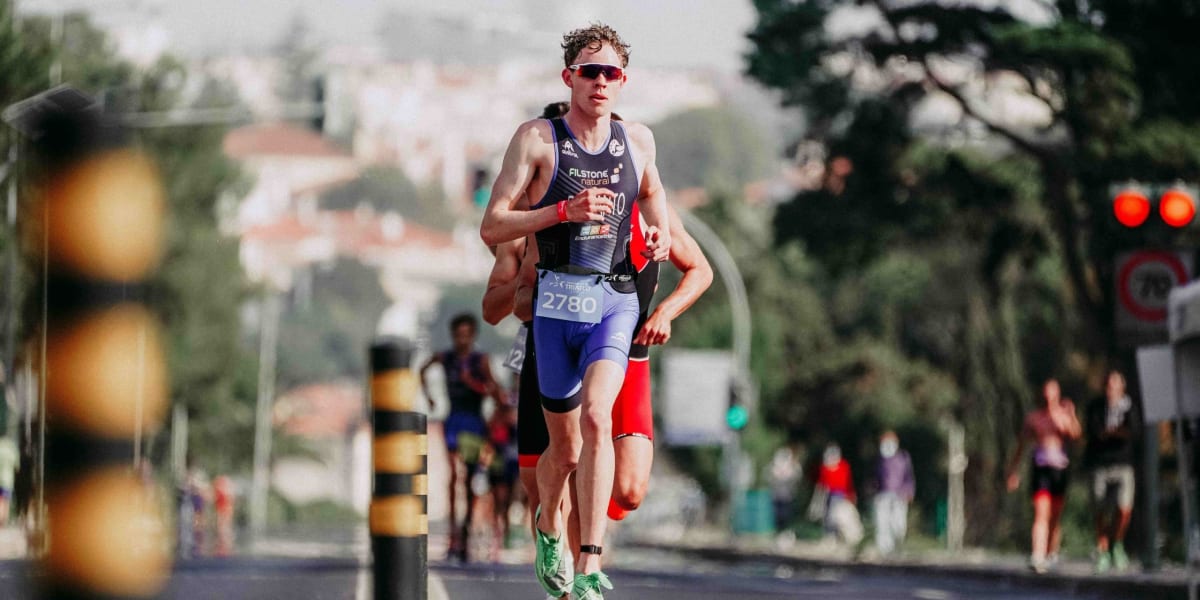
The Ironman Marathon Delivers the Final Verdict
After hours of racing, everything often comes down to the final 42.195 kilometres. An Ironman marathon is unlike any other: it punishes excess, exposes weaknesses and forces athletes to draw on reserves they never knew they had. Feared, yet sought out by those determined to discover how far they can really go.
“The marathon in an Ironman is the final judge,” says Fabio, a top finisher at AlpsMan, an extreme triathlon. Long-distance triathletes tend to agree. There is a world of difference between a standalone marathon and one run after 3.8 km of swimming and 180 km on the bike. Nikita Paskiewiez, a professional triathlete for the past three years and a Triathl’Aix athlete, has never experienced emotions like those she has felt during an Ironman marathon. “I get shivers thinking about all the times I’ve passed someone and had to hold back tears, she says with a smile. My heart was pounding when I moved into third at Lanzarote. All I wanted was to stop celebrating and stay focused, because if you let yourself get overwhelmed by emotion, it can take your breath away. It’s an incredibly intense feeling. ” The marathon rarely leaves its participants untouched. This final, punishing leg of long-distance triathlon takes its finishers through every shade of suffering. Yet despite its reputation, it continues to attract more triathletes every year.
The pull of the extreme
Triathletes know what is waiting for them. They understand the cruelty of the marathon, the final stage capable of wiping out months of preparation. That, precisely, is what draws them in. “With these races, you know you’re starting them, but you also know you might not finish. That’s what makes them beautiful,” says Fabio, an amateur triathlete. For many, the Ironman is an extraordinary challenge, a chance to measure themselves against their own limits. You do not become an Ironman at the end of the bike. You become one by crossing the finish line.
No one signs up for an Ironman expecting an easy day. Participants know they are going to suffer. More than that, it is often exactly what they come looking for. “You know it’s going to get hard at some point, but that’s why you sign up,” admits the former serviceman. You wait for that moment, the one where you go further than you thought you could.” It is a perspective that is difficult to explain to anyone who has never tasted ultra-endurance.
For those who make it to the start line, the promise of that confrontation is worth every hour of training. Nikita Paskiewiez, who ran 5 km on the road in 16:59 in 2026, says they will not be disappointed: “If you sign up for Lanzarote, you know you’re going to battle yourself for more than ten hours. You’ll have to manage your effort and you’re inevitably going to suffer. It is a bit strange to think that people pay to put themselves through that.”
It all happens in your head, and the person who resists best is the one who can make it through.
The moment of truth
For months, athletes build an idea of what they are capable of. A triathlete has already set an ambitious goal the moment they sign up for this legendary distance. It is only natural to feel at least somewhat confident when they arrive on the start line. That mindset is part of what gets them through. Not the thought that they will fail. Unfortunately, the marathon puts it to the test, far more thoroughly than they imagined. “Sometimes you have no choice but to take more risks on the bike,” Nikita admits. The challenge is to find the right balance: do enough to stay in the race without burning through everything before the final reckoning. “As soon as I put my watch on, my brain switches over and the race really begins. I’d even say there are two races, because something happens at kilometre 34.”
Online, athletes who have been through it often describe the same turning point. Philip recounts his experience at Challenge Roth in 2008: “Run smoothly, never force the pace, those are the watchwords until the halfway point (1:51),” he writes on his website. But my right knee is starting to hurt. My pace drops dangerously around kilometre 27 and I’m struggling to stay positive. With only 12 kilometres left, the prospect of failing so close to the finish acts like an electric shock: “Rather than give in, I try to speed up, and, to my surprise, I manage it. I’m in another world!”
There is no hiding from the 42.195 km still to cover before you become an Ironman. This is where the mistakes made earlier in the day come to light: an overambitious bike leg, poorly judged nutrition or a pace that was never under control. Nothing escapes the triathlon’s verdict. “It judges what you did before. If you pushed too hard in the earlier legs, you’ll pay for it,” insists Fabio, a Frenchman finisher at Carcans. As he puts it, the Ironman is above all “a long road to the cross.” Every kilometre becomes a mountain to climb, with the athlete constantly confronting suffering they never saw coming.
Yet morale can be sustained by a few footholds: good sensations, a favourable race dynamic, constant support from the crowd and the feeling of gradually moving through the field. Nikita Paskiewiez knows that dynamic well. Often out of the water behind the leading swimmers, the Triathl’Aix athlete regularly builds her races by making up time on the bike before putting her running strength to work. At Lanzarote, where she finished third, she was still well outside the podium places out of the water before beginning her comeback. “It’s much easier when you’re passing people than when they’re passing you. Still, I can’t let it influence me in any way,” Edouardo recalls on his blog, writing about the 2019 Ironman Italy Emilia Romagna. The fifty-something athlete was right.
Because the fourth lap of the marathon shows no mercy. It determines success or failure. Above all, it demands an iron will when the body seems to have stopped functioning. “From kilometre 32 onwards, I start counting down. I resist as best I can. The hardest part is picking up the pace again. Up to kilometre 36, it’s really difficult. My legs aren’t doing too badly. It’s more a general fatigue. My central nervous system is fried. Suddenly, amid all the information being processed by my brain, an image flashes into view. It’s the kilometre 40 sign. I’m overwhelmed by emotion. All the nervous fatigue built up over the day lets go. I cross the finish line completely wired.” An unforgettable rite of passage.
The leg that makes the difference
After leaving their bodies to decide their fate, triathletes are left face to face with themselves. Beyond performance, this final leg acts as a revealer. Legs are heavy, reserves are gone and strategies have sometimes disappeared altogether. There is very little left to hide behind. “There are moments in life when you can fake it, when you feel like an impostor,” Fabio adds. But you can’t fake it here. It’s do or die. And you came here specifically to experience that moment.” This final discipline channels some athletes’ raw impulses and answers others’ need to push beyond themselves.
“There are so many external factors at play. It’s not just a flat course. You have to be incredibly strong mentally. Everyone cracks. After that, it’s all in your head, and the person who resists best is the one who can make it through,” says Nikita Paskiewiez. When she passes her rivals on the course, the French athlete observes everything. “Their facial expressions, their breathing, their posture. I try to see how they’re doing and, in return, make them believe certain things about how I’m feeling.”
This suffering does not only lead to collapse. For some triathletes, the marathon is instead the moment when they take control. As many competitors walk or physically blow up, those who have managed their effort can finally show what they are capable of. For Nikita Paskiewiez, third at Embrunman, whose running is one of her main strengths, this final discipline has a particular flavour: “I’m used to running marathons where I really start catching people from kilometre 35 onwards. At Embrunman, I even passed someone in the final 500 metres, which got me onto the podium. My marathons are very unusual because I come out of the water so far back, outside the race dynamic, and I only find that rhythm at the end. It’s incredibly challenging. I sort of race in the opposite way to everyone else.” Even though she seems built for long efforts, Nikita still has to manage her race: go all the way without ever completely losing control.
Many promise never to go through a day like that again. Then, more often than not, they dive back in. “Two years ago, I ended a race report with ‘never again, Ironman’. Clearly, you should never say never,” Philip wrote after Roth. It leaves the mark of a “war against yourself,” as Fabio puts it, one you soon find yourself wanting to fight again.
More articles
Sabastian Sawe, the fight against doping and the need to believe in the marathon again
Sabastian Sawe’s sub-2 marathon reignites the doping debate. AIU, Kenya, increased testing and credibility in a sport under pressure.
Thu, September 10, 2026

How to Choose the Right Running Shoes in 2025
Marathons.com shares the key points for choosing the right running shoes in autumn 2025.
Thu, September 10, 2026

Euro Marathon Metz 2026 is scaling up with more than 9,000 runners
Euro Marathon Metz 2026 is gathering serious momentum, with more than 9,000 runners entered one month before race day.
Thu, September 10, 2026