
 © @coursptitetomate
Why Do So Many Runners Film Their Marathons? The Search for Social Recognition in the Instagram Era
These days, it is hard to run a marathon without seeing someone taking a selfie or starting a video. Covering 42.195 km is no longer just a sporting achievement: it has become content to create. Personal pride, the search for recognition, a well-oiled business model: the race is also being run on Instagram.
If you can no longer head out for a moderately hard training session without your phone to film your pace, you may have fallen victim to a very modern affliction: connected running. One that can coexist with its benefits. « I love capturing these moments because you only experience the emotion of a marathon once, says Marine Gibard, aka @coursptitetomate, one of French running's most-followed figures, with 130,000 Instagram followers. In the marathon world, it is hard to miss the trend.
But why the urge to immortalise every stride? It often starts with influencers. Those who specialise in running have made the idea commonplace that performance matters as much on the streets as it does on social media. Showing off the latest shoes, Sunday’s long run or a grimacing face at 35 km has become almost as important as the training itself. On Instagram, running is no longer just running: it is content creation. Effort has undoubtedly become a story to share.
Running, but mostly sharing
Selfies, stories, Reels… the running generation documents everything. From the pre-run coffee to the grimaces at 35 km, every moment becomes an image to post. So naturally, the urge is even stronger during a marathon. Smartphone in hand, GoPro magnet-mounted to the chest, selfie stick out at the start: runners are now videographers too. « What makes me take out my phone is wanting to share my experience, explains Marine Gibard. I’m really glad I did it for some marathons, because that way I have a record of my race too. »
A marathon has to be earned. Four months of training, weeks of fatigue, dozens of kilometres logged. So once you cross the finish line, why not keep a record of it? « What I want to show is authenticity, motivation and consistency… not skipping steps », says the 31-year-old content creator. Her videos are more than memories: they inspire people too. She often says that people have told her they signed up for their first race because of her content. Far from being simple narcissism, filming a marathon can become a way to pass on the passion.
But this storytelling comes at a cost. Raising an arm, finding the right angle, talking to the camera: all of it takes seconds off the clock. « Yes, I may lose a few seconds filming, but I’m not a professional, she admits. It’s not a big deal if I finish a minute faster or slower ». Not everyone takes such a relaxed view. Some runners deliberately slow down to capture the Arc de Triomphe in the background; others stop altogether to start a livestream. The result: a finish time sacrificed for the sake of the production.
The economics of connected running
The trend is also exploding because it is being encouraged. GoPro is developing mini cameras for runners, Apple sells iPhone armbands, and Garmin promotes automatic sharing of training sessions. « Clearly, brands have realised that running content is gold, says Julien, an amateur photographer and videographer. Every video that gets posted is free advertising. Marathons are becoming walking billboards. »
Organisers benefit too: the more people film, the more buzz an event generates and the more visibility it gains. Some races, such as the Paris Marathon and the one in Valencia, now send “content creator kits” to influential runners.
If I stopped posting, my running would stay the same. I’ve been running for more than 15 years. I run for myself, not for the cameras.
When too much content takes the joy out of running
But filming is tiring too. « After a 55 km race, I had created content before, during and after, and I fell ill a week later », Marine Guibard said. Behind the fun of a story lies a real mental load. You have to think about the camera, edit the videos and reply to messages, sometimes at the expense of the pleasure of running. Yet she insists: « If I stopped posting, my running would stay the same. I’ve been running for more than 15 years. I run for myself, not for the cameras. »
Other runners echo that view, choosing to switch everything off. « For my last marathon, I left my phone at the bag drop, says Élodie, 39, who has run six marathons. I experienced every kilometre without thinking about the image I was going to post. It was liberating ». In a world saturated with images, this “chosen disconnection” is becoming almost an act of resistance. Sharing nothing means recovering a kind of purity, an intensity that the camera dulls.
People don’t realise how much emotion we lose when we look at everything through a screen.
The real luxury is having nothing to prove
Running a marathon is already an achievement. Filming it can sometimes be one distraction too many. When we try to capture every moment, we can end up forgetting to live it fully. « People don’t realise how much emotion we lose when we look at everything through a screen, says Nicolas, who never used to race without his smartphone close at hand before gradually leaving it behind. The tears at the finish, the music, the crowd… It’s a moment to experience, not frame. »
The finish line does not need a filter to be magical, or a Reel to prove you were there. Perhaps one day the most subversive trend will be… leaving your smartphone at the bag drop and savouring your 42 kilometres in airplane mode.
We’ve seen it all: Reels at 5:00/km, pre-race stories filmed by headlamp, cameras fixed to caps. One day, perhaps, we’ll go back to running simply for the pleasure of it, without searching for the perfect angle or the right hashtag. The day when the only « like » that matters will be the one we give ourselves as we cross the finish line.
More articles
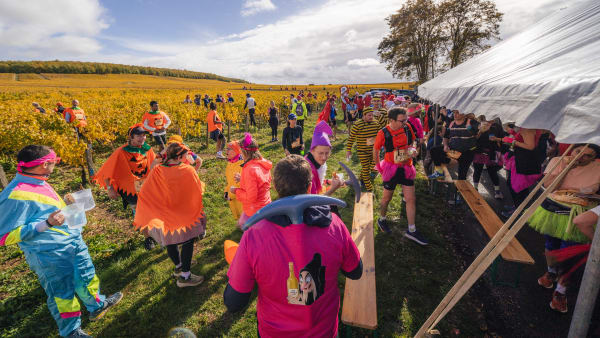
Marathon de Chablis set to welcome 4,400 runners among the vines
The Marathon de Chablis returns on Saturday, October 24, with races, hikes and a festive atmosphere among the vineyards.
Wed, October 21, 2026

Avignon Marathon makes a winning debut with more than 3,450 runners
More than 3,450 finishers turned out for the successful first edition of the Avignon Marathon on Sunday, September 27, 2026.
Wed, September 30, 2026

Night races: why does everyone want to run while everyone else is asleep?
From Glow Runs to low-key trail races, night running is taking off, offering a more festive experience and a different relationship with the clock.
Thu, September 10, 2026