 © STADION
Berlin Half Marathon: Etienne Daguinos breaks into the big league
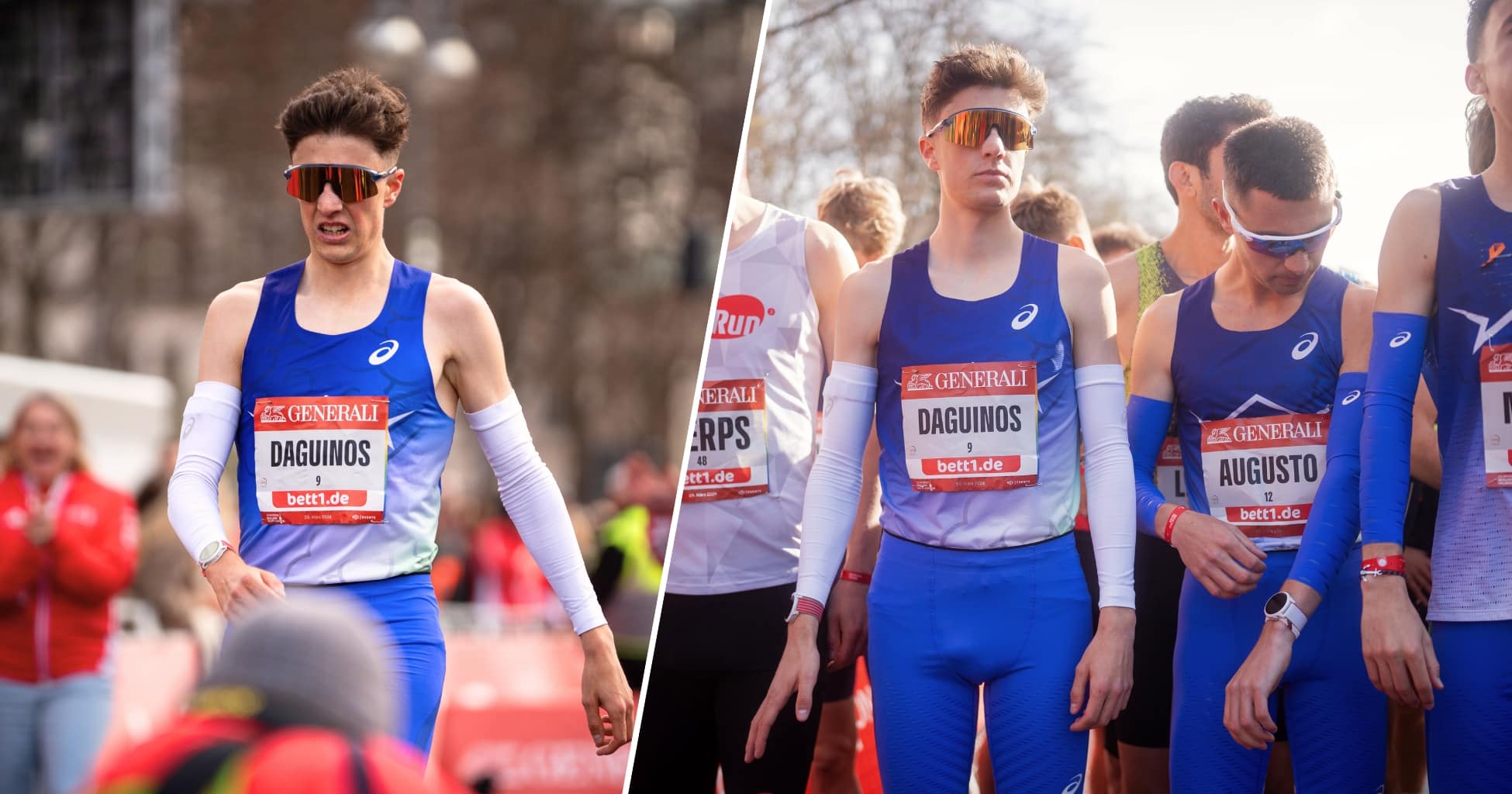
A Sunday morning in Berlin, legs turning fast—very fast—and a Frenchman stepping into history. Finishing fifth in 59:27, France’s Etienne Daguinos delivered the most complete race of his career and earned a new status: the second-fastest French man of all time over the half marathon. In a deep, electric field, the clock spoke—and it spoke loudly.
In Berlin, there’s no easing into the race. It goes out hard, surges, stretches the field. From the opening kilometers, the world’s best take control, and everyone else must decide: hang on or fade. Daguinos chose to hang on. In an ultra-stacked field, the Frenchman stayed composed. The US Talence runner never cracked, never drifted—he built his race. Fifth at the finish, but more importantly, rock-solid from start to finish. Splits of 14:03 at 5K and 27:55 at 10K told the story: controlled, consistent, ambitious. The kind of pace that demands everything—but opens the door to a breakthrough performance.
Up front, the battle for victory came down to pure speed. Kenya’s Andrea Kiptoo edged it in 59:11 after a tight duel with compatriot Denis Kipkemoi. Originally listed as a pacemaker, Kipkemoi never dropped off—and ended up racing all the way to the line. Staying within himself the whole way, Kipkemoi went beyond his assigned role. At the finish, he looked relaxed, almost as if more was still possible. Sub-59? The pace suggested it wasn’t far off. And perhaps most striking: until now, he had no major marks on the World Athletics radar. Just behind, Germany’s Amanal Petros thrilled the home crowd with 59:22, setting a new national record.
► REPLAY

| 59:27 — a time that changes everything
Some performances mark progress. Others redefine a career. 59:27 clearly belongs to the latter. By shaving nearly 20 seconds off his personal best, Daguinos moves into a new dimension over the distance. At 26, the former French 10K record holder proves he’s not just passing through the half marathon—he’s here to stay, and with authority.
Only one name now stands ahead of him in French all-time rankings: Julien Wanders, the French-Swiss runner who clocked 59:13 in 2019. Just 14 seconds separate them—and the gap suddenly feels within reach. Beyond the raw time, what stands out is the control. No drop-off, no hesitation, just a steady, almost clinical execution. The kind of race that hints at even faster performances to come on a similar course.
| Bastien Augusto knocking on the one-hour barrier
Behind Daguinos, the French collective performance also deserves attention. Bastien Augusto finished eighth in a strong 1:00:09. Just nine seconds shy of the symbolic one-hour barrier—but a personal best and a clear statement at European level.
With a 28:09 split at 10K, Augusto took his chances. And efforts like that tend to pay off. At this level, breaking 60 minutes feels more like a matter of timing than a true limit. More broadly, French depth continues to grow. In a race of this caliber, placing two athletes in the top 10 is no small feat. Berlin has often revealed emerging talents—and this edition proved no exception.
| In the women’s race, breakthroughs and records
The women’s race delivered its own share of standout performances. Ethiopia’s Likina Amebaw took the win in 1:05:07, controlling a fast, competitive race ahead of Kenya’s Daisilah Jerono (1:05:21) and Veronica Lolelo (1:05:35).
For France, Léonie Périault impressed on her debut over the distance, finishing 14th in 1:09:25—the seventh-fastest time in French history. A composed, well-executed first outing that already places her among the country’s best. There were also personal bests for Héloïse Laigle (19th in 1:10:21) and Mélanie Allier (25th in 1:10:57). But one of the standout moments came from Belgium’s Chloé Herbiet. In 1:07:32, she shattered a national record that had stood for over 20 years—an impressive leap forward that confirms her rapid rise on the European scene.
✔ Results – Berlin Half Marathon 2026

Dorian VUILLET
Journalist