 © EDP Meia Maratona de Lisboa
Lisbon Half Marathon: Jacob Kiplimo Sets the Record Straight with a New World Record
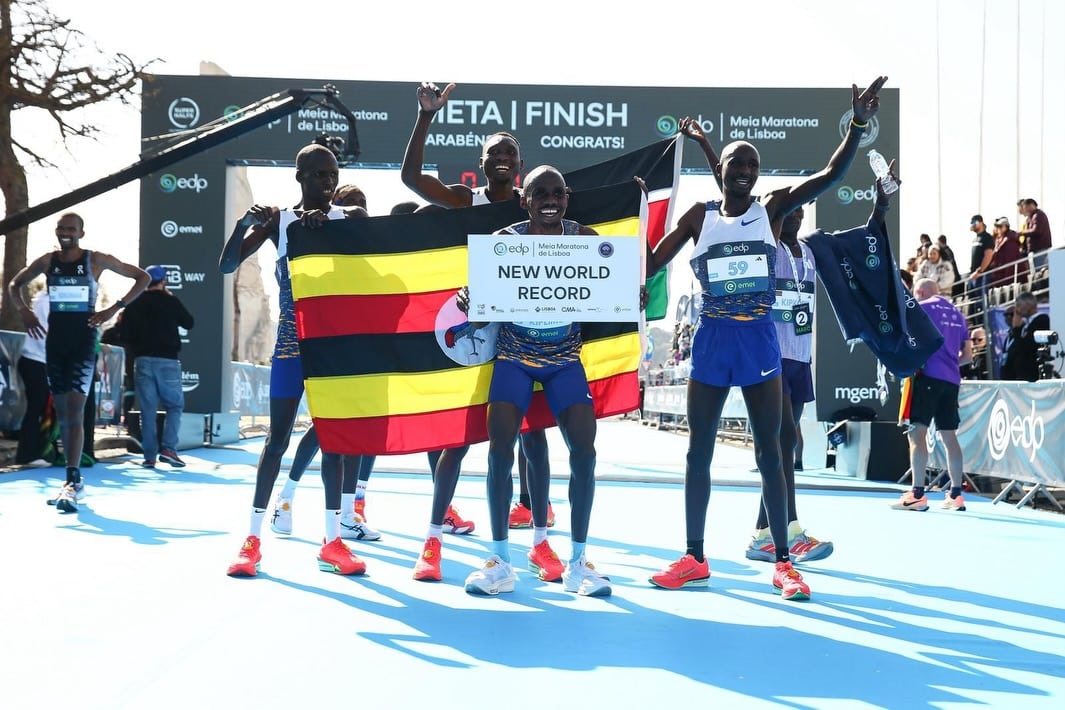
A suspension bridge over the Tagus River, an Atlantic breeze at his back, and a clock on the verge of collapse. In Lisbon this Sunday, Uganda’s Jacob Kiplimo chose the simplest way to end the controversy that erupted a few weeks earlier in Barcelona: by breaking the half marathon world record—again. In 57:20, the Ugandan star triumphed in Lisbon, slicing ten seconds off the previous mark held by Ethiopia’s Yomif Kejelcha, and reminding the running world that a true phenomenon rarely argues with history for long.
On Sunday morning in Lisbon, the asphalt felt almost like a moving walkway for the world’s half marathon elite. The setting was already iconic: a dramatic start atop the Ponte 25 de Abril, the suspension bridge towering over the Tagus River. It served as the launchpad for another dazzling display by Ugandan prodigy Jacob Kiplimo. More than a year after the controversy in Barcelona, the three-time World Cross Country champion (2023, 2024 and 2026) didn’t just win. He restored order to the half marathon record books. Official time: 57:20. A new world record by ten seconds. And this time, there was no debate about the slipstream of a lead vehicle.
| Jacob Kiplimo, or the simplest answer: this time it counts
The story almost felt cinematic. A few weeks earlier in Barcelona, Kiplimo had obliterated the clock with a staggering 56:42 at the Barcelona Half Marathon—more than 45 seconds faster than the previous world record. Too staggering, perhaps. Days later, World Athletics invalidated the performance due to unintentional drafting behind the official race vehicle, ruling that “race conditions were not fully compliant with regulations.”
The kind of controversy that leaves an awkward aftertaste. So in Lisbon, the message had to be clear: run fast—but above all, run clean. Mission accomplished. With no controversy and almost no suspense. From the opening kilometers, the pacemakers stretched the field. Kiplimo stayed calm, fluid, almost detached from the chaos around him. By halfway, the feeling was unmistakable: the 57-minute barrier was already trembling.
The splits told the story: 13:38 at 5 km, 27:20 at 10 km—a blistering yet perfectly controlled pace. The final kilometers resembled one long, silent acceleration. No glance over his shoulder, no sign of tension. At the finish: 57:20. The previous record—57:30, held by Yomif Kejelcha—was gone. “I’m so happy to have broken the world record,” he reacted moments after finishing. “After the first 10 kilometers, I thought it was possible. Then I just tried to maintain the pace over the final two kilometers.”
| And now… the marathon?
For several seasons now, one question has circulated throughout the road running world: how far can Jacob Kiplimo go? The Ugandan distance runner already boasts an extraordinary résumé in cross-country and track. On the roads, his progression looks like a carefully planned ascent.
Some observers already imagine a future marathon world record. Others even whisper about the sport’s ultimate frontier: the first official sub-two-hour marathon, a milestone that has fascinated the sport since Kenyan legend Eliud Kipchoge’s groundbreaking attempts. Nothing guarantees the story will unfold that way. But one thing is becoming increasingly clear: when Jacob Kiplimo steps onto a starting line, the clock often becomes a secondary character. And in Lisbon this Sunday, it lost again.
| Behind him: the African hierarchy
Behind the Ugandan phenomenon, the chasers did what they could. Which, in truth, wasn’t much. Kenya’s Nicholas Kipkorir finished second in 58:08, a strong performance but already far behind the winner. The podium was completed by fellow Kenyan Gilbert Kipkosgei Kiprotich in 58:59. Several more runners broke the one-hour barrier, including Benard Langat and Mohamed Ismail, confirming once again that Lisbon remains one of the sport’s favorite hunting grounds for fast times. The first European finisher appeared further down the standings—another reminder of the current state of the discipline: the battle for records is still fought at extremely high altitude… and largely dominated by East African athletes.
| Valentin Gondouin closes in on the mythical barrier
From a French perspective, attention was focused on Valentin Gondouin. His goal was clear: break the one-hour barrier, an exclusive club already featuring French standouts Étienne Daguinos, Jimmy Gressier, Morhad Amdouni, Julien Wanders (the French record holder with 59:13) and most recently Emmanuel Roudolff-Levisse. The runner from Normandy had come close before—1:00:16 in Seville in 2025—but once again fell just short in the Portuguese capital: 1:00:35, finishing 11th. Promising, but frustrating. For Étienne Daguinos, who arrived hoping to challenge his own French record (59:13), the race ended earlier than expected. The US Talence athlete stepped off the course shortly after halfway.
| Mekdes Woldu and Alessia Zarbo: a long-distance duel for the record books
The most compelling French story of the morning came in the women’s race. Amid a field dominated by Ethiopia’s Tsigie Gebreselama, who delivered a commanding victory in 1:04:48, France’s Mekdes Woldu summoned the strength for a fierce final kilometer. The result: 1:08:20 and the French national record equaled. A mark that has been held since October by Alessia Zarbo. The irony? Zarbo herself had taken that record from… Woldu.
For several seasons now, the two French internationals have engaged in a kind of statistical ping-pong. Woldu already owns the French records for the 10,000 meters and the marathon, while Zarbo holds the 10 km road record. Now the half marathon record is shared territory. In the same race, Clémence Calvin finished 10th in 1:10:10, delivering a solid performance in a deep international field.
If records regularly fall here, it’s hardly surprising. The Lisbon Half Marathon is widely considered one of the fastest courses in the world. A spectacular start atop the Ponte 25 de Abril, a long descent toward the city center, and typically ideal temperatures in March combine to create perfect conditions for time chasers. Over the years, the race has become a must-run event for athletes aiming to test their limits over 21.1 kilometers. This Sunday was no exception.
✔ 2026 Lisbon Half Marathon results

Dorian VUILLET
Journalist