 © ASO
© ASO
Refreshment stations, optional finisher T-shirt, sustainable transportation… The Paris Marathon is committed to the environment
As the Paris Marathon approaches, organizers are breaking new ground by asking participants to bring their own water bottles. This flagship initiative is accompanied by other measures to recycle race bibs, encourage more eco-friendly transportation, and encourage participants to forgo their finisher T-shirts in favor of tree-planting efforts.
The Paris Marathon is reinventing itself this year to become more sustainable and eco-friendly. The organizers of the Paris Marathon, Amaury Sport Organisation (ASO), have completely revamped their setup. From now on, gone are the liquid aid stations where runners grab a cup on the fly before tossing it a few meters down the road into a trash can. This is where the biggest innovation of this year’s event in terms of eco-responsibility lies.
| Fountains and sprinklers dotted along the path
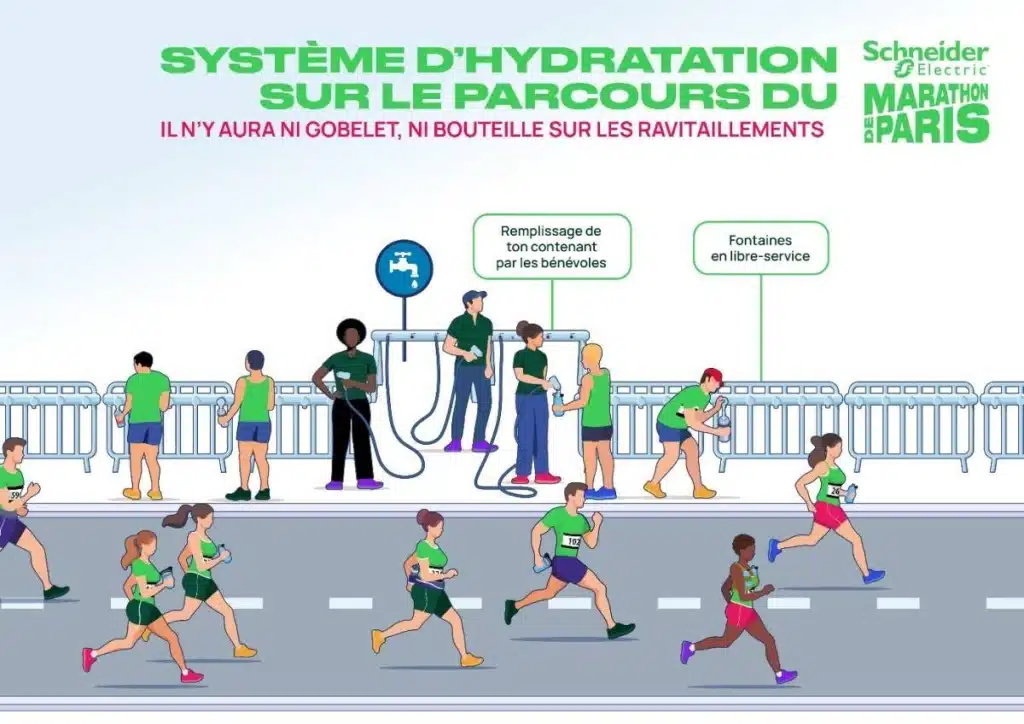
Today, the goal is clear: to ensure that competitors stay properly hydrated while minimizing environmental impact as much as possible. To balance these two priorities, self-service water stations and handheld showers have been set up approximately every five kilometers. This is a way to encourage participants to take responsibility by informing them well in advance that they must now bring their own containers: water bottles, hydration packs, or reusable, foldable cups. “It’s essential to encourage everyone to take responsibility for minimizing their impact,” says Thomas Cariou, CSR Director at ASO.
This marks a first for the Paris Marathon, though it is part of a process that began several years ago. “In 2021, during the Garmin Triathlon Paris, we were already testing this system for connecting to the city’s water supply,” he recalls. Last year, all aid stations were already connected to Paris’s water supply, putting an end to the use of plastic bottles as an alternative. Nevertheless, the organizers remain mindful of safety concerns: “We believe that the system we’ve put in place meets the runners’ hydration needs, which remain a top priority.”
After several trials (cardboard cups filled by volunteers, returnable EcoCups that were later collected), particularly during the Adidas 10K and the Half Marathon, ASO has decided to stop providing containers. “Using paper cups—whether compostable or recyclable—or EcoCups isn’t necessarily eco-friendly given all the logistics involved: transportation, washing, breakage… We have to produce a huge number of them, and the return rate doesn’t necessarily live up to the zero-waste promise,” explains ASO’s environmental and social commitments lead. With this in mind, partner Culligan will offer a reusable cup to each runner when they pick up their race bib, and a collector’s water bottle at the finish line.
On Wednesday, March 18, race organizers finally announced that the elite water station system would be extended to runners aiming for a time under 2 hours and 50 minutes. Last year, 688 participants were clocked at approximately 15 km/h or faster. The reusable water bottles, filled with water by volunteers, will be reserved for men and women running at a pace of 4:01 per kilometer or faster, who will start between 8:00 a.m. and 8:03 a.m. They must be picked up at specific areas located approximately 150 meters past the standard aid stations.
| A race that aligns with the City of Paris’s ambitions
This shift is part of a broader policy framework, in line with Paris’s environmental commitments. “We are fully aligned with the ambitions of the cities that host us, and we adapt our systems accordingly.” Admittedly, this choice entails a higher cost than previous models, but the key point lies elsewhere: “It is the role of an event like the Schneider Electric Paris Marathon—and also that of the runners who participate in it—to become ambassadors for a more sustainable world.”
Most runners already follow this approach. As for the elite runners, they will benefit from a special arrangement: their water bottles will be placed at various points along the course by their support staff, and none of them will need to stop to hydrate. “This exception, however, cannot apply to the general public,” notes Thomas Cariou. To support all the other participants and accommodate those who may struggle, an additional aid station has been added. On April 12, there will be 13 in total: 9 fully stocked and 4 offering water only. Misters will also be installed to cool participants, especially in case of high temperatures.
| The Finisher T-shirt is now optional
Another new feature: participants can choose not to receive the race T-shirt. “In the past, it was handed out at the finish line. Now, we give it out beforehand, when participants pick up their race bibs,” explains the sustainable development strategy manager. Those who don’t want to keep it—whether because they’re aware of its environmental impact or already have a pile of others—can decline it and thus make a positive contribution to the environment. To achieve this, ASO has partnered with EcoTree: for every T-shirt declined, a tree is planted in French forests.
This first edition has already attracted more than 5,000 participants, resulting in 5,000 trees planted. “Not only are we reducing T-shirt production, but we’re also directly contributing to reforestation,” adds Thomas Cariou. This initiative is seen as a transitional phase. Ultimately, ASO would like to eliminate the finisher’s T-shirt entirely—a real challenge given the symbolic importance of this memento for many participants in this legendary marathon.
| Reduce, Recycle, Empower
For several years now, the organizers have been working with the nonprofit Les Connexions to optimize recycling and minimize waste generation. The elimination of plastic bottles, followed by plastic cups, has already marked a significant milestone. This year, a new initiative launched by Garnier will further support these efforts. At the finish line, participants will be asked to deposit their race bibs in collection bins set up at the exit of Avenue Foch, so they can be recycled and given a second life.
An event of this scale also generates a significant carbon footprint due to travel. To minimize this, a bike parking area will be provided, and all Vélib’ stations will be highlighted to encourage riders to come by bike. For those who prefer public transportation, the RATP remains the most suitable option, which is why ASO is promoting sustainable transportation.
| A community of dedicated runners
Since 2022, the Green Runner community has been encouraging participants to take on a challenge: to run a total of 42 km in one month, usually from November to December. The idea is to share a passion for running with loved ones while incorporating an eco-friendly aspect. The message is clear: “Be ambassadors for a clean sport, and use this challenge to adopt a more sustainable approach to running.” ” As part of this, a plogging event is also being organized the day before the marathon, on Friday in the late afternoon. The run will start from the Run Experience exhibition at Porte de Versailles at 6:15 p.m., sponsored by Culligan. All runners are invited to participate in this short run of about 5 km to pick up litter in the surrounding area, combining exercise with concrete action for the environment.
Since the signing of the Charter for Major International Sporting Events in 2017, the Schneider Electric Paris Marathon has been committed to an increasingly sustainable approach. Once again this year, by aligning with the City of Paris’s requirements for eco-friendly events, the race demonstrates that running can go hand in hand with environmental stewardship. This is an essential step at a time when preserving our planet has never been more crucial.
➜ Check out the marathon schedule

Sabine LOEB
Journaliste