
Etienne Daguinos smashes the 20 km de Paris record beneath the Eiffel Tower
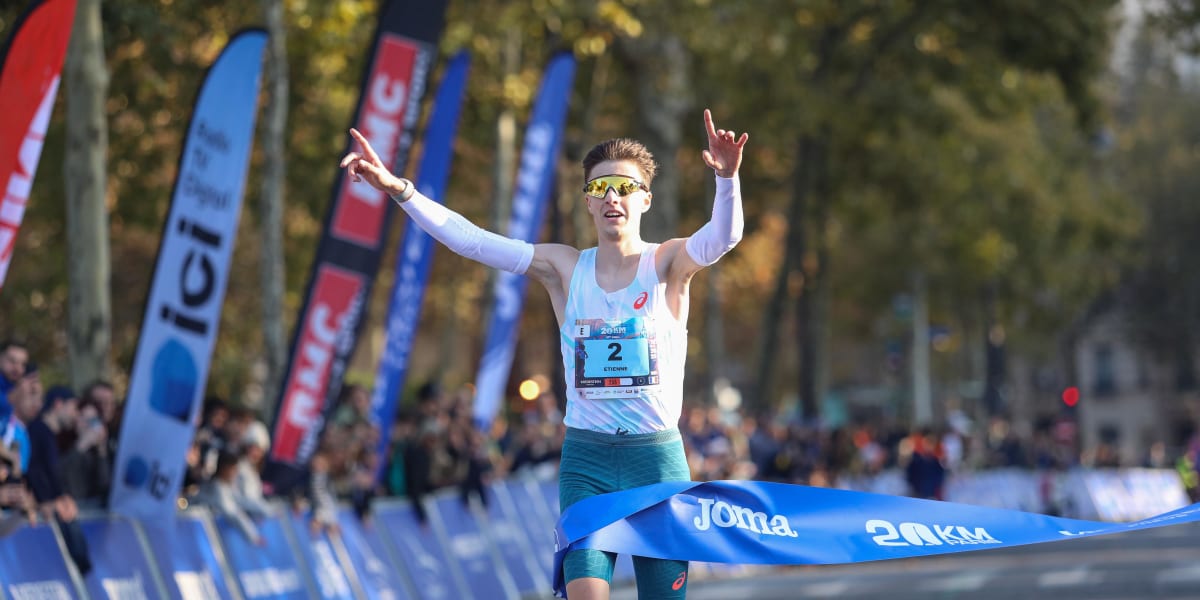 © STADION-ACTU
The 20 km de Paris record had stood for 20 years, resisting the sport's best. Etienne Daguinos obliterated the historic 57:19 mark, crossing the line in 56:18 to dominate the 47th edition of the Paris classic. Kenya's Mercy Chebwogen came close to the women's record in 1:04:55, while defending champion Manon Trapp took third. A display of power, consistency and control in front of 33,000 runners gathered just a few steps from the Eiffel Tower.
Sunday, 9 a.m. sharp. The October sky was slowly brightening over the Eiffel Tower, the leaves were beginning to turn, and Pont d’Iéna was already buzzing. Under the watchful eye of Franck Leboeuf, a member of France’s 1998 World Cup-winning team and event ambassador through the « Le Bleuet de France » charity, the first para-athletics wave set off, followed by the elites and thousands of participants in the 20 km de Paris. Soles pounded the tarmac, the noise echoed through the cool air, and the Seine quays unfolded like a grey ribbon. By the third kilometre, Avenue Marceau was already making it clear that this would be a short, demanding outing. Bodies settled into their rhythm, faces showed focus and determination, and the city played its part: the Arc de Triomphe, Bois de Boulogne and riverbanks all became a playground for the Talence magician weaving through the 33,000 starters.
Etienne Daguinos delivers a solo masterclass
Twenty years of waiting ended in 56:18. Averaging more than 21 km/h, a pace that would make more than a few amateur runners pale, the 25-year-old Etienne Daguinos hit the front from the gun and never gave it up. He did have one scare, coming within inches of a car moving over to let a para-athlete through. No harm was done, and his fluid, metronomic stride soon opened the gap on Kenya’s Evans Kiprop Cheruiyot, whose 57:19 had stood since 2005.
He passed halfway in 27:55, 45 seconds ahead of the previous record-holder’s split, putting the Vredestein 20 km de Paris record under serious threat. A slight dip between kilometres 13 and 14 briefly left the Girondin running in a trio with fellow Frenchman Emmanuel Roudolff-Levisse and Spain’s Saïd Mechaal, but the distance specialist, coached by Emmanuelle Roux and Yannick Dupouy, quickly regained control before the final quarter, dropping his rivals metre by metre. After the 15-kilometre mark, the result was all but decided.
« I said I wanted to run fast, so I took responsibility from the start, said the French 10K record holder (27:04 in Lille in 2024), who leaves with a well-earned €8,000: a €3,000 prize, €2,500 for the winners and a further €2,500 for finishing in the French top 10. I thought that, if I went out at record pace, I’d find myself alone a little earlier in the race. I put in a big kick between kilometres 14 and 15, but it hurt. At 16K, I was wondering how I was going to make it to the finish, especially since my training has been focused on the 5,000 metres. I ran 56:18, compared with 56:40 when I set my sub-hour half-marathon best. Without specifically preparing for this race, it’s a good sign for next year. I enjoyed it enormously, with an incredible atmosphere all the way around the course. Pure joy! »
Over the final five kilometres, Etienne Daguinos put on a solo masterclass: flawless technique, a strong head and a time that will go down in the event’s history. Roudolff-Levisse followed in 56:32, Mechaal completed the podium in 56:34, and Nicolas Navarro rounded out the top 10 in 59:22, a solid result for a runner mainly targeting a hard tempo session before the end of the season. The fact that the other athletes alongside Daguinos on the podium could themselves have taken the new course record says plenty about the level on show.
Emmanuel Roudolff-Levisse tunes up for New York
Behind the Daguinos show, another Girondin delivered a performance of his own. Emmanuel Roudolff-Levisse put together a complete race, fully aware of the challenge ahead. « We knew Etienne wanted the record, and he went to the front quickly. His pacemaker didn’t last long, so he did it all on his own », he said admiringly. Chasing alongside Saïd Mechaal, the Frenchman held the pace all the way, flat out from the first kilometre to the last.
Pleased with his improving form, Roudolff-Levisse sees the performance as the perfect stepping stone to the New York City Marathon in three weeks’ time. Running close to 200 kilometres a week, he feels he has found the right momentum: « I feel really good, and I hope I can arrive in New York fresh. The goal is a top-10 finish. »
Outpaced over 20 kilometres, he is not dwelling on it: Daguinos is above all a short-distance specialist, much like Mr Cross. « The marathon is a different world », he said with a smile. His endurance, patiently built over the seasons, continues to pay off. Even without pure speed work, his consistency and aerobic base now allow him to compete across every kind of course.
Mercy Chebwogen dominates the women’s race as Manon Trapp enjoys the moment
The women’s race was tighter and more unpredictable. Kenya’s Mercy Chebwogen bided her time through the first half before making her move. At 15K, she dropped Morocco’s Kaoutar Farkoussi and France’s leading hope, Manon Trapp, pulling clear to win in 1:04:58, agonisingly close to yet still well short of the fastest time in 20 km de Paris history (1:04:30). Farkoussi finished in 1:05:55, with Trapp third in 1:06:16.
Back from Japan with no major ambitions, simply looking to rediscover the pleasure of running, the Tokyo World Championships marathoner savoured the moment rather than chasing a time. « I wasn’t targeting anything in particular. I just wanted to get back into a rhythm », she said after the race. Still building back up, with barely two weeks of training behind her and a heavy workload in her legs, she chose to listen to her body.
« I run by feel and don’t put pressure on myself », said the Savoie native. Her weekend mantra was simple: pleasure first. The atmosphere, the sunshine and the friends around her all added to the simple, genuine moment. In the background, new goals are taking shape: some 10Ks and shorter races to work on speed, before turning towards a spring marathon, probably Seville or Barcelona. « To last, you have to keep a lightness in your head », she advised calmly. No calculations, no predictions, just the pleasure of shared effort. A Paris interlude to move steadily towards what comes next.
Behind her, the French women showed real strength. Célia Tabet was fourth in 1:06:52, Inès Hamoudi fifth in 1:07:51, Mathilde Sénéchal sixth in 1:08:25, and Latifa Mokhtari seventh in 1:08:28. Three months after giving birth, Anaïs Quemener finished in the top 10, taking 10th in 1:09:04.
A sprint finish in the men’s wheelchair race
The race also put the para-athletes in the spotlight, with an impressive display of fighting spirit and a thrilling finish. The men’s race was particularly close, with Thibault Daurat (47:53) snatching the win after a highly tactical contest, edging Julien Casoli by a wheel (one second). The multiple Paris Marathon winner and wheelchair racing stalwart explained that he had led for much of the race because nobody really wanted to take control before the tactical stalemate gave way to a final sprint. The demanding course, with its hills and cobbles, required constant vigilance.
Even in the closing metres, a small speed bump disrupted the sprint, allowing the eventual winner to catch back up. « I think I was stronger in the sprint, but that speed bump disrupted the finish a little », he said, praising his rival’s fight and sporting spirit. Behind them, Lito King Anker (47:57) completed the podium after a solid, consistent race, confirming the growing strength of the European field in the category.
In the women’s race, Shauna Bocquet (57:48) finished almost 10 minutes ahead of her rivals. Italy’s Rita Cuccura was second in 1:12:21, while France’s Nadège Monchalin (1:14:37) took bronze. The 35 joëlettes also provided a spectacle that was as spectacular as it was inspiring.
 © STADION-ACTU
Among them, Clément Gass, the blind runner who holds the marathon record run independently, completed his 20 kilometres in 1:38:01, comfortably beating his initial goal of finishing under two hours. « You have to stay fully concentrated throughout the effort, the Alsatian runner told us. You also have the cane to hold. I have to run with my arm out in front at belly-button height, sweeping from left to right. It isn’t natural. The cane also has some weight, which unbalances the body and requires extra effort ». The engineer by profession ran with a cane, an adapted GPS device and voice guidance, following the course precisely. Performances like these showcase both the talent and resilience of para-athletes, and left no one unmoved.
✔ All the results from the 2025 edition of the Vredestein 20 km de Paris.