 © QuieroMisFotos.com
Behobia San Sebastián 2025: A Record-Breaking Edition Rocked by a Thousand Disqualifications
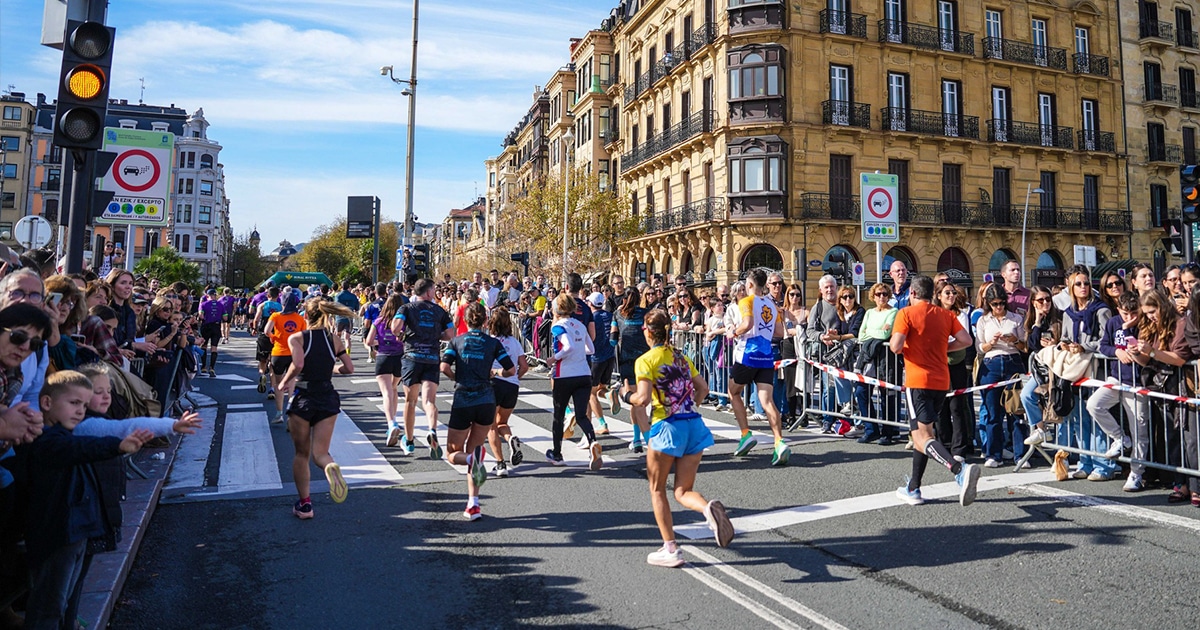
20/11/2025 15:50The 2025 Behobia–San Sebastián once again sent the Basque Country into full-blown celebration mode on November 9, with more than 25,000 runners streaming toward Donostia like a human river. It was a record-setting edition where the party atmosphere never dipped—yet nearly a thousand participants were disqualified for starting too early, a reminder that even in the middle of the euphoria, every rule still counts.
The race, which starts on the French–Spanish border, transformed the region into a 20-kilometer corridor of effort and exhilaration. More than 26,000 runners—an all-time high—painted the course like a massive, moving serpent. Sixty editions in, the Behobia remains dense, intense, and radiant. But amid this iconic celebration, a stubborn reality resurfaced: close to a thousand runners lost their official result before even setting foot on the finishing straight in Donostia.
A total of 918 disqualifications—almost identical to last year’s 958. Proof that some habits are as persistent as the sea winds battering the climb to Gaintxurizketa.
| The simplest rule in the world
The Behobia leaves no room for grey areas. Every bib clearly displays a starting wave and a precise start time. Every corral is marked with visible signs and colors. The message, repeated year after year, could not be clearer: starting before your assigned time means automatic removal from the results. The regulations even specify that starting later is allowed—mainly to let friends run together without disrupting anyone.
Starting earlier, however, disrupts everything. The race is a giant choreographed flow. The entire rhythm depends on the fluidity of the waves. A runner entering a faster wave creates blockages, slows others down, and can even introduce safety risks on a demanding, uneven urban course of climbs, false flats, bridges, and tight turns—where the smallest irregularity can snowball.
| A powerful control system
The organization has built an almost military-grade monitoring structure: MYLAPS chip bibs, timing mats every five kilometers, nineteen tightly calibrated start groups to manage the massive flow, mobile medical units from start to finish, and an army of volunteers guiding, reassuring, filtering, and informing runners.
Every crossing of a timing mat sends a digital signal. Every runner leaves a chronological footprint. A time anomaly is instantly visible, and the system removes the runner from the results without debate. It’s an implacable mechanism—but one made necessary by the race’s extraordinary popularity. With more than 25,000 finishers, absolute precision is essential to maintain safety and prevent congestion.
| Why so many disqualifications when the rule is so clear?
It’s a puzzling trend. In 2025, just like in 2024, nearly a thousand runners tried to sneak into an earlier wave. Several factors overlap. Some may simply not have understood the rule despite constant reminders on the website and in the race village. Others wanted to join a friend in a faster wave without realizing the consequences.
And some believed they could gain a few precious seconds by starting ahead—without seeing how an individual shortcut turns into a collective problem. The organization stands firm: respecting the start corrals is essential to keep the race flowing smoothly. With such density, a single misplacement can destabilize the wave system. A slower runner in an elite wave. A faster runner trapped behind a wall of bodies. The whole structure fractures quickly.
| A sanction whose consequences may go further
For those disqualified, the frustration is heavy. No official time. No ranking. No trace in the race’s historical results. Some may even be denied future entry if the violation is deemed intentional. Participants can file a complaint within the official timeframe—a process available each year to avoid technical mistakes or bib mix-ups.
Not all infractions come from selfishness: confusion, adrenaline, or the pressure of the moment can push someone just a few meters too far forward. A small mistake that becomes a big consequence.
| A massive celebration beyond the disciplinary reminder
Thankfully, the wave of disqualifications did not overshadow the day’s magic. For the record, Spain’s Raúl Celada led from start to finish, flying through the course in 1:01:28. Right behind him, Diego Méntrida secured second in 1:01:42, followed by the ever-consistent Iraitz Arrospide in 1:01:46.
In the women’s race, Katherine Tisamela kept full control to win in 1:09:34, chased by Noshim Kimuge (1:09:58) and Maria Varok (1:10:42) completing the podium.
Neighborhoods along the route pulsed with drums and cheering. The mid-race climbs delivered their usual spectacle of gritted teeth and burning legs. Supporters once again acted as invisible engines. Aid stations became islands of relief. And Donostia’s iconic finish unfurled a human tunnel of noise and outstretched arms. Classic Behobia energy—raw, vibrant, unmatched by almost any other race in Europe.
➜ Find all information about the Behobia–San Sebastián 20K
Dorian VUILLET
Journalist