Chengdu Marathon: gels in a backpack, a full split mid-race… and an invisible line crossed
23/03/2026 19:12At the Chengdu Marathon on March 22, the script was supposed to follow the familiar rhythm of major Chinese road races. Instead, it veered off course. A refreshment station turned into a personal stockpile, a mid-race acrobatic pose in the middle of the pack—two moments, two viral images, and one shared consequence: a two-year ban from competition. Beyond the anecdotes, the incident reveals deeper tensions shaping the global running scene today.
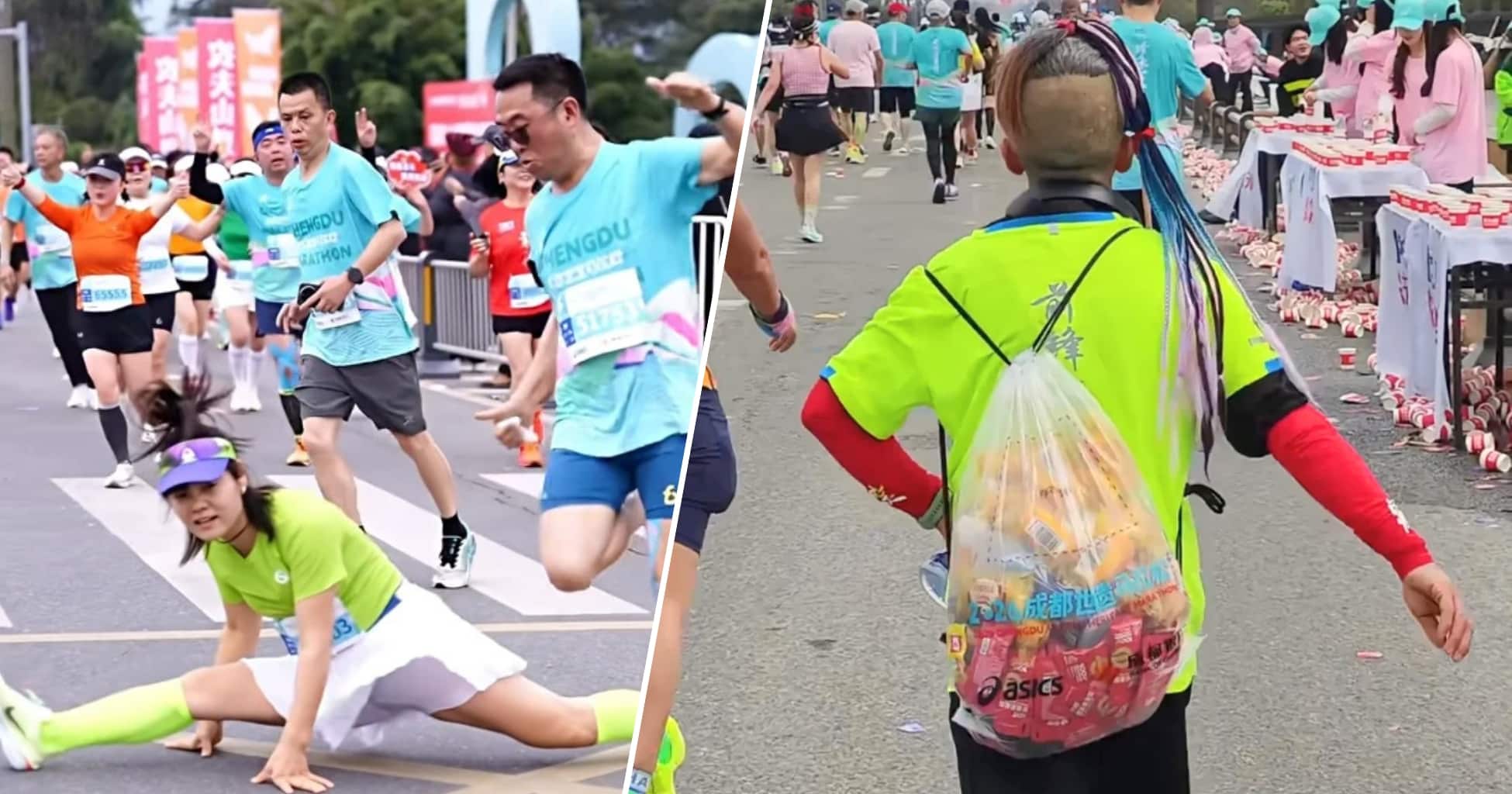
The photo doesn’t look like a victory shot. No arms raised, no finish line, no time to celebrate. Just a transparent backpack, stuffed to the brim with energy gels. At first glance, almost ordinary. But it tells the whole story. Earlier that day, on the Chengdu Marathon course, one runner stopped at an aid station. Instead of grabbing a gel and moving on, he took far more—enough to turn a simple running accessory into a mobile reserve.
There was nothing discreet about it. No quick gesture, no glance over the shoulder. The transparent bag made everything visible: the contents, the quantity, the intent. As if the limit hadn’t been seen—or no longer existed. Within hours, social media took over. The image spread, sparked reactions, raised questions. The discussion quickly moved beyond how much to why—and more importantly, how far is too far?
The Sichuan Athletics Association didn’t hesitate. In an official statement, it described an athlete who had “taken a large quantity” of supplies, calling it a “serious violation of sportsmanship.” Because in a race, aid stations are never just logistics. They’re part of a balance—carefully designed for thousands of runners, calibrated so everyone can access what they need without depriving others. An unwritten contract, but a deeply understood one.
Breaking it—even without intent to cheat in the traditional sense—shifts the line. The sanction came quickly: disqualification, followed by a two-year ban from all races organized in Sichuan Province, ruling the athlete out through 2027.
Two runners of 2026 Chengdu World Heritage Marathon face 2‑year provincial bans for dangerous and selfish conduct.
· A female runner stopped mid‑race to perform a full‑split pose for photos, causing a dangerous pile‑up.
· A male runner was caught stuffing his backpack with dozens… pic.twitter.com/H8nopSqZ7R— Shanghai Daily (@shanghaidaily) March 25, 2026
| When the race becomes a stage—and sometimes an obstacle
That incident alone could have fueled post-race debate. But in Chengdu, another moment added a new layer. A female runner suddenly stopped mid-course. She smiled, positioned herself—and performed a full split. Clean, deliberate, almost choreographed. The goal: a photo. The marathon, however, doesn’t stop. Behind her, another runner approached at speed. Surprised, he swerved at the last second. Balance wavered.
A fall narrowly avoided. A brief moment—but enough to highlight how every movement matters within a crowded field. The video went viral. The response followed quickly. In its statement, the Sichuan Athletics Association described the act as “endangering other athletes” and “compromising race safety.” Same outcome: disqualification and a two-year ban.
Two very different actions. One identical consequence. Because in a marathon, the course is never purely individual. Every stop, every deviation, every decision plays out within a collective flow. And sometimes, that flow leaves no room for error.
| Running together—or running alongside
Taken together, these two moments go far beyond isolated incidents. Over the past decade, China has become a major force in global road running. Cities like Beijing and Shanghai host massive events, with growing fields and increasingly diverse participants. Chengdu reflects that same momentum: more runners, more ambition—but sometimes fewer shared reference points.
In that context, the nature of racing is evolving. It’s still a physical challenge—but also a platform for expression. A performance, yes—but also a story to tell, an image to capture, a moment to share. Aid stations can become opportunities. The course becomes a backdrop. And the line between use and excess, spontaneity and risk, grows thinner.
Organizers now have to adapt—set boundaries, restate fundamentals, and sometimes enforce them. In Chengdu, the message was clear. Two years. A heavy sanction that goes beyond discipline. A reminder that running a marathon isn’t just about moving toward the finish line. It’s about moving within a shared space, governed by visible rules—and others more subtle, but just as essential. That Sunday in March, another line appeared. Invisible, but very real. And for two runners, it was crossed—without a way back.
➜ Check out the marathon calendar

Dorian VUILLET
Journalist