
How Marathon Aid Stations Evolved from Wine to Energy Gels
 © ASO / Marathon de Paris
From the first modern marathons in the early 20th century to today’s races in 2026, on-course fueling has changed dramatically. From extreme minimalism to the rise of energy gels and the latest innovations, aid stations have been transformed over the decades.
Gingerbread, bananas, drinks and energy gels. Today, race organisers offer a wide range of food and fluids to help runners cover the distance. Athletes of every level rely on carbohydrate intake throughout their race. Nutrition strategy is now central to performance. But it was not always that way.
When drinking during a marathon was viewed with suspicion
For decades, the idea that athletes should neither drink nor eat during exertion, including in a marathon, was widespread. One belief held sway: hydrating made you heavier, increased the risk of cramping and therefore reduced performance. Drinking was seen as risky, as well as ineffective or even counterproductive.
As early as the first modern Olympic marathon in Athens in 1896, runners had no official aid stations. Spectators handed them various drinks along the course, including wine, which was then associated with virility and strength.
A few years later, the 1904 Summer Olympics offered a perfect illustration. In appalling conditions, with temperatures around 32°C, only one main aid station had been set up. It had almost no water. This was supported by the Games director, James Edward Sullivan, who wanted to test the limits of the human body and study dehydration during strenuous exercise. Of the 32 athletes who started, only 14 finished the race.
Several runners ended up in the emergency room, some close to death. The winner, American Thomas Hick, took the title in 3:28:53, the slowest winning time in Olympic history. He had also been doped with strychnine, in other words rat poison, mixed with brandy. The event, dubbed “the strangest in Olympic history”, nearly led to the marathon being dropped from the Olympic programme altogether.
Ideas that refused to disappear
Despite several races resembling the 1904 event, taking on fuel remained widely regarded as ineffective for a long time. Olympic marathon champion Alain Mimoun won the blue-riband distance in 1956 without any real hydration strategy, even though the race took place in Melbourne during the Australian summer. Aid stations remained basic, sometimes offering only water and sugar, and were spaced far apart. There might even be just one station over the entire marathon.
That belief persisted into the 1970s. Emmanuel Lamarre, founder of French nutrition laboratory Pyrene, explained at a Saucony pop-up store that even in the 2000s, fuelling practices during exercise were still very limited. “Athletes ate little or nothing during exertion, or used older-generation products such as Gatorade in the United States and Isostar in France,” the specialist said. Hitting the wall at 30 kilometres was considered inevitable.
Controversial athlete and coach Alberto Salazar, who was later suspended for doping, won the Boston Marathon in 1982 in 2:08:52 without drinking. The man who often finished his races in hospital even said: “If you want to achieve a lofty goal, you’re going to have to take risks.” It was a philosophy he applied to himself, and one that inspired many marathoners of his generation, despite the health risks involved.
Wine and milk
At the 1924 Paris Olympic Marathon, aid stations were limited to water, milk and, more surprisingly, wine, sometimes accompanied by other alcoholic drinks. In France, wine was everywhere, associated with a healthy lifestyle and regarded as a stimulant. Training manuals even recommended a glass of red wine with every meal. Very little water was available, while these unusual drinks were handed out in small quantities, sometimes mixed or diluted.
Wine was considered a tonic, even a medicine for fatigue, while water was viewed with fear and suspicion. The presence of alcohol reflected French society at the time and naturally found its way into sport. The prevailing belief was that wine warmed the body, reduced fatigue and provided a useful boost. The dehydration caused by alcohol, along with its negative impact on coordination and endurance, was completely overlooked.
This was not limited to France, as alcohol was often part of endurance practices elsewhere. Beer, low-alcohol drinks and brandy in the United States could all turn up at aid stations, a long way from today’s standards, where carbohydrate and fluid intake are carefully optimised.
2010 to 2026: major changes
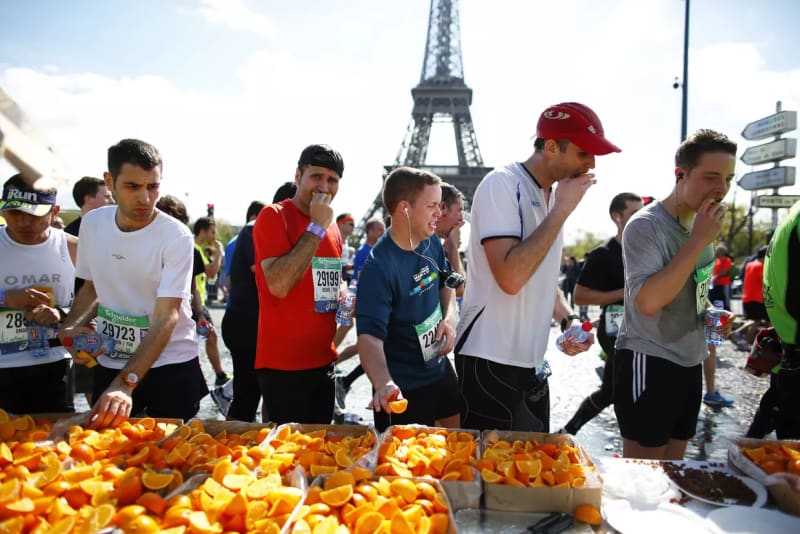 © ASO / Paris Marathon
Today, we know that dehydration is dangerous and harms performance. Alcohol is obviously harmful, especially during exercise.
The importance of appropriate hydration, along with the role of carbohydrates and electrolytes, is no longer in doubt. Aid stations became more substantial and more frequent, roughly every five kilometres, and became standard during the 1990s. Major marathons such as New York and London played a major role in structuring this now-essential part of racing.
Emmanuel Lamarre says the 2010s were marked by the widespread adoption of energy gels. “They became the standard in sports nutrition, but the technology was still fairly basic, relying on fast sugars to provide a quick boost,” the founder explains.
In his view, the real breakthrough came in 2015, with significant advances in nutritional knowledge. Today, sports nutrition brands have flooded the market. Some offer products based on multiple transportable carbohydrates, containing both glucose and fructose.
Physiological capacity was thought to be around 60 grams of carbohydrate per hour. We knew that glucose, a fast-acting sugar, was oxidised in the intestine. This was when multiple carbohydrate oxidation came to light. We learned that adding fructose, a more complex sugar oxidised by the liver, and therefore engaging several organs, increased intake to 90 grams of carbohydrate per hour.
This development helped push back the limits of endurance performance, including breaking the two-hour marathon barrier in 2026. Runners of every level are increasingly interested in this aspect of training, which has become inseparable from performance.
From rejecting all forms of on-course fuelling to serving wine at some races in the 1920s, and now to next-generation gels, race nutrition has undergone a major transformation in a century. With performances soaring and amateur training becoming increasingly structured, hydrating and fuelling over the marathon distance is now a carefully calibrated process, based on robust scientific data rather than empirical wisdom alone.
From the first modern marathons in the early 20th century to today’s races in 2026, on-course fueling has changed dramatically. From extreme minimalism to the rise of energy gels and the latest innovations, aid stations have been transformed over the decades.
Gingerbread, bananas, drinks and energy gels. Today, race organisers offer a wide range of food and fluids to help runners cover the distance. Athletes of every level rely on carbohydrate intake throughout their race. Nutrition strategy is now central to performance. But it was not always that way.
When drinking during a marathon was viewed with suspicion
For decades, the idea that athletes should neither drink nor eat during exertion, including in a marathon, was widespread. One belief held sway: hydrating made you heavier, increased the risk of cramping and therefore reduced performance. Drinking was seen as risky, as well as ineffective or even counterproductive.
As early as the first modern Olympic marathon in Athens in 1896, runners had no official aid stations. Spectators handed them various drinks along the course, including wine, which was then associated with virility and strength.
A few years later, the 1904 Summer Olympics offered a perfect illustration. In appalling conditions, with temperatures around 32°C, only one main aid station had been set up. It had almost no water. This was supported by the Games director, James Edward Sullivan, who wanted to test the limits of the human body and study dehydration during strenuous exercise. Of the 32 athletes who started, only 14 finished the race.
Several runners ended up in the emergency room, some close to death. The winner, American Thomas Hick, took the title in 3:28:53, the slowest winning time in Olympic history. He had also been doped with strychnine, in other words rat poison, mixed with brandy. The event, dubbed “the strangest in Olympic history”, nearly led to the marathon being dropped from the Olympic programme altogether.
Ideas that refused to disappear
Despite several races resembling the 1904 event, taking on fuel remained widely regarded as ineffective for a long time. Olympic marathon champion Alain Mimoun won the blue-riband distance in 1956 without any real hydration strategy, even though the race took place in Melbourne during the Australian summer. Aid stations remained basic, sometimes offering only water and sugar, and were spaced far apart. There might even be just one station over the entire marathon.
That belief persisted into the 1970s. Emmanuel Lamarre, founder of French nutrition laboratory Pyrene, explained at a Saucony pop-up store that even in the 2000s, fuelling practices during exercise were still very limited. “Athletes ate little or nothing during exertion, or used older-generation products such as Gatorade in the United States and Isostar in France,” the specialist said. Hitting the wall at 30 kilometres was considered inevitable.
Controversial athlete and coach Alberto Salazar, who was later suspended for doping, won the Boston Marathon in 1982 in 2:08:52 without drinking. The man who often finished his races in hospital even said: “If you want to achieve a lofty goal, you’re going to have to take risks.” It was a philosophy he applied to himself, and one that inspired many marathoners of his generation, despite the health risks involved.
Wine and milk
At the 1924 Paris Olympic Marathon, aid stations were limited to water, milk and, more surprisingly, wine, sometimes accompanied by other alcoholic drinks. In France, wine was everywhere, associated with a healthy lifestyle and regarded as a stimulant. Training manuals even recommended a glass of red wine with every meal. Very little water was available, while these unusual drinks were handed out in small quantities, sometimes mixed or diluted.
Wine was considered a tonic, even a medicine for fatigue, while water was viewed with fear and suspicion. The presence of alcohol reflected French society at the time and naturally found its way into sport. The prevailing belief was that wine warmed the body, reduced fatigue and provided a useful boost. The dehydration caused by alcohol, along with its negative impact on coordination and endurance, was completely overlooked.
This was not limited to France, as alcohol was often part of endurance practices elsewhere. Beer, low-alcohol drinks and brandy in the United States could all turn up at aid stations, a long way from today’s standards, where carbohydrate and fluid intake are carefully optimised.
2010 to 2026: major changes
© ASO / Paris MarathonToday, we know that dehydration is dangerous and harms performance. Alcohol is obviously harmful, especially during exercise.
The importance of appropriate hydration, along with the role of carbohydrates and electrolytes, is no longer in doubt. Aid stations became more substantial and more frequent, roughly every five kilometres, and became standard during the 1990s. Major marathons such as New York and London played a major role in structuring this now-essential part of racing.
Emmanuel Lamarre says the 2010s were marked by the widespread adoption of energy gels. “They became the standard in sports nutrition, but the technology was still fairly basic, relying on fast sugars to provide a quick boost,” the founder explains.
In his view, the real breakthrough came in 2015, with significant advances in nutritional knowledge. Today, sports nutrition brands have flooded the market. Some offer products based on multiple transportable carbohydrates, containing both glucose and fructose.
Physiological capacity was thought to be around 60 grams of carbohydrate per hour. We knew that glucose, a fast-acting sugar, was oxidised in the intestine. This was when multiple carbohydrate oxidation came to light. We learned that adding fructose, a more complex sugar oxidised by the liver, and therefore engaging several organs, increased intake to 90 grams of carbohydrate per hour.
This development helped push back the limits of endurance performance, including breaking the two-hour marathon barrier in 2026. Runners of every level are increasingly interested in this aspect of training, which has become inseparable from performance.
From rejecting all forms of on-course fuelling to serving wine at some races in the 1920s, and now to next-generation gels, race nutrition has undergone a major transformation in a century. With performances soaring and amateur training becoming increasingly structured, hydrating and fuelling over the marathon distance is now a carefully calibrated process, based on robust scientific data rather than empirical wisdom alone.