
The Guinness World Records Marathon Feats That Defy Belief
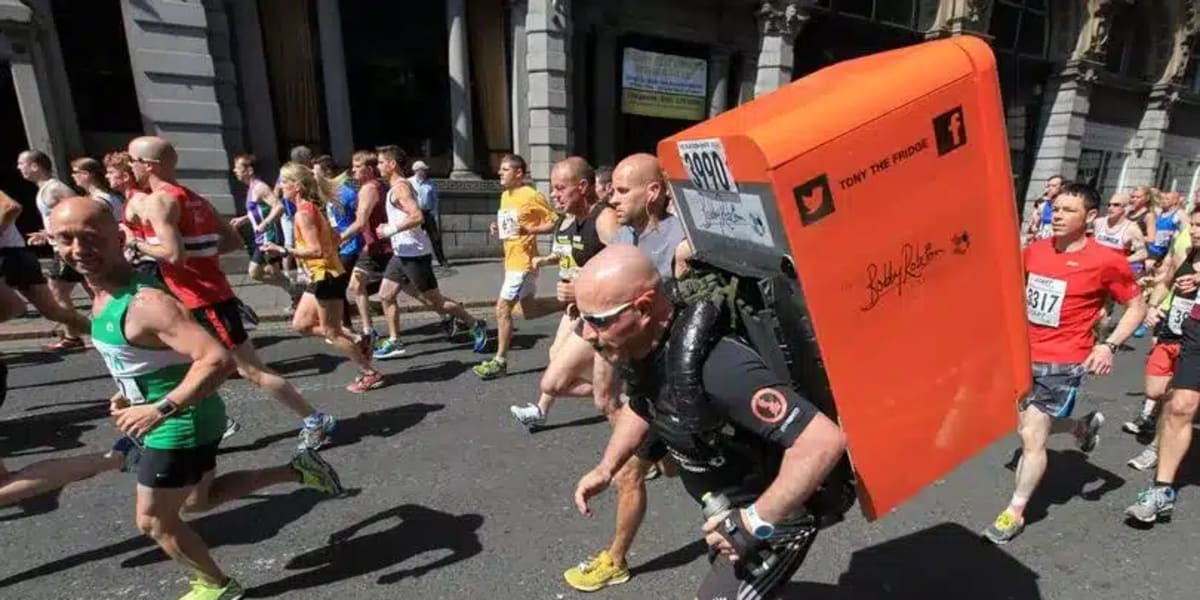
42.195 km is no small challenge. But for some runners, that simply isn’t enough. So they raise the stakes: suits and ties, high heels, flip-flops or even a fridge strapped to their backs. Welcome to the wildest marathoners in the Guinness World Records, turning pain into performance art… and, just a little, into a happening.
Marathon in a suit: looking sharp all the way to the finish
Running a marathon is already a challenge. Doing it in a three-piece suit is another matter entirely. Emmanuel Bonnier knows that better than most. The Frenchman pulled off a feat that was as absurd as it was stylish: completing a marathon in 2:40:52 while dressed in a full suit. White shirt, tightly knotted tie, dress trousers and even formal shoes. All officially recognised by Guinness World Records, naturally. A performance that was equal parts athletic and… sartorial.
For Axel Ramponi, who fell short in his attempt to break the record with a 2:49 finish, the dress code was a little more relaxed at the Paris Marathon. No wool jacket or leather brogues, but a GoPro in hand, a cap pulled low and a sharp eye for everything happening around the pack. His costume was that of an insider, a runner-reporter capturing the details that are so often lost when everyone is chasing the clock. A nod to the runners who turn performance into a show, a story or a message.
📌 The funny detail? To have a Guinness record recognised, the tie has to stay knotted all the way to the finish. A little stricter than Strava, isn’t it?
In flip-flops: for those who really want to suffer
In the world of quirky records, some feats are both genuinely impressive and impossible not to smile at. Take the marathon record run in flip-flops, a challenge where simply reaching the finish line in a pair of sandals becomes a Guinness World Records-worthy achievement. Sadly, it doesn’t belong to the courageous runner spotted in sandals at the Paris Marathon a few weeks ago, but to Alistair Kealty, an Australian runner who completed a marathon in flip-flops in 3 hours, 37 minutes and 32 seconds, at the Almaty Marathon in Kazakhstan in April 2019.
It was no small challenge. Running a marathon in footwear that light and ill-suited demands a mix of resilience, endurance and courage – especially when a good pair of running shoes is generally considered essential for long-distance racing. But Alistair wasn’t the first to try it. In 2012, Keith Levasseur, an American runner, also attempted to set a record by completing the Baltimore Marathon in flip-flops. His time of 2:46:58, though not officially recognised by Guinness, remains an exceptional feat, especially for anyone who has tried running 42.195 km in flip-flops.
📌 Worth noting: the sound of flip-flops slapping the ground for 42 km is a form of psychological torture for every runner nearby.
The fridge on his back, or how to run with a burden
Tony Phoenix-Morrison, nicknamed “Tony the Fridge”, didn’t just run a marathon. He ran with a 42 kg fridge strapped to his back, and even completed the feat for 100 consecutive days. Behind what initially sounds like a completely mad idea, there is a story: Tony runs to raise money for cancer research, a disease that has hit his family particularly hard. The fridge represents the symbolic weight of loss, struggle and memory. From a sporting perspective, it is obviously absurd.
No coach worth their salt would approve of carrying such a load for 42 kilometres. And yet he did it. Slowly, steadily, with a consistency that commands respect. Above all, he carried a powerful message: “If I can carry this, you can carry something far worse.” He may not have inspired many followers, but on the courage scale, the Briton went very high.
📌 The moral? Everyone runs with a weight on their shoulders. His was literal.
High heels: it’s not just about glamour
Running a marathon is a sport. Running a marathon in 7-centimetre heels is an extreme sport. Yet a woman from Pau did just that at the Paris Marathon in 2019. And this was no five-minute catwalk appearance: Christelle Doyhambehere took 6 hours and 4 minutes to cover the 42 km, with her feet presumably in a state of civil war by the finish. No spare trainers hidden in a bag, no musical-theatre trickery. Just pain, glamour and iron will. Honestly, even the most seasoned Marathon du Médoc runners wouldn’t go that far.

📌 Fun fact: Guinness doesn’t mess around here either. For the record to count, the heels must be more than 5 cm high and worn from start to finish. Yes, there is a judge for that.
Giant dinosaur: a prehistoric performance
In recent years, an inflatable T-Rex costume has gone viral across social media. You see it everywhere: birthday parties, stag dos, flash mobs… and now marathons. An American runner completed the full 42.195 kilometres in a complete giant dinosaur costume, setting a record for the category along the way. And this wasn’t a walking effort: he can boast of crossing the line in 3:59. With the heat inside the costume, near-zero visibility and precarious balance, it starts to look like a superhuman feat. But it is also the kind of challenge that puts a smile on everyone’s face along the course. A Tyrannosaurus galloping down the Champs-Élysées or across Tower Bridge is worth every one of those encouragement signs.
📌 Food for thought: if a dinosaur can do it, you can finish your 10K too.
Behind every outrageous costume or improbable fridge, there is a simple idea: running can be serious without ever taking itself too seriously. These quirky records challenge the conventions of a sport sometimes too focused on performance, times and medals. They remind us that we can run 42.195 km for a cause, on a dare, to make our friends laugh or simply to stand out. And honestly, in a world where everything moves too fast, a guy dressed as a banana sprinting down the Champs-Élysées may be exactly what we needed.