
Paris Marathon 2026: Reusable Bottles for Runners Chasing Sub-2:50
 © ASO / Marathon de Paris
A few months ago, we reported that ASO would remove cups and bottles from the aid stations at the 2026 Schneider Electric Paris Marathon. The decision sparked plenty of debate. Now, just weeks before race day, the organizer has softened its stance, but only for the fastest runners. Those targeting a sub-2:50 finish will have access to pre-filled water bottles, a system usually reserved for elite athletes. For everyone else, the new setup using water fountains for hydration remains in place.
We all remember it. Last autumn, ASO announced a small revolution in the marathon world: no more paper cups, no more plastic bottles. For the 2026 edition of the Schneider Electric Paris Marathon, scheduled for April 12, runners will have to arrive at the start with their own hydration vessel, whether a soft flask, collapsible cup or anything else. It will be a world first for an event of this size, with 55,000 finishers in 2024, and a move that excited some runners while making others uneasy. The running community reacted, sometimes sharply. And it seems ASO listened, at least in part. On Wednesday, March 18, the organizers announced a new measure: an expansion of the elite bottle system for runners targeting a time under 2:50.
An expanded version of the elite bottle system
Elite athletes have always had their own protocol. They prepare their personalized sports drinks, which the organizers place at specific points along the course before the race. It is a well-drilled, efficient system designed entirely around performance. At the highest level, every second counts. Much like a Formula 1 pit stop, losing as little time as possible at the aid stations is essential. ASO will therefore extend the system to a broader category of runners: those running faster than 4:01 per kilometer and starting from the preferred corral between 8:00 and 8:03 a.m.
Last year, almost 700 runners finished under 2:50. Not a huge number, but clearly the group for whom a badly timed sip of water can derail a race prepared for over months. For them, stopping mid-effort for a few seconds to fill a bottle is out of the question.
How will it work in practice?
These runners will have access to pre-filled water bottles supplied by the organizers. They will not be allowed to tuck them into a pocket and carry on: the bottles must be deposited in designated collection zones located around 150 meters beyond each aid station.
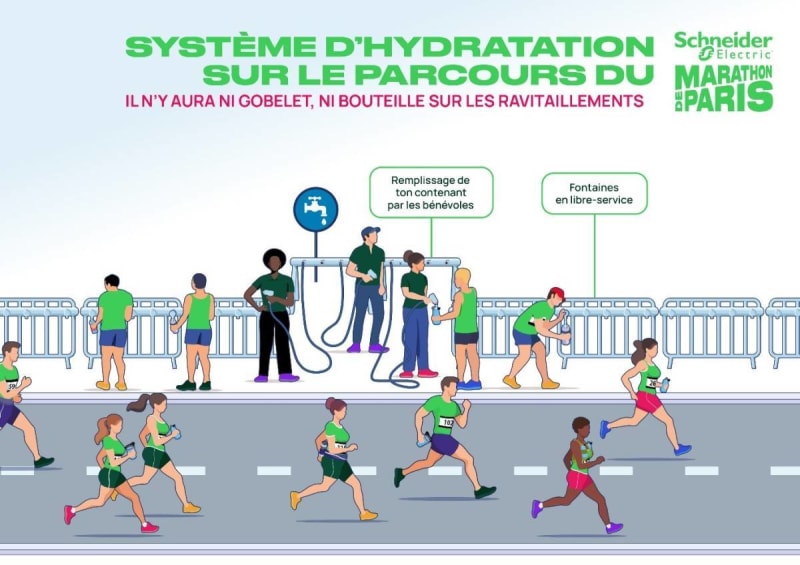
And what happens if someone forgets, deliberately or otherwise, to return their bottle? The rules are clear: disqualification is a possibility. ASO is taking this seriously, and quite rightly. The whole point is to prevent reusable bottles from ending up scattered along the course like ordinary cups on the ground. We have all seen the images of thousands of cups littering the road after a race. Once the front group has gone through, the bottle operation will be removed. The runners behind them will switch to the system originally planned for everyone: 13 aid stations with water rails, spray nozzles and... their own container.
 © A.S.O./Alexandre Baudet
Why the decision makes sense
Let’s be honest: when you’re targeting a sub-2:50, you’re in serious territory. Hydrating at an aid station is an art. Slowing down, finding an open water rail, positioning your flask, waiting for the flow... it takes time. Seconds that matter. Seconds that can make the difference in a tight race. Then there is the extra effort required to get back up to cruising pace. Those accelerations disrupt your rhythm and can clearly affect your finishing time.
For runners in the middle and at the back of the field, the new personal-container system remains perfectly manageable. There is time to get into position, make adjustments and move on calmly. But for someone running 3:55 per kilometer and chasing the performance of a lifetime, the slightest snag in the works can be frustrating, even psychologically devastating.
ASO understands that. It is a pragmatic decision, even if some people may see it as a half-measure.
A compromise that still divides opinion
The reaction on social media was immediate. On one side, sub-2:50 runners breathing a sigh of relief. On the other, those running 3:00, 3:30, 4:00 and beyond, wondering why they should not have access to the same convenience. It is a fair question, even if the numbers make the logistics unavoidable: managing reusable bottles for 688 runners concentrated within a three-minute window is feasible. Doing the same for 55,000 people spread over several hours is an entirely different logistical challenge.
We will probably have to see how the 2026 edition plays out in practice. The real full-scale test will come once all 55,000 runners have finished, volunteers have managed the water rails for hours and the feedback has come in. That is often when decisions about the following year are made.
 © ASO
© ASOASO’s green vision remains unchanged
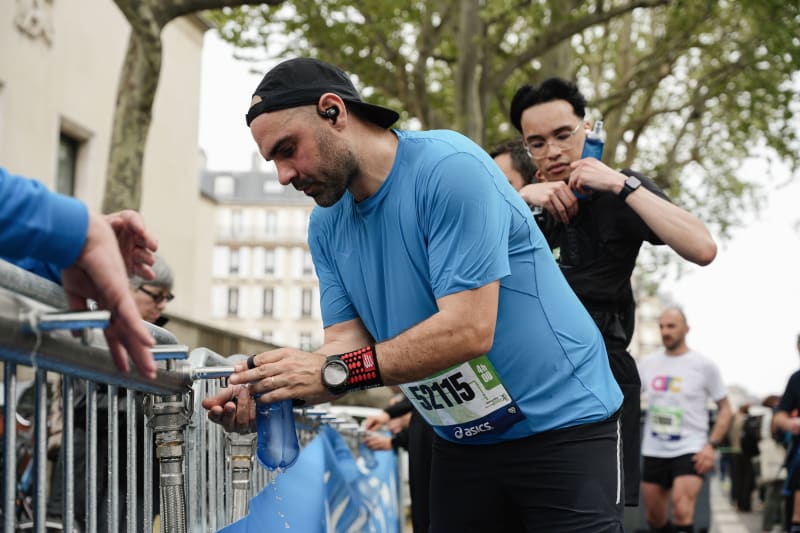
At its core, ASO is not backing away from its environmental ambition. The removal of disposable cups and plastic bottles remains firmly on the agenda for the vast majority of runners. The organizers took care to test the concept in real race conditions at the Lyon Marathon in October 2025 and, more recently, at the Paris Half Marathon. Push-button fountains, water rails and spray nozzles: the whole setup is designed to work quickly and efficiently.
Alongside the aid stations, other green initiatives follow the same path: finishers will have the option to forgo the event T-shirt in exchange for having a tree planted. Not much in itself, perhaps, but symbolically significant.
The key takeaway
If you’re targeting a sub-2:50 finish on April 12, the good news is that pre-filled bottles will be available. Make sure you return them to the designated zones, 150 meters beyond the aid station, or you risk disqualification. No nasty surprises. If you’re expecting to finish outside that mark, the original setup applies. Bring your own container, train with it beforehand and plan for the water-rail stops. It is manageable, especially if you have already tested your flask on a few long runs.
Either way, the 2026 Paris Marathon looks set to be a pivotal event. Plenty of other organizers will be watching the French capital closely to see whether this model holds up. And if it works well, there is a good chance we will see it adopted at other major races in the years ahead. See you in Paris on April 12. And don’t forget your flask.
✓ All the information about the 2026 Paris Marathon