
What Weather Can You Expect at the Paris Marathon?
 © Marathon de Paris / A.S.O
The Paris Marathon is one of the biggest marathons in the world. Drawing the attention of committed runners and sports fans alike, the race welcomes just under 60,000 starters and continues to grow in popularity. To earn a place on the Champs-Élysées, you need to be among the first to register when entries open. There is no ballot, and once every bib has been snapped up, registration closes. The field includes plenty of French runners, along with competitors from around the world. The Paris Marathon takes place in early April, a time of year when the weather can vary significantly from one edition to the next. So what conditions should you expect on race day, and how can you prepare for Paris's changeable climate? This guide gives you everything you need to put together the perfect race-day kit for the Paris Marathon.
The Paris Marathon ranks among the biggest
The Paris Marathon has steadily established itself among the biggest marathons on the planet. With 56,950 starters, the Paris race stands alongside New York and London as one of the world's biggest marathons. Although the Paris Marathon is not part of the World Marathon Majors, it proves year after year that it remains every bit as prestigious. Paris, France's capital and a charming, hugely popular destination, draws plenty of international runners to its starting line.
The course, atmosphere and race organization offer an almost unique experience to those lucky enough to secure a bib. The organizers generally set the race off at 8:00 a.m. local time in mid-April, from the famous Champs-Élysées. The 56,000 runners then have a maximum of six hours to cover the 42.195 km and reach the finish line. April temperatures are not always easy to predict, so runners need to keep a close eye on the latest forecasts and adjust their race-day kit accordingly.
What weather should you expect in Paris in April?
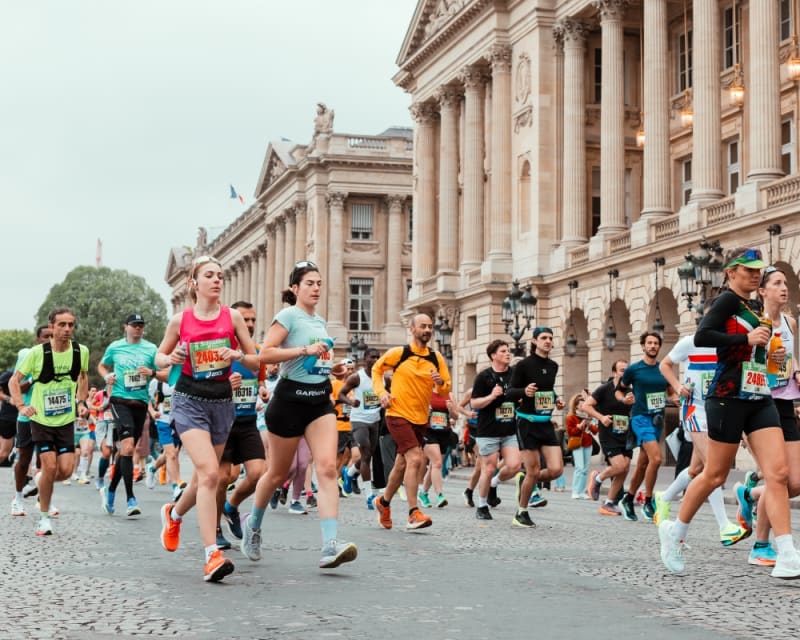 © ASO
© ASOApril in France marks a period of climatic transition. Winter is giving way to spring, and then gradually to summer. The weather can therefore vary considerably from one year to the next, and even from one week to the next. Temperature swings are also much greater than at other times of year. In other words, it can be distinctly cool or already warm, and the Paris Marathon forecast can still spring a surprise. On average, temperatures in April range from 6 to 10°C at the start, rising to between 12 and 18°C later in the race.
Winds are generally moderate, although they can pick up along the riverbanks. Rain is equally difficult to predict. Be ready for several possibilities: bright sunshine, spring showers or steady rain. Overall, the weather at the Paris Marathon is hard to anticipate because it changes from year to year. This transitional period makes forecasting particularly tricky. That said, truly extreme conditions are rare, giving runners a good chance of lining up in favorable weather.
Acclimatization and adapting to Paris weather
Although the weather at the Paris Marathon is generally favorable for running the full distance, it can feel very different depending on where you come from. The race attracts a large international field, and for some runners, the Parisian climate at this time of year is a long way from what they are used to.
North American runners accustomed to cooler conditions at races such as Boston in April may be surprised by what they encounter in Paris. Don't underestimate the impact of warmer temperatures, especially late in the race.
For runners from Asia, Parisian air will be noticeably less humid than what they are used to at home. The cool temperatures can therefore come as a surprise at the start and over the opening kilometers. Packing an extra lightweight layer is a sensible option.
For runners from Africa or South America, April temperatures in Paris are generally well below those of their home climate. Arrive prepared with something to cover up: thin gloves, arm sleeves or a lightweight technical layer.
For runners from Scandinavia, the starting temperature may feel ideal, since it is slightly cool. Even so, stay alert to the gradual rise in temperatures as the race unfolds.
Weather at recent editions
The past few years have confirmed what many experienced runners already know: early April in Paris is defined more by transition than stability. In 2023, runners faced cool, damp conditions, with rain and wind at times. The following year, skies remained heavily overcast and temperatures reached around 14 to 18°C by late morning. At the most recent edition, participants raced in mild but humid conditions, with light rain and temperatures ranging from around 11°C at the start to 17°C later in the morning.
The pattern is clear: Paris rarely delivers extreme conditions, but it is almost always changeable. From one year to the next, runners may face a notably chilly dawn, spring humidity and gradually milder conditions late in the race. The Paris Marathon therefore demands genuine adaptability, starting with your choice of race kit
Common mistakes runners make at the Paris Marathon
Testing your race kit for the first time on race day
Assuming it will be either very hot or very cold
Not packing enough options
Getting your hydration wrong
Assuming it will stay cool throughout the race
Wearing too much or too little at the start
Failing to check the local climate
What should you wear for the Paris Marathon?
As you've gathered, predicting the weather for the Paris Marathon is difficult, so preparation is your best ally. You may need to wait until the final few days for a reliable forecast, but you can start checking conditions a week before the race. This first look will help you identify the trend and prepare your race kit accordingly. If you're arriving several days before the race, don't hesitate to pack a few extra options. At worst, you won't need them. If you're packing at the last minute, make sure you keep up with the latest forecast updates.
In any case, it's a good idea to arrive at the Paris Marathon start with a light extra layer. The first wave sets off at 8:00 a.m., when temperatures are often still cool. If you warm up quickly, there's no need to overdress: your body will heat up naturally after a few kilometers. If you are more sensitive to the cold, arm sleeves and thin gloves can be useful. You can easily remove them and tuck them into a pocket as the race progresses. Finally, a cap is a practical way to deal with sunshine and rising temperatures.
Live weather
All of this advice should be adapted to your home climate and your own perception of the conditions. In early April, Paris weather remains uncertain and changeable. It is difficult to predict the exact conditions on race day, which is why you should follow the forecast closely during the week before the race.
✔ Find all the information you need to enter the Paris Marathon